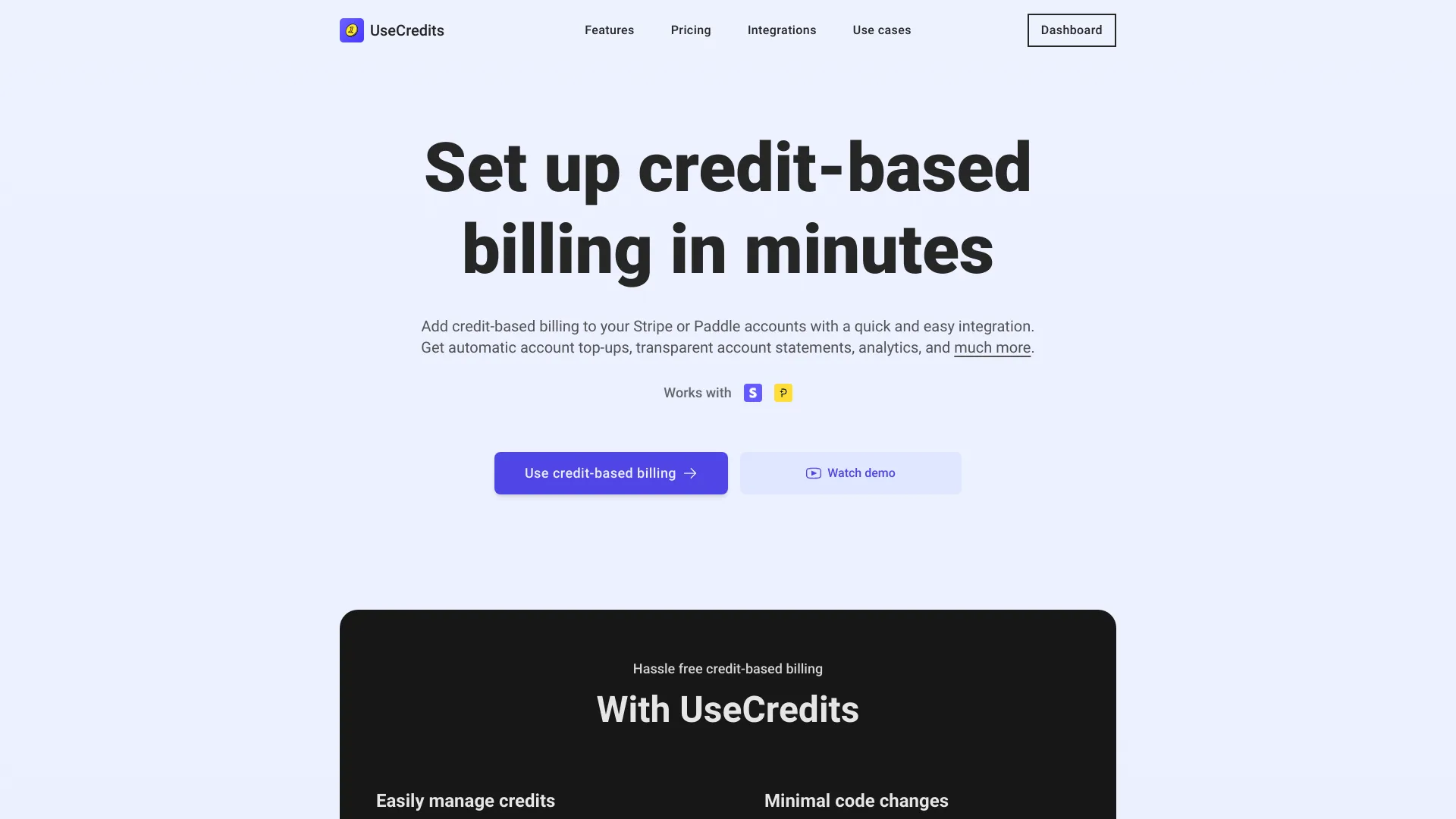
```It seems you have provided a snippet of HTML content, possibly from a web page that discusses how to use a feature called "UseCredits." The text appears to be in Chinese and outlines the functionality and integration of UseCredits with payment systems like Stripe or Paddle.
Here’s a brief summary of the content:
1. **How to Use UseCredits**:
- UseCredits will be linked to your Stripe or Paddle account upon registration.
- It serves to manage the credit limits for your products.
- The SDK provided by the service allows for seamless integration with your account for transactions and balance management.
2. **Core Functions of UseCredits**:
- The section likely elaborates on the primary features and benefits of using UseCredits, possibly touching on aspects such as automatic account credits, detailed transaction calculations, and more.
If you need a specific analysis or help with something related to this content, please let me know!It looks like you've posted a snippet of HTML code that includes some elements written in Chinese. The code appears to be part of a user interface, possibly related to account management or financial services. Here’s a brief explanation of the content:
1. **Section Headers**: The `
` elements contain Chinese text:
- "自动账户充值" which translates to "Automatic Account Recharge."
- "透明的账户计算单" which translates to "Transparent Account Calculation Statement."
- "内置使用分析" which translates to "Built-in Usage Analysis."
2. **Divider**: The `
` creates a horizontal line, likely serving as a visual separator between sections.
3. **Main Title**: The `
` element contains the title "UseCredits 的使用案例," which translates to "Use Cases of UseCredits."
4. **Spacing**: The `mt-6 space-y-5` classes are likely using a CSS framework (possibly Tailwind CSS) to add margin and spacing between elements.
If you need help with a specific aspect of this code (e.g., styling, functionality, translation, or integration into a larger project), please provide more details!It looks like you've shared a snippet of HTML code that includes some content in Chinese. Here is a breakdown of the content:
1. **#1**: AI图像生成应用 (AI Image Generation Application)
2. **#2**: 电子邮件或短信API (Email or SMS API)
3. **#3**: 游戏和娱乐 (Games and Entertainment)
If you need help with something specific regarding this code or content, please let me know!It looks like you've pasted a fragment of HTML code related to a webpage, possibly a FAQ section. The text appears to be in Chinese, asking about the workings of a service or system called "UseCredits". If you need help with this code, such as understanding its structure, modifying it, or translating it, please let me know!It seems like you've pasted a segment of SVG code along with some HTML structure. This code represents part of a web component that includes an icon and a question in Chinese, which translates to "What should I do if I have multiple accounts?"
If you have a specific question or need help with something related to this code, such as rendering it, modifying it, or understanding its functionality, please let me know!It seems like you're sharing a snippet of HTML and SVG code that appears to be part of a web page, possibly from a FAQ or a question-and-answer section. The text in Chinese translates to "What should I do if I cannot use full credit?"
If you need help with something specific regarding this code or the content, such as how to modify it, how to use it in a web project, or a translation, please let me know!It seems like you've shared a snippet of HTML code that contains some components of a user interface, likely from a web application. The code includes a question in Chinese that translates to "What should I do if my credit score is used up?" along with an icon represented by an SVG element.
If you need help with this code or have specific questions about it, please provide more context or clarify what you would like assistance with!It seems you've pasted a snippet of HTML code along with some Chinese text. The text can be translated to English as follows:
1. "我还需要进行编码吗?" translates to "Do I still need to code?"
2. "您需要访问我的API密钥吗?" translates to "Do you need to access my API key?"
If you have a specific question or need assistance with anything related to this snippet, feel free to ask!It looks like you are sharing a piece of HTML code that includes SVG icons, styling classes, and text in Chinese. This code appears to be part of a user interface, possibly for a FAQ section or a data collection prompt, given the question "您收集哪些数据?" which translates to "What data do you collect?"
Here's a breakdown of the key components and their potential functions:
1. **SVG Icon**: The SVG element is used to render an icon, which seems to represent some action or status (possibly indicating a question or data collection). The properties like `fill`, `stroke`, and `stroke-width` define its appearance.
2. **Text Element**: The text "您收集哪些数据?" serves as a prompt for users, asking them what types of data are being collected, which is relevant in contexts like data privacy, user consent, or service offerings.
3. **Styling Classes**: The use of classes like `flex`, `items-start`, `justify-between`, `text-xl`, and `font-semibold` suggests that a CSS framework (likely Tailwind CSS) is being utilized for responsive design and visual hierarchy. These styles help in aligning the elements and defining their appearance (e.g., text size, weight, and color).
4. **Interactive Elements**: The `cursor-pointer` class indicates that the element is clickable, suggesting that users can interact with this component, possibly to reveal more information or to submit data.
5. **Structure**: The overall structure, including `dt` (description term) and `div` elements, suggests that this piece of code is part of a list or card layout, which organizes content neatly for better user experience.
If you need further assistance with specific modifications or explanations regarding this code, feel free to ask!It looks like you've provided a snippet of SVG (Scalable Vector Graphics) code along with some HTML. The SVG part appears to be a simple line drawing, likely representing a plus sign or a cross. Here’s a breakdown of the SVG:
```xml
```
### Explanation:
1. **`