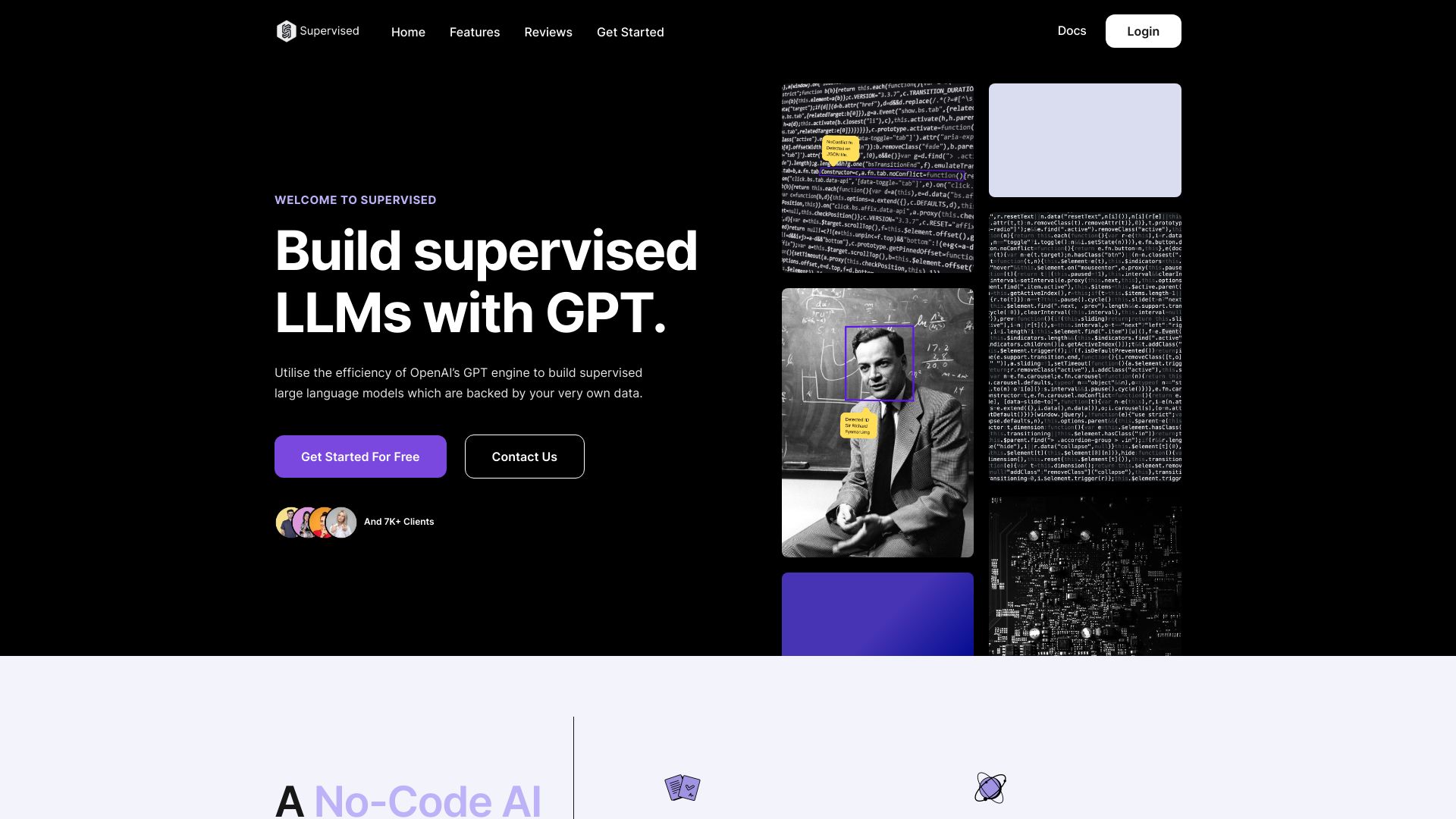
Supervised app
marketingai-analytics-assistantChecking...

Supervised app

标题:利用Supervised构建用户友好的平台 元描述:探索如何利用Supervised技术有效构建用户友好的平台,提升微调、部署和商业化语言模型的体验。 在当今数字化时代,构建一个用户友好的平台至关重要。利用Supervised技术,可以有效提升平台的可用性和用户体验。以下是几种利用Supervised进行微调、部署和商业化语言模型的方法: 1. 用户友好的界面设计 - 通过Supervised技术,优化用户界面,使其更直观易用。 - 提供清晰的导航和易于访问的功能,提升用户操作的便捷性。 2. 精细化的微调 - 利用Supervised进行模型微调,确保语言模型能够准确满足用户需求。 - 根据用户反馈不断调整和优化模型,提高语言处理的准确性。 3. 高效的部署流程 - 通过Supervised简化部署流程,减少上线时间,快速响应市场变化。 - 确保模型在不同平台上的兼容性,提升用户的使用体验。 4. 商业化语言模型的策略 - 研究用户行为,利用Supervised分析数据,从而制定有效的商业化策略。 - 提供个性化的服务和内容,增加用户粘性,提高转化率。 通过以上方法,利用Supervised技术可以有效构建一个友好的平台,提升用户的整体体验。探索这些策略,助力您的项目成功,实现商业价值最大化。

#受监督的LLM#无代码AI开发#GPT引擎#自定义模型#AI应用#数据源#云部署#商业化#用户界面模板#预构建的模型#支付收款#API集成
Jun 24, 2023
0 views
Supervised app

AI项目详情

什么是Supervised学习?

Supervised学习,又称监督学习,是一种机器学习的基本类型。在这种学习模式中,算法使用带标签的数据进行训练,以便在未来对未知数据进行预测。具体来说,Supervised学习的目标是从输入数据中学习到一个映射关系,进而能够对新的输入数据进行准确的分类或回归。

Supervised学习的主要特点包括:

  • 使用有标签的数据集进行训练
  • 适用于分类和回归问题
  • 能够提供高准确度的预测结果

在实际应用中,Supervised学习广泛应用于图像识别、语音识别、欺诈检测等多个领域。通过不断优化算法,Supervised学习可以有效提升模型的性能和准确性,为决策提供有力支持。

```Supervised 是一个平台,允许用户使用 OpenAI 的 GPT 引擎构建受监控的语言模型(LLM)。它提供了良好的用户界面,并支持自定义数据进行 AI 模型的微调功能。用户还可以利用 Supervised API 部署、商业化和集成他们的模型。 ### 如何使用 Supervised? 1. **注册和登录**:首先,您需要在 Supervised 平台上注册一个账户并登录。 2. **数据准备**:整理您的自定义数据集,确保数据的质量和相关性,以便进行有效的模型训练。 3. **模型选择**:选择一个适合您需求的基础模型,通常是 OpenAI 提供的 GPT 模型。 4. **微调**:使用您的数据集对选定的模型进行微调,Supervised 平台会提供指导和工具来帮助您完成这个过程。 5. **测试与评估**:在模型训练完成后,进行测试以评估其性能。您可以使用测试集来检查模型的准确性和可靠性。 6. **部署**:一旦您对模型的表现满意,可以使用 Supervised API 将其部署到生产环境中,以便用户可以通过 API 访问该模型。 7. **监控与维护**:继续监控模型的表现,必要时进行更新和维护,以适应新的数据和需求。 通过以上步骤,您可以有效地利用 Supervised 平台来构建和使用定制的 AI 语言模型。看起来您在提到 OpenAI 的 Supervised 模式和使用 GPT 模型的相关功能。Supervised 模式允许用户通过注册账户并登录后,利用 OpenAI 的 GPT 模型与自己的数据进行交互,从而构建自定义的语言模型。这个平台提供了模型自定义、云部署和商业化工具,方便用户根据自己的需要进行调整和优化。 如果您需要更详细的信息或有具体问题,建议您访问 OpenAI 的官方网站,查阅相关文档和指南,以获取最新和最全面的信息。It looks like you're sharing a section of HTML code that includes some content in Chinese. The content appears to describe the core functions of a supervised model or system, specifically related to AI applications using OpenAI's GPT architecture. Here’s a brief summary of the points mentioned: 1. **Using OpenAI's GPT Architecture**: Implementing a large language model (LLM) that is monitored. 2. **Custom Data for AI Models**: Utilizing specific datasets for fine-tuning AI models. 3. **Cloud Deployment**: Hosting the model on cloud services. 4. **Commercial AI Applications**: Adapting AI models for business use cases. 5. **Integration of Custom Data Sources**: Combining proprietary data with models. 6. **User Interface Adaptation**: Switching between different user interfaces. 7. **Accessing Pre-trained Models**: Consulting pre-trained models and data sources from a repository. 8. **No-code Solutions**: Enabling solutions that require no programming. 9. **Utilizing Supervised APIs**: Using APIs to build AI models in various contexts. If you need more specific information or a different type of assistance, feel free to ask!It looks like you're working with HTML content that includes some structured information about supervised learning applications. Below is a cleaned-up version of the content you provided, along with some explanations based on what I can infer from it: ```html

Supervised 的使用案例

#1

Supervised 可用于各种场景,例如:
  1. 企业希望加速AI实施的可利用Supervised构建可扩展的AI应用。
  2. 希望构建自己的LLM的人可以使用Supervised利用OpenAI的GPT引擎和自己的数据。
  3. ...

``` ### Explanation: 1. **Heading**: The main heading (`h2`) indicates that the section is about "Supervised Learning Use Cases". 2. **List of Applications**: - The first application suggests that businesses can leverage supervised learning to build scalable AI applications. - The second application discusses individuals wanting to create their own large language models (LLMs) using supervised learning with OpenAI's GPT and their own datasets. 3. **HTML Structure**: - The content is structured using semantic HTML elements (`h2`, `h3`, `ol` for ordered lists), which helps in understanding the hierarchy and organization of the information. 4. **Styling Classes**: The classes like `text-2xl`, `text-gray-1000`, etc., suggest that CSS is used for styling, possibly from a utility-first CSS framework like Tailwind CSS. If you need further assistance with this content, such as adding more use cases or explaining specific concepts, feel free to ask!这段文字讨论了企业如何利用数据来构建全新的AI模型,以及开发人员可以利用其他开发人员创建的数据源和模型来定制AI应用。以下是一些要点及其含义: 1. **企业利用数据构建AI模型**:企业可以使用从各类数据源收集的数据,以便从头开始构建AI模型。这意味着企业需要具备数据采集、处理和分析的能力。 2. **开发人员的协作**:开发人员可以利用其他开发人员已经创建的数据源和模型,进行二次开发和定制。这种协作可以提高开发效率,降低创新成本。 3. **特定数据集的训练**:企业可以通过培训和构建具有特定数据集的机器学习模型,以更好地利用AI。这强调了数据质量和相关性在AI开发中的重要性。 4. **来自监督学习的常见问题**:可能会讨论在监督学习过程中常见的挑战和问题,例如数据标注的准确性、数据集的平衡性等。 总之,这段文字强调了数据在AI模型构建中的核心作用,以及开发人员之间的协作如何推动AI应用的定制化和高效化。The text you provided seems to be a snippet of HTML code, likely from a web page or application, that contains a heading related to the distinction between artificial intelligence (AI) and machine learning (ML). The heading is written in Chinese and translates to "What is the difference between AI and machine learning?" Here’s a brief explanation of the difference: - **Artificial Intelligence (AI)**: This is a broad field of computer science focused on creating systems capable of performing tasks that typically require human intelligence. These tasks can include reasoning, problem-solving, perception, language understanding, and more. - **Machine Learning (ML)**: This is a subset of AI that specifically deals with the development of algorithms that enable computers to learn from and make predictions based on data. ML algorithms improve their performance as they are exposed to more data over time. In summary, while all machine learning is AI, not all AI is machine learning. AI encompasses a wider range of technologies and methods beyond just learning from data.It looks like you've pasted a snippet of HTML code that appears to be part of a web page, possibly related to a section discussing "Supervised and Sttabot v1.0." The code includes various elements such as headings, SVG icons, and styling classes. If you're looking for a specific analysis, explanation, or any help related to this HTML snippet, please provide more context. What would you like to know or do with this code?建立自定义模型可以通过以下几个步骤来帮助你赚取收入: 1. **确定目标市场**:首先,明确你想要针对的市场或行业。例如,金融、医疗、教育、电子商务等。 2. **选择应用场景**:根据目标市场,选择一个具体的应用场景,比如客户服务聊天机器人、个性化推荐系统、预测分析等。 3. **数据收集与处理**:收集相关的数据集,并对其进行清洗和处理,以确保数据的质量和可用性。 4. **模型选择与训练**:选择合适的机器学习或深度学习模型,并利用之前处理好的数据进行训练。可以使用开源框架如TensorFlow、PyTorch等。 5. **验证与优化**:使用验证集评估模型的性能,并根据结果进行优化,调整模型参数以提高预测准确性。 6. **部署与维护**:将模型部署到生产环境中,并定期维护和更新,以确保其在实际应用中的有效性。 7. **商业化策略**:制定商业化策略,例如订阅服务、按需付费或将模型作为API提供给其他企业使用。 8. **营销与推广**:通过社交媒体、行业会议、网络广告等方式推广你的产品,吸引潜在客户。 9. **客户反馈与迭代**:收集用户反馈,持续改进模型和服务,以满足市场需求和用户期望。 通过这些步骤,你可以将自定义模型转化为一项盈利的业务。It seems like you've pasted a snippet of HTML and SVG code, possibly from a web application or a component of a UI. The code appears to be part of a section that discusses AI applications in a business context, as indicated by the Chinese text "如何商业化我的AI应用并收收益?", which translates to "How to commercialize my AI application and generate revenue?" Here's a brief breakdown of the components in your snippet: 1. **Flexbox Layout**: The use of classes like `flex`, `justify-center`, and `items-start` suggests that this is styled with a utility-first CSS framework, likely Tailwind CSS, which is commonly used for responsive design. 2. **SVG Icon**: The SVG element is used to render an icon, which seems to represent some action (possibly related to adding or creating). The attributes `fill`, `stroke`, and `viewBox` define how the icon is displayed. 3. **Text Content**: The text within the `

` tag poses a question about AI application commercialization, indicating that the surrounding content may provide insights or answers to this question. 4. **Hover Effects**: The class `hover:text-purple-1300` suggests that the text changes color when hovered over, enhancing user interaction. If you need help with a specific aspect of this code, or if you have questions about how to implement, modify, or use it, feel free to ask!It looks like you've provided a snippet of SVG code, which is typically used for rendering vector graphics, along with some HTML structure that includes text in Chinese. The Chinese text translates to "Can I directly set up a data source and collect machine personnel without using a model?" If you have a specific question or need assistance with a particular aspect of this code or topic, please let me know!It looks like you've shared a snippet of HTML code that includes SVG elements, some classes for styling, and a link related to "Supervised 登録" (which translates to "Supervised Registration" in English). Here's a brief overview of the components in the code: 1. **SVG Elements**: The SVG path within the code represents a simple graphic, likely an icon, which is styled with attributes for line cap and join. 2. **Div Structure**: The code includes various `
` elements likely used for layout purposes, including a horizontal line (`
`) that serves as a visual separator. 3. **List of Information**: The `moreInfo` class indicates a section that contains more detailed information, formatted as a list (`
    `). 4. **Supervised 登録 Section**: Within the list, there is a heading (`

    `) for "Supervised 登録" and a paragraph (`

    `) that provides a link to a specific URL related to Supervised Registration. The link is styled with a class for color and is set to open in a new tab (`target="_blank"`). If you have any specific questions about this code or need help with something in particular, feel free to ask!It looks like you've pasted a snippet of HTML code that contains information about "Supervised" resources. The code features two list items (`

  • `) with headings (`

    `) and paragraphs (`

    `), along with links to a website and a YouTube channel. Here's a summary of the content: 1. **Supervised 价格 (Pricing)** - A link to the pricing page: [Supervised Pricing](https://supervised.co/?page_id=1775) 2. **Supervised YouTube** - A link to the Supervised YouTube channel: [Supervised YouTube Channel](https://www.youtube.com/channel/UCuvTGIQeGZ0FXAd91ChIrvQ) If you need help with a specific aspect of this code or further information about the content, feel free to ask! \n

    \n

  • \n \n

It seems like you've shared a snippet of HTML code. This snippet appears to be a fragment of a web page structure, specifically ending a list item (``), an unordered list (``), and several div elements (`
`). If you need help with HTML or web development in general, please provide more context or let me know what specific information or assistance you’re looking f