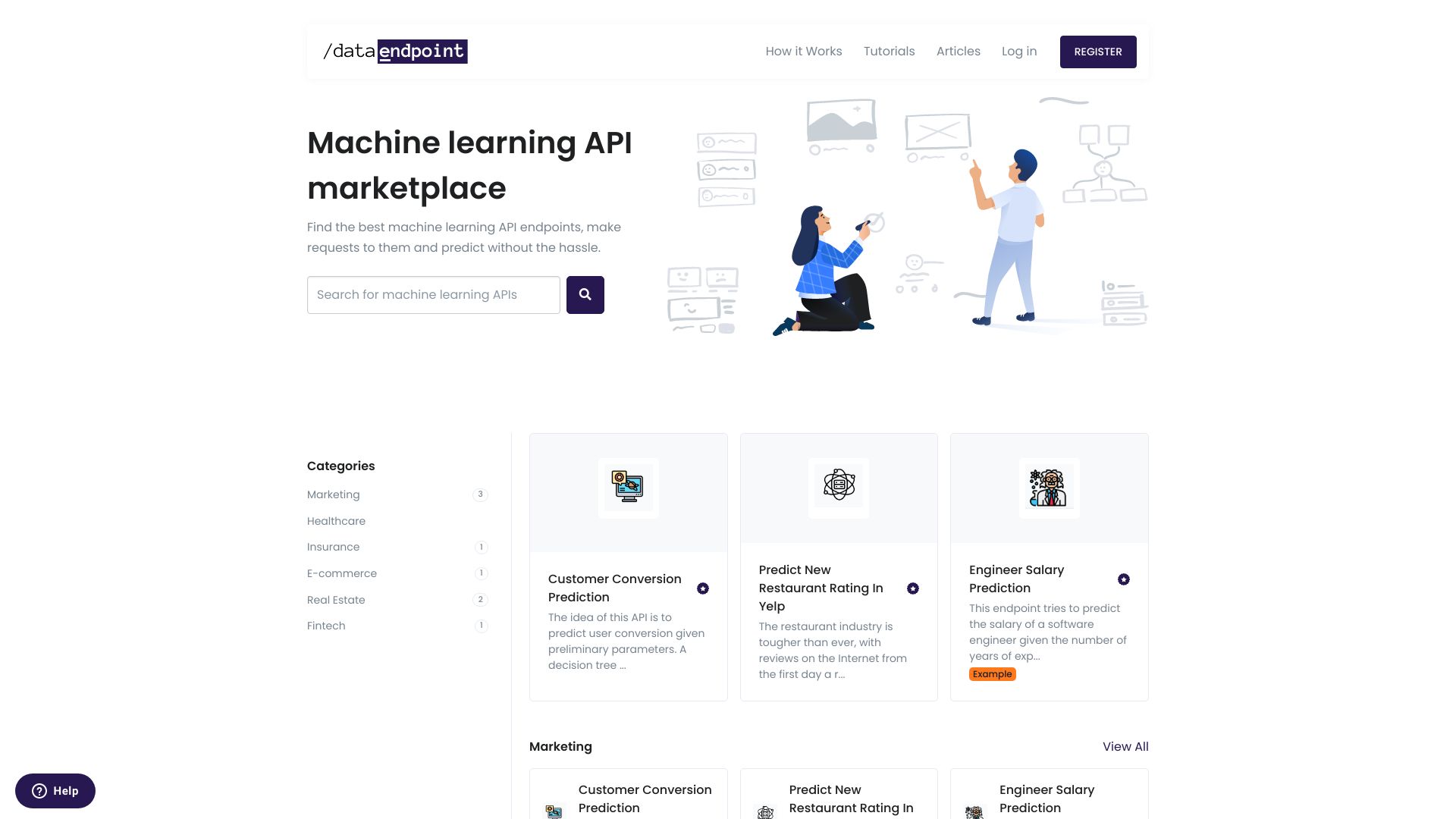
```很高兴您对dataendpoint.co感兴趣!这是一个专注于AI和机器学习API的平台,用户可以通过该平台进行数据请求和结果预测,而无需复杂的设置。
如果您想使用该平台,以下是一些基本步骤:
1. **访问网站**:首先,请前往[dataendpoint.co](https://dataendpoint.co)。
2. **注册账户**:如果您还没有账户,您需要注册一个新账户。
3. **选择API**:浏览可用的AI和机器学习API,选择适合您需求的API。
4. **发送请求**:根据API文档,构建并发送请求。
5. **获取结果**:您将会收到预测或分析结果,可以根据需要进行处理和使用。
如果您有任何具体问题或需要进一步的帮助,请随时告诉我!您似乎在讨论与AI和机器学习相关的API(应用程序编程接口)和功能。以下是一些步骤和信息,帮助您更好地理解如何使用这些API:
1. **不同类型的浏览和搜索特定的AI和机器学习API**:可以从众多在线资源(如API市场、开发者文档和技术博客)中了解不同的API,了解它们的功能和用途。
2. **选择一个API并查看其描述、文档和示例**:一旦选定了一个API,您可以查阅其官方文档,通常会提供详细的说明,包括如何进行请求、可用的端点、请求参数和响应格式等。
3. **注册并登录网站**:大多数API都要求用户注册并获得访问权限。注册后,您通常会收到一个API密钥,用于身份验证。
4. **根据说明向所选API发送请求**:在文档中,您会找到如何构造HTTP请求的详细信息(通常是GET或POST请求),包括所需的头部和参数。
5. **根据API的功能获取预期或结果**:通过调用API,您可以获得所需的数据或执行特定的操作。结果通常以JSON或XML格式返回,您可以根据需要进行解析和处理。
6. **数据集的核心功能**:许多API提供数据集的访问,可以用于训练和测试机器学习模型。这些数据集可以包括文本、图像、音频等,具体取决于API的应用领域。
如果您有特定的API或功能想要了解,欢迎提供更多信息,我可以为您提供更详细的指导或示例!It seems that you have provided a snippet of HTML content, which includes some Chinese text related to AI and machine learning APIs. Here's a brief translation and summary of the key points:
1. **Various AI and Machine Learning APIs**: The text suggests that there are multiple AI and machine learning APIs available for inquiry.
2. **Classification and Search APIs**: It mentions the capability to perform classification searches and browsing through APIs.
3. **Detailed Descriptions for Each API**: Each API is expected to provide detailed descriptions, documentation, and examples.
4. **Lightweight Testing and Result Generation**: There is a focus on lightweight testing and generating results, which indicates a user-friendly approach to working with these APIs.
If you need more specific information or assistance regarding AI and machine learning APIs, feel free to ask!It appears that you have shared a snippet of HTML code, which includes some class names and text content in Chinese. The code seems to be part of a web page that lists use cases for data collection. Here's a breakdown of the content:
1. **Section Title**: The title is "生数据集 的使用案例," which translates to "Use Cases of Raw Data Sets."
2. **Use Cases Listed**:
- **#1**: "程序师资预测" (Programmer Resource Prediction)
- **#2**: "数据科学API" (Data Science API)
The HTML structure indicates that these items are listed in a flexible layout, with a numbering system and titles that describe specific use cases related to data collection.
If you have any specific questions or need help with modifying this code, feel free to ask!The provided text appears to be a snippet of HTML code, likely from a web application or a component of a user interface. It includes structured elements such as headers, spans, and divs, with some text in both English and Chinese. Here’s a breakdown of the important elements in the snippet:
1. **Section Titles**:
- The section includes titles that likely represent topics or categories related to APIs:
- **#3**: "AI和机器学习API" (AI and Machine Learning API)
- **#4**: "深度学习API" (Deep Learning API)
2. **Common Theme**:
- The text references APIs related to artificial intelligence and machine learning, indicating that the content may be focused on technology, programming, or data science.
3. **Additional Section**:
- There is an additional header titled "来自生数据集的常见问题" which translates to "Common Questions from Real Datasets," indicating that the content may address frequently asked questions or common issues encountered when working with real data.
4. **Styling and Structure**:
- The use of classes like `text-lg`, `text-gray-1000`, and `flex-1` suggests that this is styled using a CSS framework, likely Tailwind CSS, which is popular for utility-first styling in modern web development.
5. **Layout**:
- The layout includes a responsive design structure with flexbox properties, allowing for a flexible arrangement of elements.
This snippet likely belongs to a web page intended to provide information about various APIs in the field of AI and machine learning, along with addressing common questions that arise in data handling. If you need further assistance or a specific analysis, feel free to ask!It looks like you've pasted a snippet of HTML code, possibly from a user interface component that displays some information about "dataendpoint.co". This snippet includes various classes for styling and some SVG icons for visual elements.
If you're looking to understand or modify this code, here’s a brief breakdown of its structure:
1. **Container**: The outermost `div` has classes for styling, including a division (divide) style for separating elements visually.
2. **Definition Term (`dt`)**: This is styled to be a flexible container that aligns items in a specific way (using Flexbox). It contains:
- A heading (`h3`) that displays the text "dataendpoint.co是什么?" which translates to "What is dataendpoint.co?" in English.
- An icon represented by an SVG that appears to be a plus sign (indicating an expandable section or additional information).
3. **Styling Classes**: The classes like `text-xl`, `leading-6`, `font-semibold`, and color classes (e.g., `text-gray-1000`, `hover:text-purple-1300`) are likely from a CSS utility framework like Tailwind CSS, which is used for rapid UI development.
4. **SVG Icon**: The SVG included is for rendering an icon, which may be interactive (e.g., to expand/collapse content).
If you need specific help with this code—such as how to implement it, modify it, or integrate it into a larger project—please provide more details!Based on the provided text, it appears to be a snippet of HTML code that includes some user interface elements, likely for a webpage or application. The text is primarily in Chinese and relates to the functionality of "dataendpoint.co". Here’s a brief summary of the content:
1. **Title/Header**:
- The first header asks, "如何使用dataendpoint.co?" which translates to "How to use dataendpoint.co?"
- The second header asks, "dataendpoint.co的核心功能是什么?" which means "What are the core functions of dataendpoint.co?"
2. **Visual Elements**:
- The HTML includes SVG graphics, which are commonly used for icons or visual representations. The specific SVG here appears to represent a plus sign, typically associated with adding or expanding information.
3. **Styling**:
- The classes used (e.g., `text-gray-1000`, `hover:text-purple-1300`, `cursor-pointer`) suggest that this component is styled using a utility-first CSS framework, likely Tailwind CSS. These classes define color, hover effects, and cursor styles.
4. **Structure**:
- The content is organized using `
` elements, suggesting it may be part of a definition list or FAQ section, where questions are posed and answers are likely provided further down the page.
If you have specific questions about this code or need further assistance with it, feel free to ask!It looks like you've provided a snippet of HTML code that includes various elements such as headings, spans, and SVG icons. This code appears to be part of a user interface, potentially for a FAQ section or a feature list, given the context of headings and questions.
If you need assistance with this code, such as understanding its structure, modifying it, or implementing it into a web page, please let me know how I can help!It looks like you've provided a snippet of SVG (Scalable Vector Graphics) code, which is often used to create vector graphics for web applications. This specific snippet seems to represent an icon or graphic element within a web page's HTML structure.
Here's a breakdown of the important components of the SVG code you provided:
- `stroke="currentColor"`: This attribute allows the stroke color of the SVG to inherit the current text color, making it adaptable to different contexts.
- `stroke-width="1.5"`: This sets the width of the stroke (outline) of the shapes drawn in the SVG.
- `viewBox="0 0 24 24"`: This defines the coordinate system of the SVG. It defines the position and dimension of the viewable area.
- `