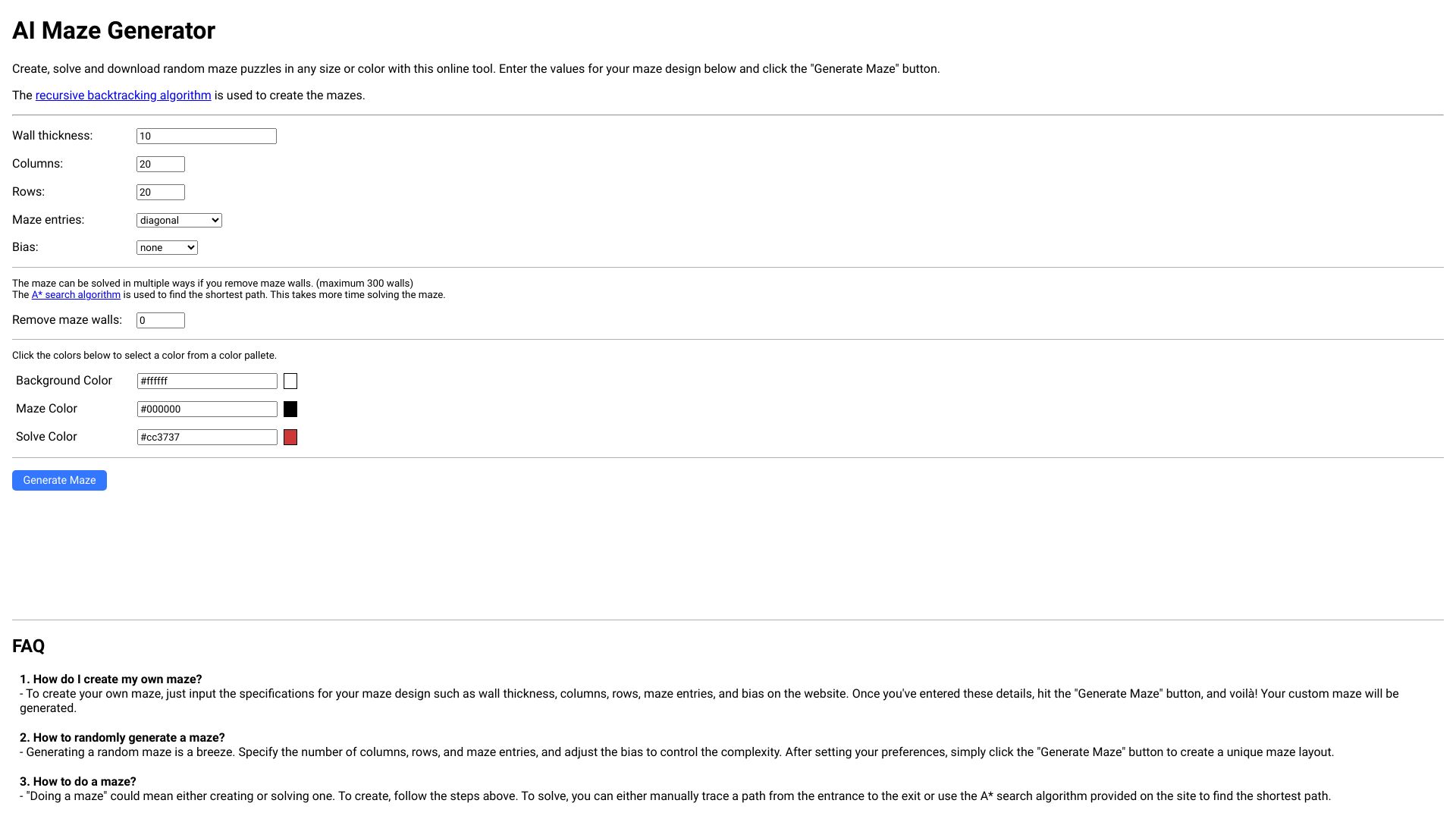
AI Maze Generator
标题:AI驱动的驾驶舱建设工具 元描述:探索AI驱动的驾驶舱建设工具,提升数据可视化和决策能力,助力企业效率提升。 在现代企业中,AI驱动的驾驶舱建设工具越来越受到重视。这些工具使得企业能够实时监控关键指标,从而做出快速而准确的决策。通过集成数据分析和可视化技术,AI驱动的驾驶舱帮助企业提升运营效率。 使用AI驱动的驾驶舱建设工具的优势: 1. **实时数据监控**:能够快速获取和分析数据,确保决策基于最新信息。 2. **增强数据可视化**:通过图表和仪表盘,使复杂数据变得易于理解。 3. **智能预测分析**:利用AI算法预测未来趋势,帮助企业提前应对挑战。 4. **自定义报告生成**:根据需要生成专业报告,提升管理效率。 作为企业的决策支持系统,AI驱动的驾驶舱建设工具不仅优化了数据管理,还提升了团队协作的效率。选择合适的工具,将为企业带来显著的竞争优势。 在寻找AI驱动的驾驶舱建设工具时,考虑其用户友好性、功能集成和技术支持等因素,确保选用的工具能够满足企业的特定需求。通过有效利用这些工具,企业将能够在快速变化的市场中保持领先地位。
AI项目详情
什么是AI迷宫生成器?
AI迷宫生成器是一种基于人工智能技术的工具,能够自动生成复杂的迷宫结构。通过算法和深度学习,AI迷宫生成器不仅可以创建多种类型的迷宫,还能根据用户的需求进行自定义设置。这种技术在游戏开发、教育和娱乐领域都有广泛的应用。
AI迷宫生成器的特点
- 自动生成多种迷宫样式,适应不同需求。
- 支持自定义迷宫的大小和复杂度。
- 提供实时预览,便于用户调整设置。
- 适合游戏开发、教学以及休闲娱乐。
如何使用AI迷宫生成器?
使用AI迷宫生成器非常简单,只需按照以下步骤操作:
- 选择迷宫类型和风格。
- 设置迷宫的规模和复杂度。
- 点击生成按钮,获取迷宫。
- 根据需要进行调整和优化。
AI迷宫生成器不仅提高了迷宫设计的效率,还为用户提供了创造性的空间。无论是想要挑战自我的游戏玩家,还是需要教学工具的教师,AI迷宫生成器都是一个不可或缺的助手。
` tag is in Chinese, asking "如何创建自己的庙宇?" which translates to "How to create your own shrine?"
If you have specific questions about this code, need help with HTML/CSS, or want assistance with a different topic, please let me know!It looks like you've provided a snippet of HTML code that includes some content in Chinese, specifically asking questions about resolving and creating a maze. Here’s a translation and interpretation of the text:
1. **如如何解决迷宫?** - "How to solve a maze?"
2. **如如何绘制迷宫主题?** - "How to create a maze theme?"
If you would like to discuss maze-solving techniques or how to create mazes, please specify what information or assistance you need!It appears that you have provided a snippet of HTML code, specifically involving SVG icons and some text in Chinese that translates to "Is the maze free to use?" The code includes details about the layout and design, with classes for styling and SVG for graphical representation.
If you need assistance with a specific aspect of this code, such as modifying it, understanding its structure, or any other questions, please let me know!It looks like you've posted a snippet of SVG (Scalable Vector Graphics) code along with some HTML structure. The SVG code appears to define a simple graphic, likely an icon, consisting of two lines that could represent a plus sign, minus sign, or similar geometric shape. The HTML structure suggests that this SVG is part of a larger document.
Here's a brief breakdown of the SVG and HTML elements within your snippet:
1. **SVG Namespace Declaration**:
```xml
xmlns="http://www.w3.org/2000/svg"
```
This indicates that the SVG uses the standard XML namespace for SVGs.
2. **Path Element**:
```xml
```
- The `d` attribute defines the shape of the path.
- `M12 6` moves the starting point to coordinates (12, 6).
- `v12` draws a vertical line downward by 12 units.
- `m6-6` moves the starting point to (6, -6) relative to the previous point and then `H6` draws a horizontal line back to the left at y-coordinate 6.
- `stroke-linecap` and `stroke-linejoin` set the appearance of the line's endpoints and joins.
3. **HTML Structure**:
The snippet suggests that this SVG is part of a definition list or a description list (using ``, `- `, and `` elements), likely used for displaying items or terms in a structured format.
If you need help with specific aspects of this code or have questions about how to use it within a web page, feel free to a
- `, `
- `, and `` elements), likely used for displaying items or terms in a structured format. If you need help with specific aspects of this code or have questions about how to use it within a web page, feel free to a