``````html
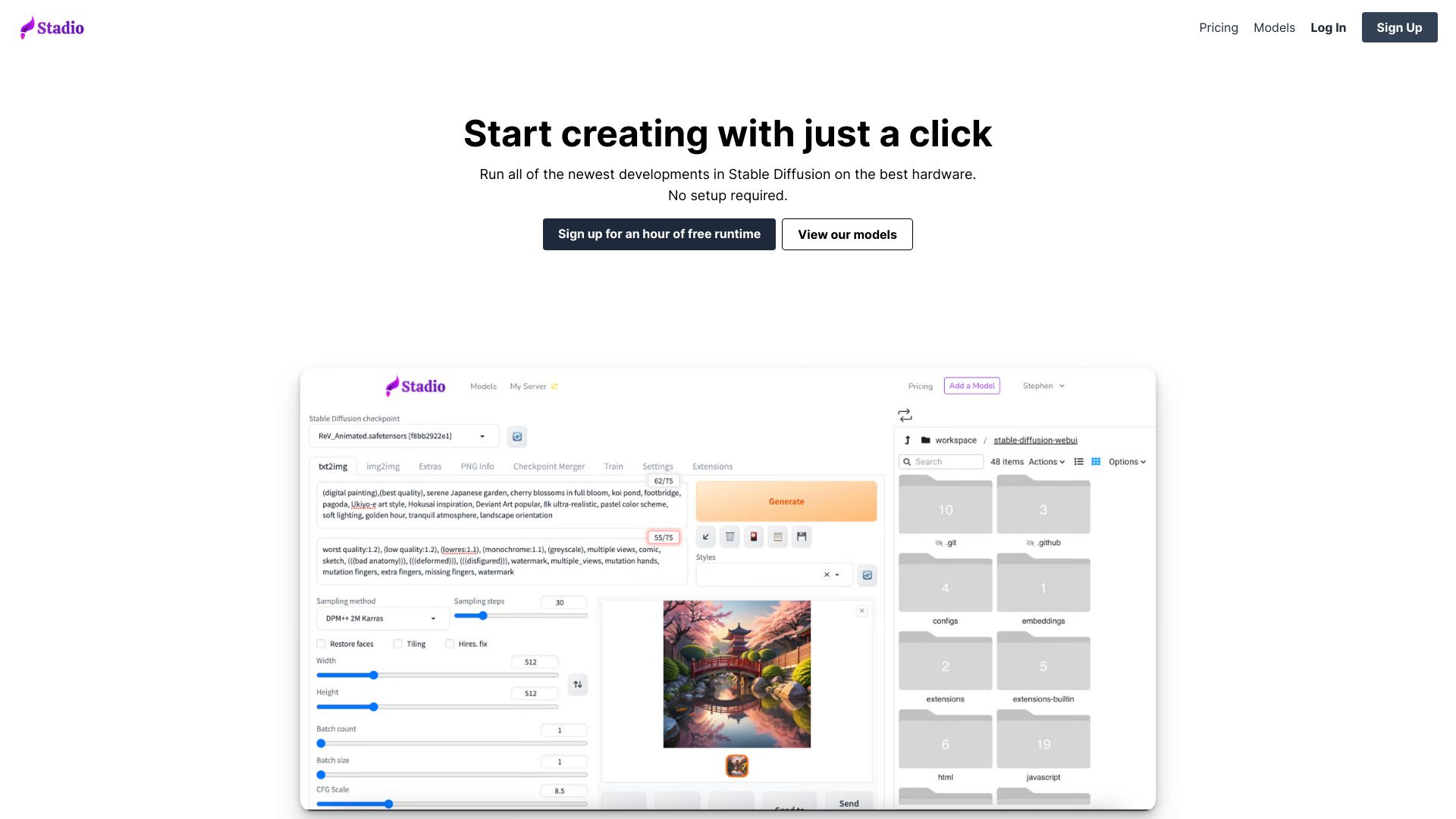
Comece com a Difusão Estável em minutos. Experimente qualquer um dos nossos centenas de modelos ou faça o upload dos seus próprios. Execute a Difusão Estável nas GPUs mais rápidas sem complicações. A maneira mais fácil de executar o Automatic1111 online.
Principais recursos da Stadio
Execute a Difusão Estável nas GPUs mais rápidas
```
This HTML code snippet showcases a section of a webpage that promotes a stable diffusion service, highlighting its features such as quick execution times and the ability to use powerful GPUs. Additional features could be added to the section indicated by the comment.It looks like you've shared some HTML code containing a series of headings (h3 elements) related to a service or tool for uploading, generating, or using AI-generated art. Here's a summary of the content from the headings:
1. **Upload and Use Templates**: Users can easily upload and access hundreds of templates.
2. **No Tedious Configuration or Downloads**: The service does not require complicated setup or downloads.
3. **Instant AI-Generated Art**: Users can generate AI art instantly.
4. **Popular Diffusion UI**: The tool features a well-known user interface for diffusion.
If you need help with something specific regarding this content, such as formatting, translating, or elaborating on it, feel free to ask!It looks like you're sharing some HTML code related to a web page, specifically about "Casos de uso da Stadio" (Use Cases of Stadio) and features like AI-generated images and experimenting with different models. If you need assistance or have specific questions regarding this content, such as how to format it, improve it, or integrate it into a web application, feel free to ask!It looks like you're sharing a snippet of HTML that outlines a section of a webpage, possibly for a product or service related to art creation and diffusion. The content includes headings and descriptions that highlight unique features or benefits.
Here's a breakdown of the key elements in the provided HTML:
1. **Numbered Features**:
- **#3**: "Gere obras de arte únicas rapidamente" (Create unique works of art quickly)
- **#4**: "Execute a Difusão Estável sem complicações técnicas" (Execute Stable Diffusion without technical complications)
2. **Section Header**:
- "Perguntas frequentes de Stadio" (Frequently Asked Questions of Stadio) - This indicates a Q&A section that may address common inquiries about the service or product.
3. **Styling**: The classes used (e.g., `text-lg`, `text-gray-1000`, `font-semibold`) suggest the use of a utility-first CSS framework, such as Tailwind CSS, for styling elements.
If you have specific questions about this snippet or need help with something related to it, feel free to ask!It looks like you've pasted a snippet of HTML code, possibly from a webpage or component that includes a question and an icon. The code seems to be part of a FAQ section where a question is posed regarding uploading custom models.
Here's a breakdown of the structure:
1. **Outer Container**: The main div has classes for spacing and dividing elements (`space-y-6`, `divide-y`), making it visually organized.
2. **Question Section**:
- **`dt` Element**: The question "Posso fazer o upload de modelos personalizados?" is wrapped in a `dt` (definition term) element, which is typically used in definition lists.
- **Heading**: The question is in an `h3` tag for proper semantic structure and styling.
- **Icon**: There’s an SVG icon next to the question that likely indicates it's expandable or clickable, suggesting that more information may be revealed upon interaction.
3. **Styling**: The classes used (such as `text-xl`, `font-semibold`, `text-gray-1000`, etc.) are likely from a CSS framework (possibly Tailwind CSS) to style the text and elements in a modern, responsive manner.
If you need help with something specific regarding this code, such as modifying the HTML, adding interactivity with JavaScript, or understanding how to implement it, please let me know!It seems you're sharing a snippet of HTML code that includes some elements related to privacy and server sharing. This snippet contains headings, SVG icons, and specific styling classes.
If you have a specific question or need assistance regarding this code—such as modifying it, understanding it, or implementing it into a project—please let me know!It looks like you've pasted a snippet of HTML code that includes SVG icons and some structured content, possibly from a FAQ section of a website. The question presented is "Posso fazer o download de extensões?" which translates to "Can I download extensions?"
If you need assistance with this HTML code, such as how to modify it, style it, or implement it in a project, please provide more context or specify what you need help with!It looks like you've pasted a portion of an HTML snippet that contains SVG (Scalable Vector Graphics) code and some structured content, possibly from a FAQ section. The specific question appears to be "Posso treinar meus próprios modelos no meu servidor?" which translates to "Can I train my own models on my server?"
If you have a specific question or need assistance with this content—like how to style it, modify the SVG, or provide an answer to the question—please let me know!It looks like you've pasted a snippet of HTML code that includes some SVG icons and a structured layout, possibly from a FAQ section or a similar content layout. The content includes a question ("Como faço para começar?") which translates to "How do I get started?" in English.
If you need help with this code, such as modifying it, understanding its structure, or implementing it in a web page, please provide more details on what you're looking f