WebMCP
Open-source JavaScript library for exposing website actions, prompts, resources, and sampling hooks directly to MCP-capable AI agents.
AI Project Details
WebMCP review: Open-source JavaScript library for exposing website actions, prompts, resources, and sampling hooks directly to MCP-capable AI agents.
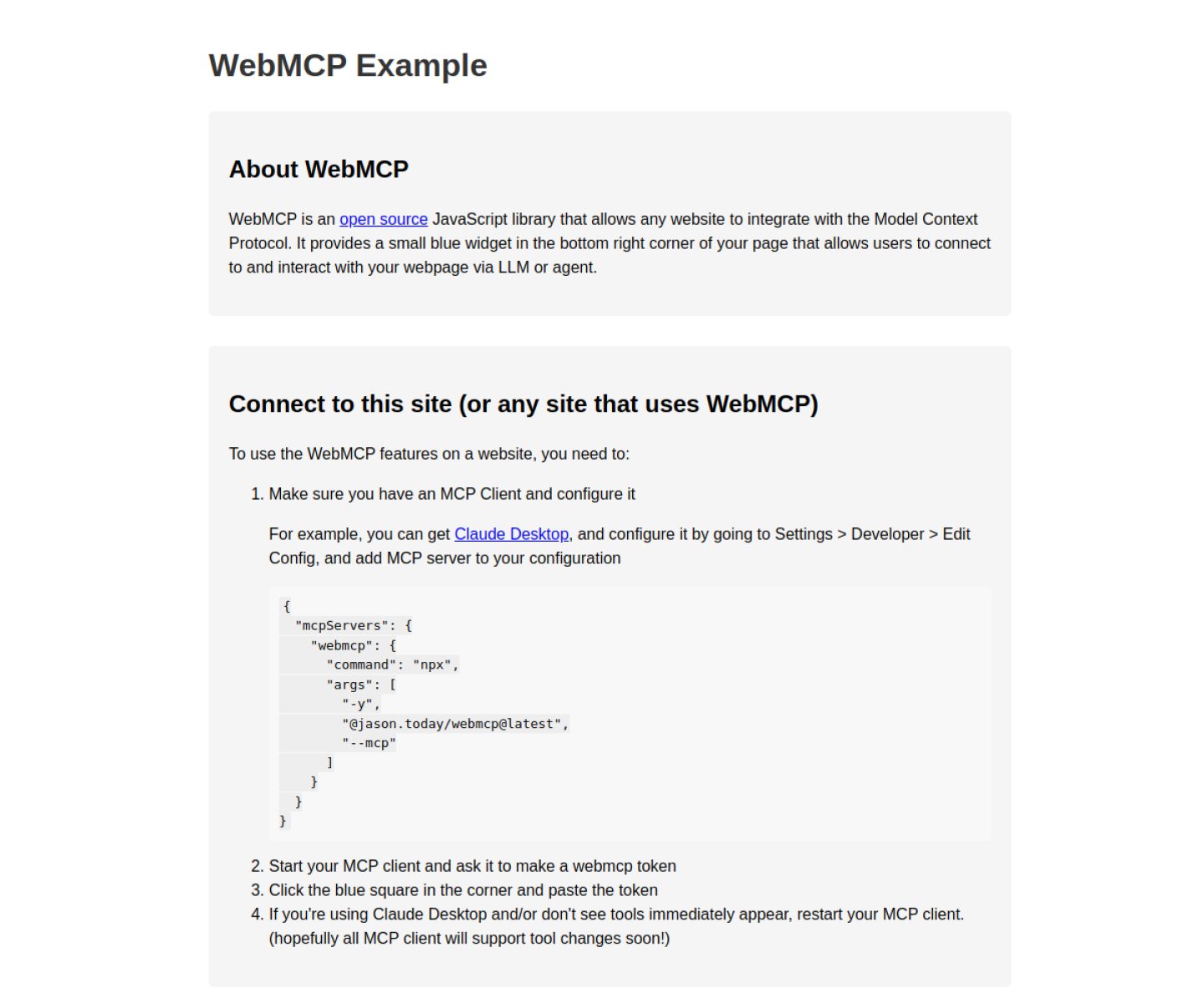
WebMCP stands out because it is not just another chat shell. The product materials describe a system centered on add the webmcp script or react hook package to a site, register tools and resources with json-schema inputs, then connect an mcp client so agents can call those functions directly. That matters because the mechanism is the product, not a thin wrapper around a frontier model.
Why the architecture matters
WebMCP treats the website itself as the integration surface, which is materially different from shipping a separate proxy or headless browser wrapper. The official examples are concrete: tools, prompts, resources, and client-side sampling are all shown with working code instead of abstract protocol talk. The React-focused demo and kitchen-sink playground make the product easier to evaluate than many protocol launches.
How to evaluate the core loop
Start by testing the narrowest real workflow the product claims to improve. For WebMCP, that means users should add the webmcp script or react hook package to a site, register tools and resources with json-schema inputs, then connect an mcp client so agents can call those functions directly. The result should be easier to inspect, integrate, or control than a direct agent session.
Where it stands out
| Evaluation angle | Fit | Why it matters | | --- | --- | --- | | Best-fit user | High | Frontend and product engineers who want AI agents to interact with web applications through structured tools instead of brittle DOM scraping. | | Core workflow clarity | High | Add the WebMCP script or React hook package to a site, register tools and resources with JSON-schema inputs, then connect an MCP client so agents can call those functions directly. | | Switching cost reducer | Medium to high | WebMCP treats the website itself as the integration surface, which is materially different from shipping a separate proxy or headless browser wrapper. | | Adoption risk | Medium | Adoption still depends on MCP client support and on teams being willing to design explicit tool surfaces for their sites. |
Practical use cases
- Making a SaaS product callable by agents through explicit website tools
- Giving AI clients structured access to page resources and app actions
- Replacing fragile site automation with a browser-native MCP layer
Limits and buying notes
Adoption still depends on MCP client support and on teams being willing to design explicit tool surfaces for their sites. WebMCP improves agent interaction quality, but it does not remove the need for careful tool security and input validation. Pricing status today: WebMCP is presented as an open-source JavaScript library, and the reviewed official pages did not expose a separate commercial pricing plan.
FAQ
What is WebMCP best for?
WebMCP is strongest when making a saas product callable by agents through explicit website tools matters more than a generic AI demo. The official product materials position it around a concrete workflow rather than a blank chatbot shell.
Who should try WebMCP first?
Frontend and product engineers who want AI agents to interact with web applications through structured tools instead of brittle DOM scraping. Teams with a real workflow match will get value faster than general curiosity users.
What should buyers verify before adopting WebMCP?
Adoption still depends on MCP client support and on teams being willing to design explicit tool surfaces for their sites. WebMCP improves agent interaction quality, but it does not remove the need for careful tool security and input validation. Pricing, privacy, and workflow fit should be checked directly on the current product before rollout.
Reviewed sources
- https://webmcp.dev/
- https://webmcp.sh/
- https://www.producthunt.com/categories/llm-developer-tools?order=recent_launches
FAQ
What is WebMCP best for?
WebMCP is strongest when making a saas product callable by agents through explicit website tools matters more than a generic AI demo. The official product materials position it around a concrete workflow rather than a blank chatbot shell.
Who should try WebMCP first?
Frontend and product engineers who want AI agents to interact with web applications through structured tools instead of brittle DOM scraping. Teams with a real workflow match will get value faster than general curiosity users.
What should buyers verify before adopting WebMCP?
Adoption still depends on MCP client support and on teams being willing to design explicit tool surfaces for their sites. WebMCP improves agent interaction quality, but it does not remove the need for careful tool security and input validation. Pricing, privacy, and workflow fit should be checked directly on the current product before rollout.