Tusk
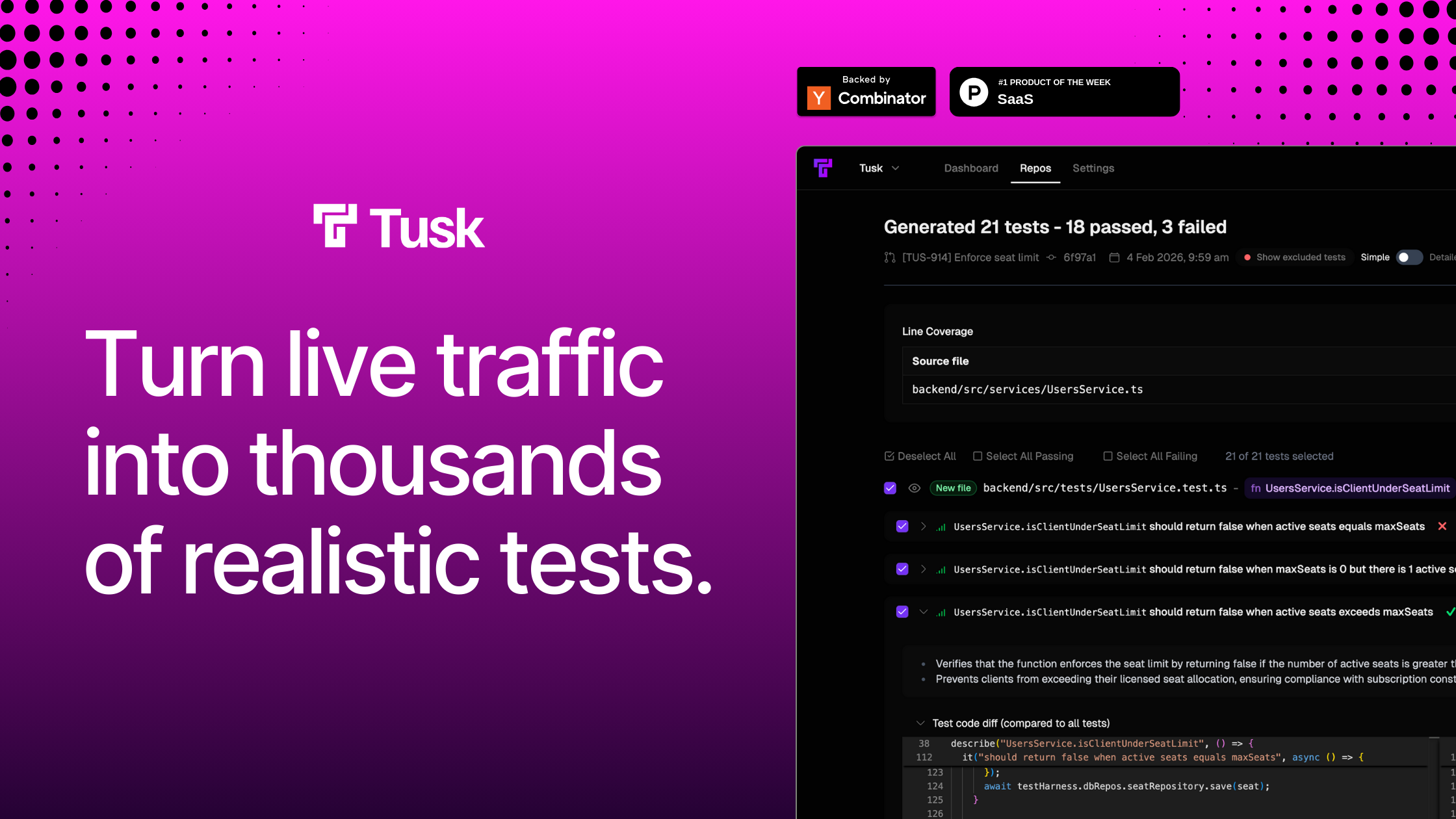
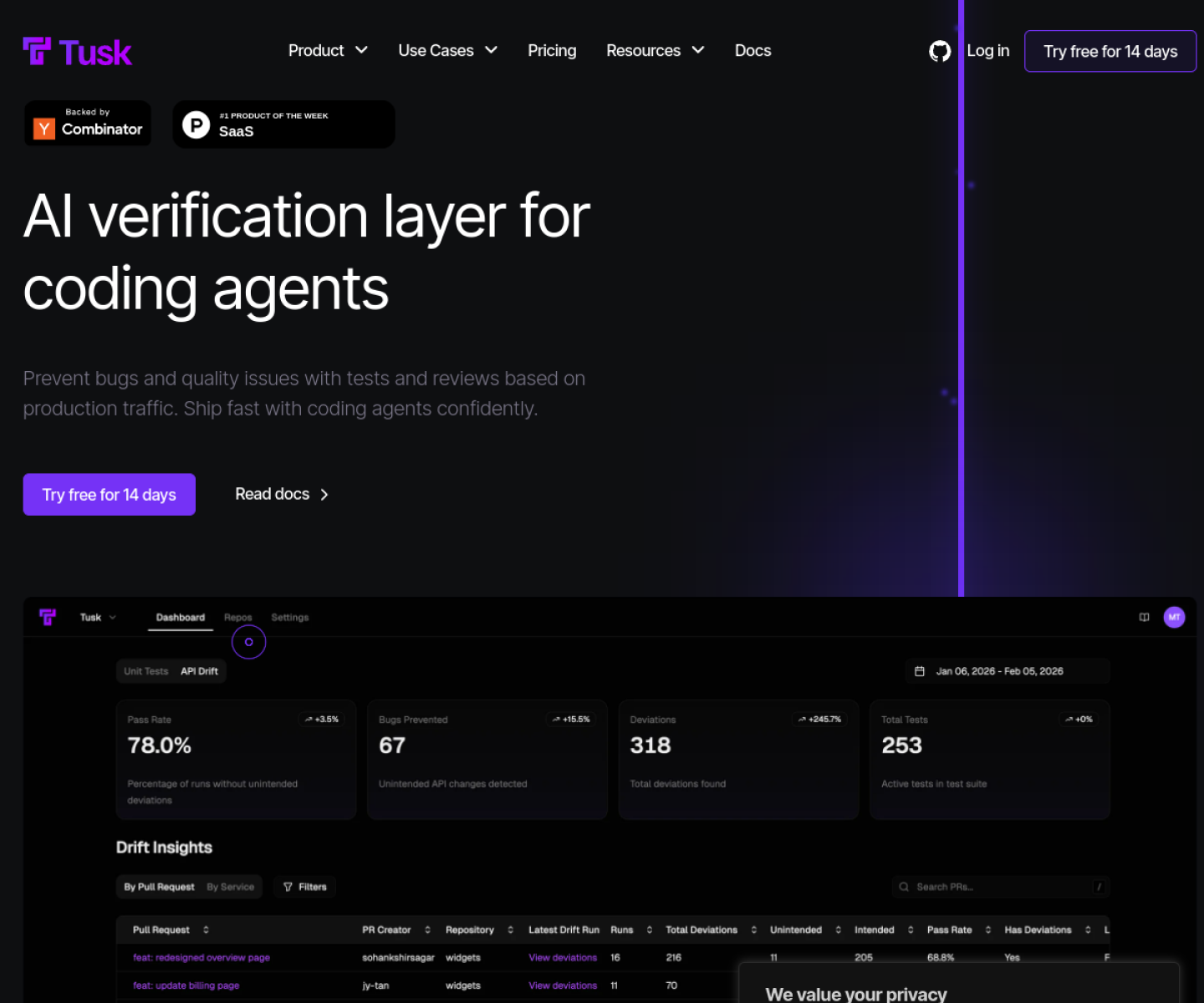
AI testing platform that uses live traffic and business context to generate, maintain, and run executable tests in local and CI workflows.
AI Project Details
Tusk review: AI testing platform that uses live traffic and business context to generate, maintain, and run executable tests in local and CI workflows.
Tusk is aimed at software teams that want stronger regression detection and coverage growth without hand-authoring every new unit or api test. The current product materials describe a workflow built around install the cli, let tusk generate tests from production behavior and code changes, run them in prs or ci, and keep suites updated as the app evolves. That framing matters because many new AI launches still stop at a broad promise. Tusk has a clearer job to do.
The stronger reason to care is operational fit. The product anchors on production traffic rather than abstract test generation, which is a sharper angle than many AI testing wrappers. Its self-iterating and self-healing positioning suggests a full maintenance loop, not just first-draft test code. Recent public posts and Product Hunt activity make it a timely testing candidate rather than an old launch resurfacing.
How the workflow works
A sensible first pass is simple: start from the product's core entry point, validate the main loop on a representative task, and only then judge whether the surrounding automation is real. For Tusk, that means users should install the cli, let tusk generate tests from production behavior and code changes, run them in prs or ci, and keep suites updated as the app evolves. If that loop feels shorter, clearer, or easier to control than the alternatives, the product is doing something useful.
Where Tusk stands out
| Evaluation angle | Fit | Why it matters | | --- | --- | --- | | Best-fit user | High | Software teams that want stronger regression detection and coverage growth without hand-authoring every new unit or API test. | | Core workflow clarity | High | Install the CLI, let Tusk generate tests from production behavior and code changes, run them in PRs or CI, and keep suites updated as the app evolves. | | Switching cost reducer | Medium to high | The product anchors on production traffic rather than abstract test generation, which is a sharper angle than many AI testing wrappers. | | Adoption risk | Medium | Teams should validate how representative their traffic is before assuming generated tests capture the right edge cases. |
Practical use cases
- Regression testing from production behavior
- Coverage expansion in pull requests
- Self-maintaining test suites in CI
Limits and buying notes
Teams should validate how representative their traffic is before assuming generated tests capture the right edge cases. Sensitive or highly regulated systems may need a close review of how traffic-derived inputs and CI execution are handled. Pricing status today: Official site offers a 14-day free trial but does not publish plan pricing on the reviewed pages.
FAQ
What is Tusk best for?
Tusk is strongest when regression testing from production behavior matters more than a generic AI demo. The official product materials position it around a concrete workflow rather than a blank chatbot shell.
Who should try Tusk first?
Software teams that want stronger regression detection and coverage growth without hand-authoring every new unit or API test. Teams with a real workflow match will get value faster than general curiosity users.
What should buyers verify before adopting Tusk?
Teams should validate how representative their traffic is before assuming generated tests capture the right edge cases. Sensitive or highly regulated systems may need a close review of how traffic-derived inputs and CI execution are handled. Pricing, privacy, and workflow fit should be checked directly on the current product before rollout.
Reviewed sources
- https://www.usetusk.ai/
- https://docs.usetusk.ai/
- https://www.producthunt.com/products/tusk-4
- https://blog.usetusk.ai/what-if-your-production-traffic-was-your-test-suite/
FAQ
What is Tusk best for?
Tusk is strongest when regression testing from production behavior matters more than a generic AI demo. The official product materials position it around a concrete workflow rather than a blank chatbot shell.
Who should try Tusk first?
Software teams that want stronger regression detection and coverage growth without hand-authoring every new unit or API test. Teams with a real workflow match will get value faster than general curiosity users.
What should buyers verify before adopting Tusk?
Teams should validate how representative their traffic is before assuming generated tests capture the right edge cases. Sensitive or highly regulated systems may need a close review of how traffic-derived inputs and CI execution are handled. Pricing, privacy, and workflow fit should be checked directly on the current product before rollout.