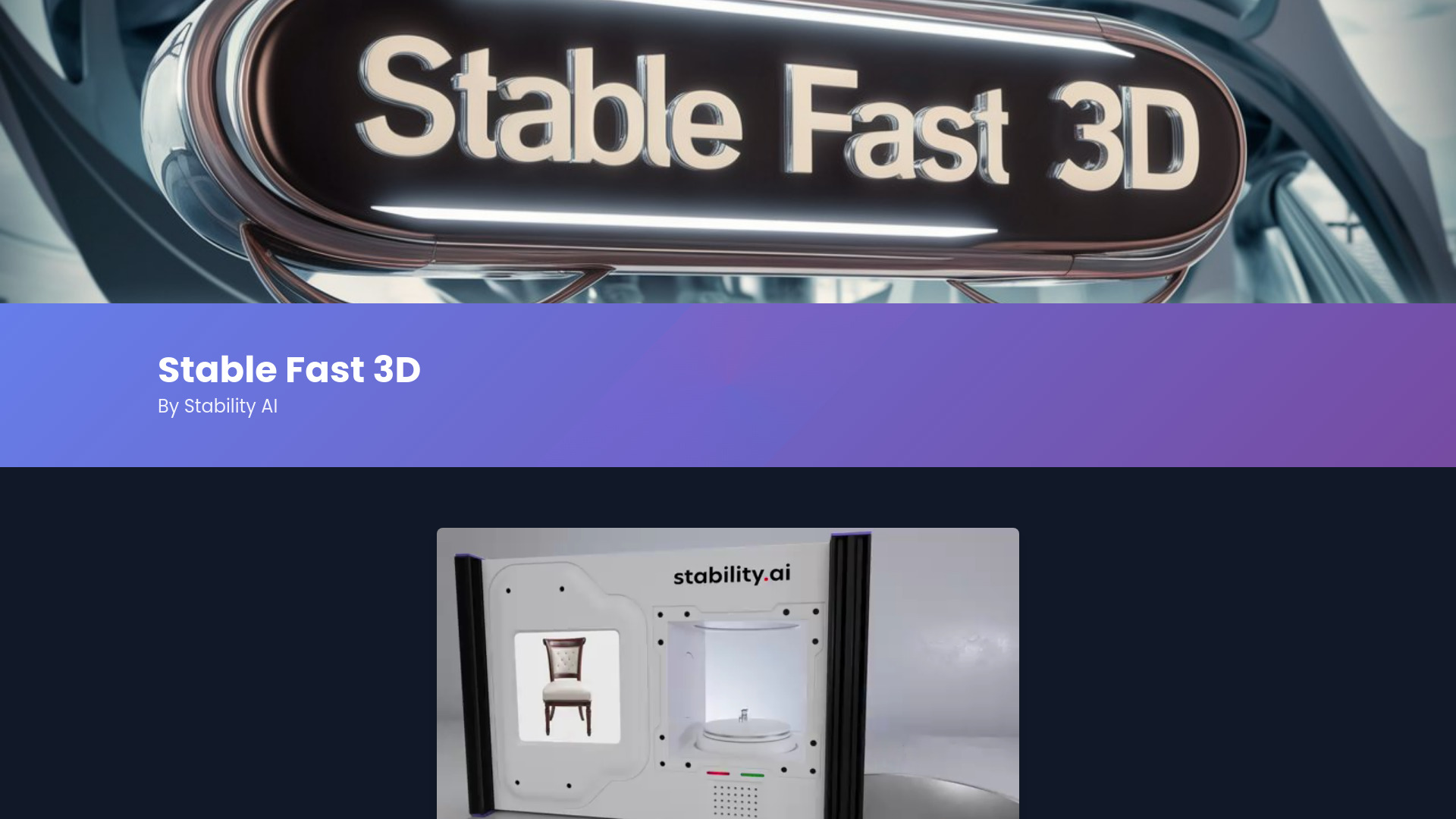
Stable Fast 3D(SF3D)
Rapid 3D Model Generation from Individual Images
AI Project Details
Stable Fast 3D review: single-image 3D reconstruction from Stability AI
Stable Fast 3D, often shortened to SF3D, is Stability AI's fast image-to-3D reconstruction model. Stability AI's announcement describes it as a model that turns a single object image into a detailed 3D asset in about 0.5 seconds, producing a UV-unwrapped mesh, material parameters, albedo colors with reduced illumination bake-in, and optional remeshing.
For TakeAI users, SF3D should be positioned as a 3D asset reconstruction model rather than a full creative suite. It is most useful when a game, AR, VR, ecommerce, retail, architecture, or design workflow needs many object assets quickly and can tolerate cleanup after generation.
Best-fit use cases
| Use case | Stable Fast 3D fit | Notes | |---|---:|---| | Image-to-3D object reconstruction | High | Strong fit for turning single object images into GLB-style assets. | | Game and VR prototyping | High | Useful for fast static props, clutter, furniture, and background assets. | | Ecommerce 3D previews | Medium to high | Needs product accuracy and rights review. | | Final production hero assets | Medium | Requires topology, texture, scale, and engine-readiness QA. | | Text-to-3D from scratch | Low | SF3D is primarily image-to-3D. |
What to verify before using SF3D
Teams should check input image isolation, object shape complexity, texture quality, mesh topology, UV unwrapping, material parameters, file format support, API cost, license threshold, commercial rights, and whether output imports cleanly into Blender, Unity, Unreal, ecommerce viewers, or internal asset pipelines.
Stability AI states that the model is released under the Stability AI Community License, with commercial use allowed for individuals or organizations up to a revenue threshold and enterprise licensing required above it. That licensing detail should be reviewed before commercial deployment.
Strengths
- Extremely fast single-image 3D reconstruction compared with slower generative workflows.
- Produces assets with practical 3D pipeline details such as UV unwrapping and material parameters.
- Relevant to game, VR, AR, ecommerce, retail, architecture, and design prototyping.
Limitations
- Output is not guaranteed to be production-ready without cleanup.
- Works best with clear object images; complex or occluded inputs can reduce quality.
- Licensing and revenue thresholds matter for commercial use.
Bottom line
Stable Fast 3D should be indexed as a serious image-to-3D reconstruction model. The right test is technical: generate several assets from realistic inputs, import them into the target pipeline, and measure cleanup time, license fit, and production usefulness.
Sources reviewed: Stability AI Stable Fast 3D announcement, Stability AI 3D models page, Stable Fast 3D GitHub, Stable Fast 3D project site.
FAQ
What is Stable Fast 3D best for?
Stable Fast 3D is best for fast image-to-3D object reconstruction, game and VR prototyping, ecommerce previews, and rapid asset exploration from single images.
Is Stable Fast 3D text-to-3D?
No. Stable Fast 3D is primarily an image-to-3D reconstruction model that takes a single object image as input.
What should teams check before commercial use?
Check output quality, topology, textures, imports, file formats, API costs, rights to the input image, and Stability AI Community License or enterprise license requirements.