Skill Atlas Workbench
Serverless visual IDE for agent skill repositories that maps markdown instructions into a dependency graph, validates them, and lets teams edit and open GitHub pull requests from the browser.
AI Project Details
Skill Atlas Workbench review: Serverless visual IDE for agent skill repositories that maps markdown instructions into a dependency graph, validates them, and lets teams edit and open GitHub pull requests from the browser.
Skill Atlas Workbench is built for teams building large skill libraries for coding agents and other llm systems who need more than a folder full of markdown files. Instead of asking users to replace their whole toolchain, the product wraps a familiar workflow around load a skill repository into the workbench, inspect the generated dependency graph and diagnostics, edit files in the browser, then stage and push changes back to github through a pull request flow. That makes it easier to judge on practical fit rather than hype.
What the product changes day to day
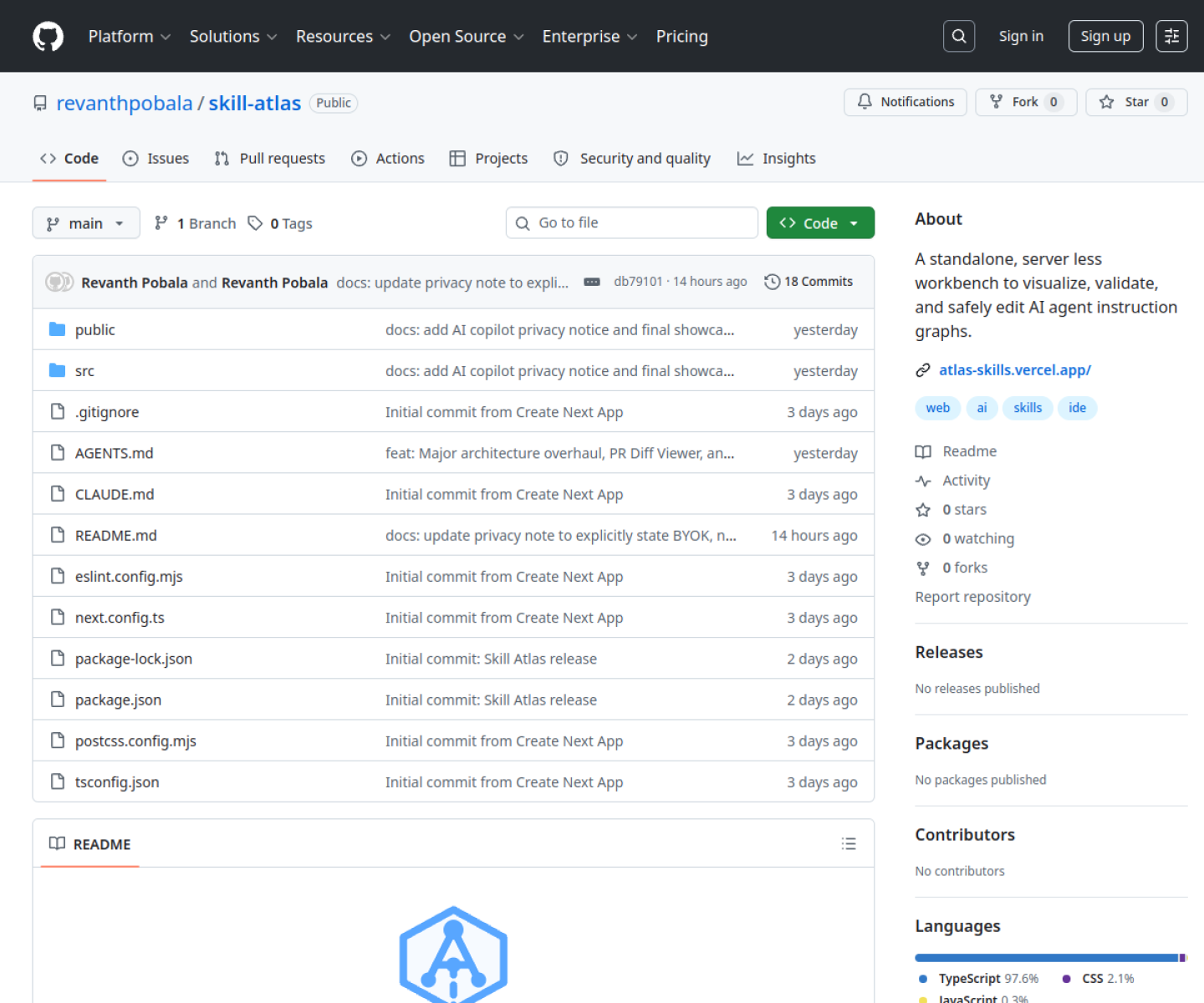
The real question is whether the workspace removes enough friction to matter. Skill Atlas is focused on skill-repository structure and dependency hygiene instead of generic prompt editing. The README documents concrete features like DAG visualization, token-limit diagnostics, duplicate tracking, and PR-based editing. Its BYOK browser-first model keeps the tool local and inspectable instead of pushing users into a hosted orchestration layer.
What the workflow feels like
For a serious evaluation, start with one active project instead of a synthetic demo. In practice that means users should load a skill repository into the workbench, inspect the generated dependency graph and diagnostics, edit files in the browser, then stage and push changes back to github through a pull request flow. If the product keeps context visible and cuts down tool hopping, the value shows up quickly.
Where it earns attention
| Evaluation angle | Fit | Why it matters | | --- | --- | --- | | Best-fit user | High | Teams building large skill libraries for coding agents and other LLM systems who need more than a folder full of markdown files. | | Core workflow clarity | High | Load a skill repository into the workbench, inspect the generated dependency graph and diagnostics, edit files in the browser, then stage and push changes back to GitHub through a pull request flow. | | Switching cost reducer | Medium to high | Skill Atlas is focused on skill-repository structure and dependency hygiene instead of generic prompt editing. | | Adoption risk | Medium | The product is most useful once a team already has a non-trivial skill repository with real dependency sprawl. |
Practical use cases
- Visualizing and debugging dependencies across a large agent skill repository
- Editing skill markdown with diagnostics before opening a GitHub pull request
- Tracking oversized or duplicated skill files before they bloat context windows
Limits and buying notes
The product is most useful once a team already has a non-trivial skill repository with real dependency sprawl. Teams still need to decide which validation rules reflect their own agent design standards. Pricing status today: The current public materials present Skill Atlas as a self-hostable open-source workbench rather than a paid hosted product.
FAQ
What is Skill Atlas Workbench best for?
Skill Atlas Workbench is strongest when visualizing and debugging dependencies across a large agent skill repository matters more than a generic AI demo. The official product materials position it around a concrete workflow rather than a blank chatbot shell.
Who should try Skill Atlas Workbench first?
Teams building large skill libraries for coding agents and other LLM systems who need more than a folder full of markdown files. Teams with a real workflow match will get value faster than general curiosity users.
What should buyers verify before adopting Skill Atlas Workbench?
The product is most useful once a team already has a non-trivial skill repository with real dependency sprawl. Teams still need to decide which validation rules reflect their own agent design standards. Pricing, privacy, and workflow fit should be checked directly on the current product before rollout.
Reviewed sources
- https://github.com/revanthpobala/skill-atlas
- https://raw.githubusercontent.com/revanthpobala/skill-atlas/main/README.md
- https://news.ycombinator.com/item?id=48558684
FAQ
What is Skill Atlas Workbench best for?
Skill Atlas Workbench is strongest when visualizing and debugging dependencies across a large agent skill repository matters more than a generic AI demo. The official product materials position it around a concrete workflow rather than a blank chatbot shell.
Who should try Skill Atlas Workbench first?
Teams building large skill libraries for coding agents and other LLM systems who need more than a folder full of markdown files. Teams with a real workflow match will get value faster than general curiosity users.
What should buyers verify before adopting Skill Atlas Workbench?
The product is most useful once a team already has a non-trivial skill repository with real dependency sprawl. Teams still need to decide which validation rules reflect their own agent design standards. Pricing, privacy, and workflow fit should be checked directly on the current product before rollout.