PULSE8.ai Cortex
Agent-native knowledge vault built on Markdown, full-text search, a typed graph, and MCP access instead of a traditional database stack.
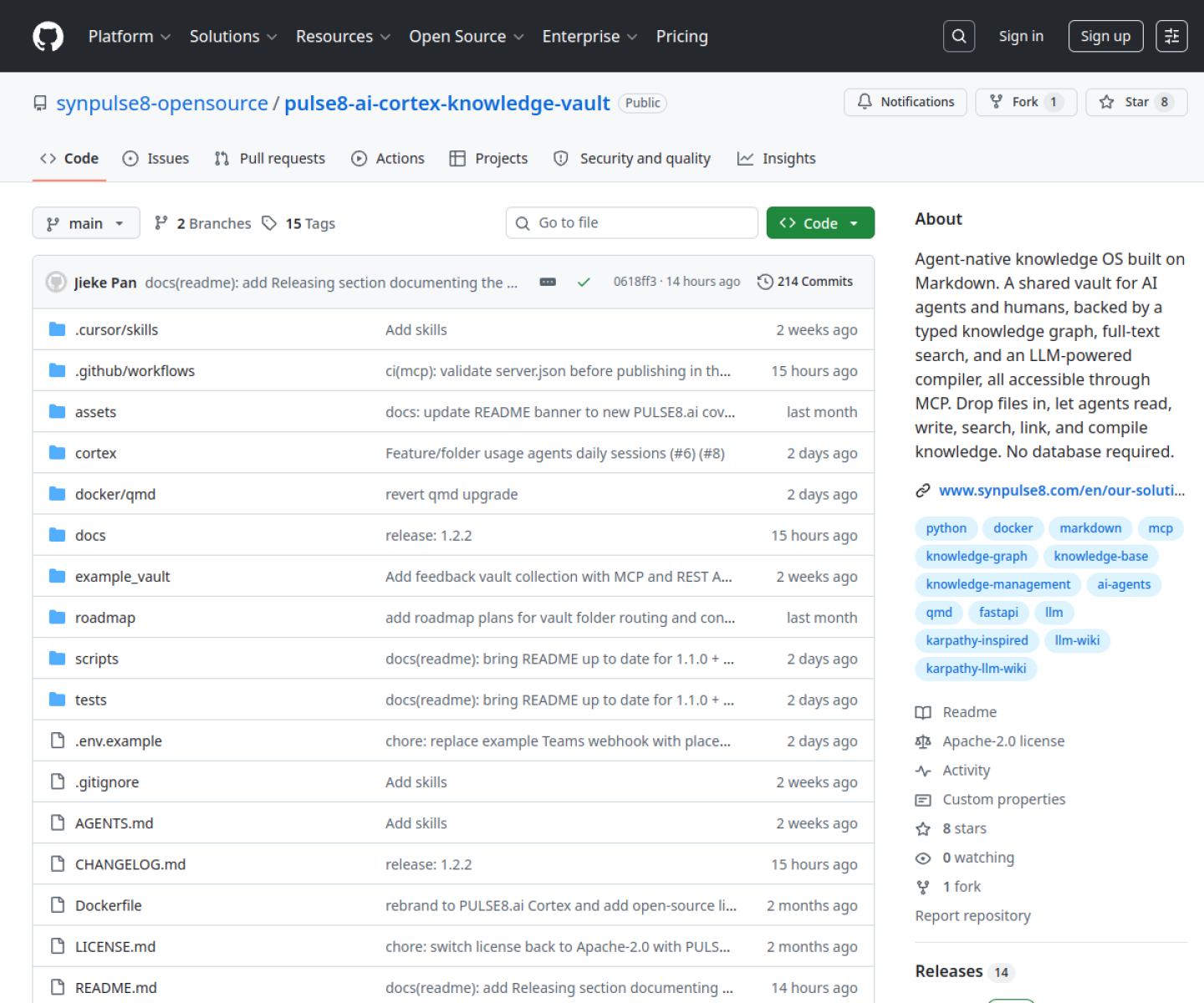
AI Project Details
PULSE8.ai Cortex review: Agent-native knowledge vault built on Markdown, full-text search, a typed graph, and MCP access instead of a traditional database stack.
PULSE8.ai Cortex stands out because it is not just another chat shell. The product materials describe a system centered on start the stack, ingest raw files into the vault, compile them into markdown knowledge pages, then let agents read, write, search, link, and build context windows through mcp or the rest api. That matters because the mechanism is the product, not a thin wrapper around a frontier model.
Why the architecture matters
Cortex is explicit that the storage layer is plain Markdown plus JSON on the filesystem, which makes the knowledge base easier to inspect and move. The README is detailed about the graph engine, QMD-backed search, file compiler, watcher, and MCP tools instead of hand-waving at knowledge management. Its document-ingest path and daily activity log make it more operationally concrete than many 'second brain for agents' projects.
How to evaluate the core loop
Start by testing the narrowest real workflow the product claims to improve. For PULSE8.ai Cortex, that means users should start the stack, ingest raw files into the vault, compile them into markdown knowledge pages, then let agents read, write, search, link, and build context windows through mcp or the rest api. The result should be easier to inspect, integrate, or control than a direct agent session.
Where it stands out
| Evaluation angle | Fit | Why it matters | | --- | --- | --- | | Best-fit user | High | Teams that want humans and agents to share a durable knowledge base that stays inspectable on disk and searchable across many document types. | | Core workflow clarity | High | Start the stack, ingest raw files into the vault, compile them into Markdown knowledge pages, then let agents read, write, search, link, and build context windows through MCP or the REST API. | | Switching cost reducer | Medium to high | Cortex is explicit that the storage layer is plain Markdown plus JSON on the filesystem, which makes the knowledge base easier to inspect and move. | | Adoption risk | Medium | The setup expects Docker and some operational comfort, so it is a stronger fit for technical teams than casual note-taking users. |
Practical use cases
- Building a shared Markdown knowledge base for agents and humans
- Ingesting documents and exposing them through MCP search and context tools
- Keeping an inspectable knowledge graph without adopting a separate database-backed product
Limits and buying notes
The setup expects Docker and some operational comfort, so it is a stronger fit for technical teams than casual note-taking users. Teams still need to decide how much knowledge hygiene and tagging discipline they are willing to maintain for the graph to stay useful. Pricing status today: PULSE8.ai Cortex is presented as an open-source project; the reviewed public sources mention an optional OpenRouter key for some cross-referencing features but do not show a separate hosted pricing table.
FAQ
What is PULSE8.ai Cortex best for?
PULSE8.ai Cortex is strongest when building a shared markdown knowledge base for agents and humans matters more than a generic AI demo. The official product materials position it around a concrete workflow rather than a blank chatbot shell.
Who should try PULSE8.ai Cortex first?
Teams that want humans and agents to share a durable knowledge base that stays inspectable on disk and searchable across many document types. Teams with a real workflow match will get value faster than general curiosity users.
What should buyers verify before adopting PULSE8.ai Cortex?
The setup expects Docker and some operational comfort, so it is a stronger fit for technical teams than casual note-taking users. Teams still need to decide how much knowledge hygiene and tagging discipline they are willing to maintain for the graph to stay useful. Pricing, privacy, and workflow fit should be checked directly on the current product before rollout.
Reviewed sources
- https://github.com/synpulse8-opensource/pulse8-ai-cortex-knowledge-vault
- https://raw.githubusercontent.com/synpulse8-opensource/pulse8-ai-cortex-knowledge-vault/main/README.md
- https://www.synpulse8.com/en/our-solutions/pulse8#pulse8-ai
FAQ
What is PULSE8.ai Cortex best for?
PULSE8.ai Cortex is strongest when building a shared markdown knowledge base for agents and humans matters more than a generic AI demo. The official product materials position it around a concrete workflow rather than a blank chatbot shell.
Who should try PULSE8.ai Cortex first?
Teams that want humans and agents to share a durable knowledge base that stays inspectable on disk and searchable across many document types. Teams with a real workflow match will get value faster than general curiosity users.
What should buyers verify before adopting PULSE8.ai Cortex?
The setup expects Docker and some operational comfort, so it is a stronger fit for technical teams than casual note-taking users. Teams still need to decide how much knowledge hygiene and tagging discipline they are willing to maintain for the graph to stay useful. Pricing, privacy, and workflow fit should be checked directly on the current product before rollout.