PRFlow
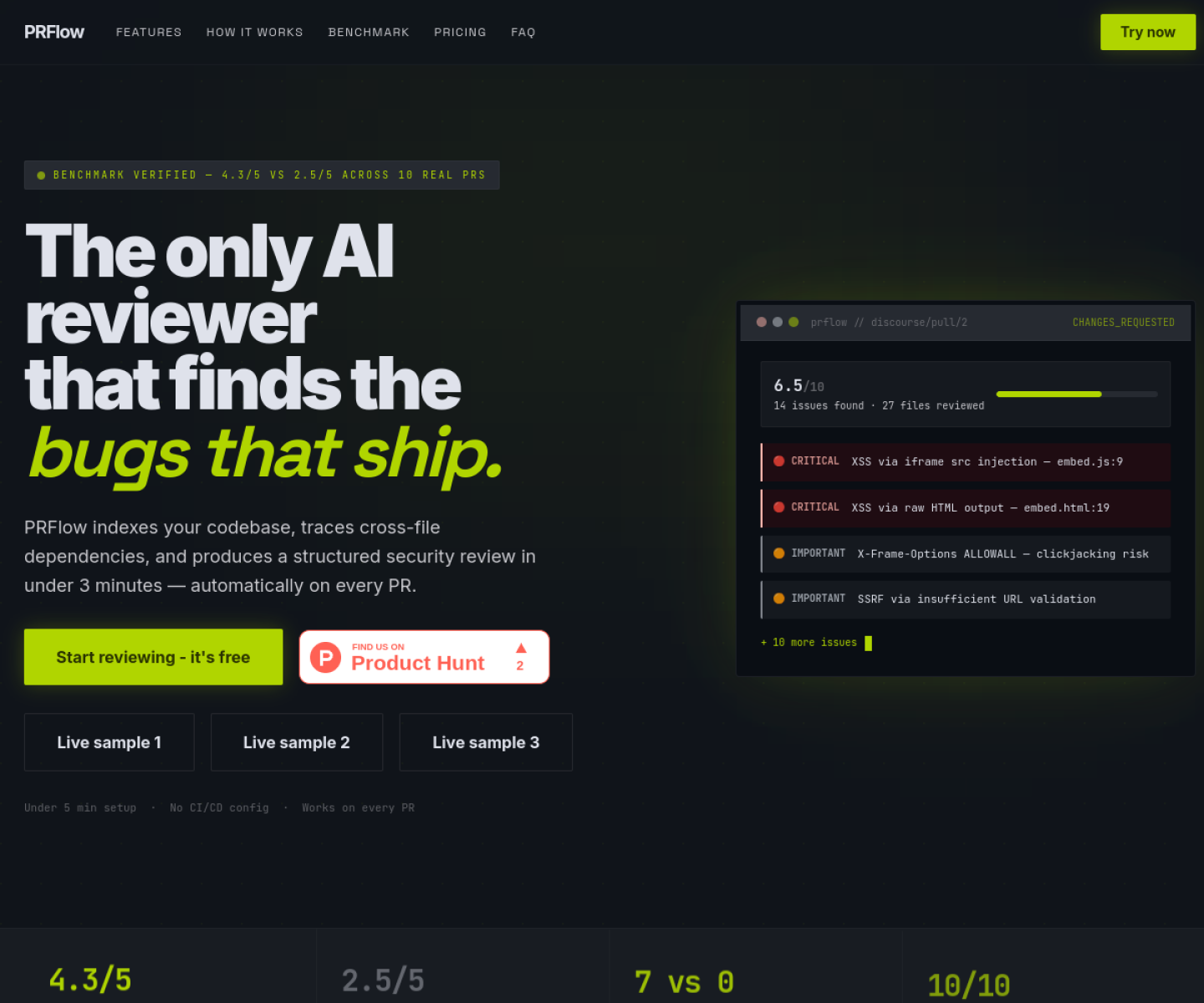
AI pull-request reviewer focused on cross-file security and architecture issues, with repository memory and direct GitHub review output.
AI Project Details
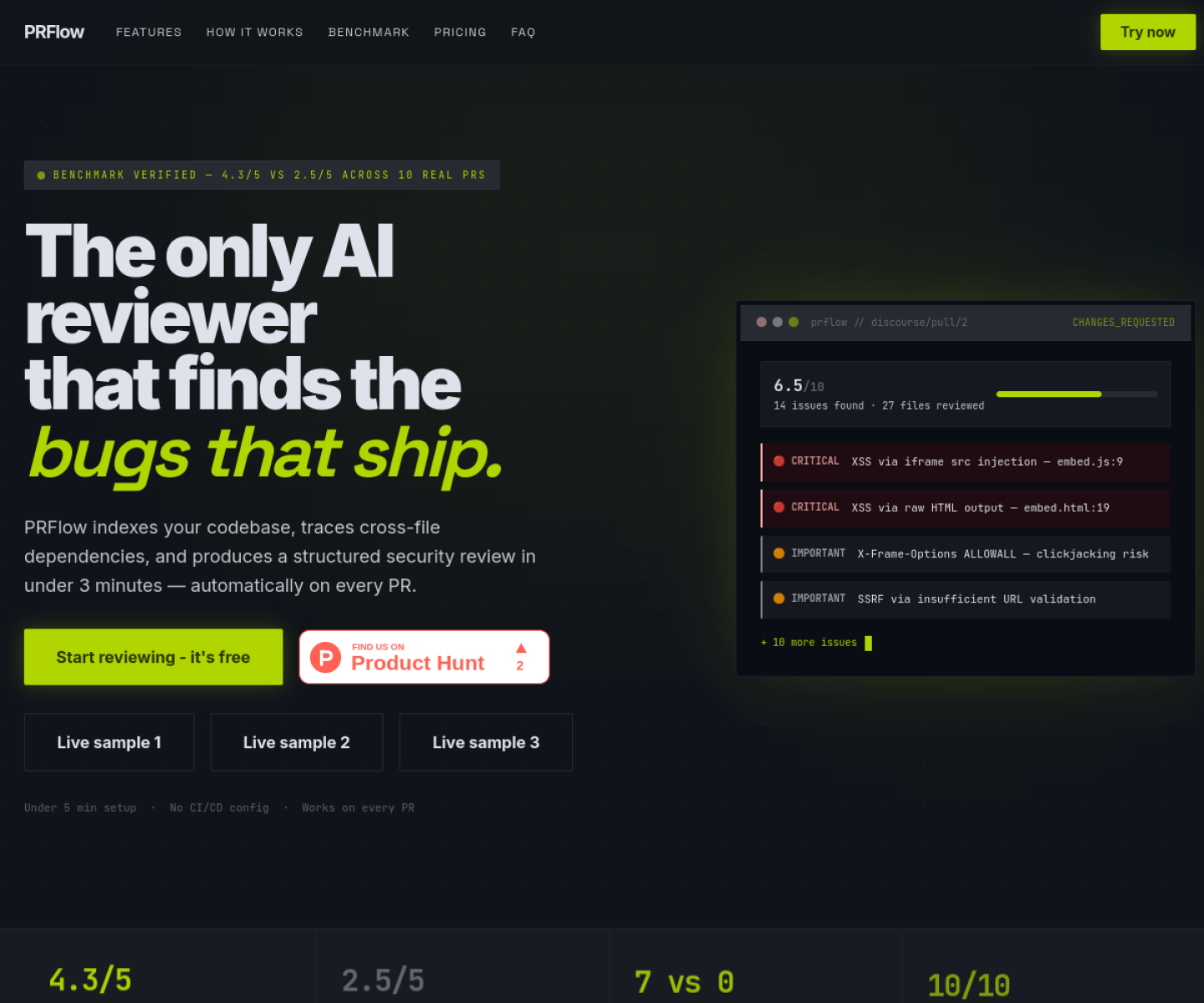
PRFlow review: AI pull-request reviewer focused on cross-file security and architecture issues, with repository memory and direct GitHub review output.
PRFlow is aimed at engineering teams that want deeper automated pr review than diff-only comment bots, especially for security-sensitive code paths. The current product materials describe a workflow built around install the github app, let prflow index the repository, open a pull request, and receive a structured review with file-level findings, severity, and follow-up comments in the pr thread. That makes the page easier to read as an operating model, not just a brand claim.
Why it is timely
PRFlow is explicit that it traces function boundaries and cross-file dependencies instead of reviewing isolated diff hunks. The product publishes public benchmark examples against real pull requests, which is more inspectable than anonymous vendor claims. Its repository memory and feedback-learning loop make it more operational than one-off comment generators.
How the workflow works in practice
A sensible first pass is to start from the product's main entry point and test the shortest path to value. For PRFlow, that means users should install the github app, let prflow index the repository, open a pull request, and receive a structured review with file-level findings, severity, and follow-up comments in the pr thread. If that loop reduces review drag, coordination, or governance work, the product is doing something real.
Where PRFlow stands out
| Evaluation angle | Fit | Why it matters | | --- | --- | --- | | Best-fit user | High | Engineering teams that want deeper automated PR review than diff-only comment bots, especially for security-sensitive code paths. | | Core workflow clarity | High | Install the GitHub app, let PRFlow index the repository, open a pull request, and receive a structured review with file-level findings, severity, and follow-up comments in the PR thread. | | Switching cost reducer | Medium to high | PRFlow is explicit that it traces function boundaries and cross-file dependencies instead of reviewing isolated diff hunks. | | Adoption risk | Medium | The current product is GitHub-only, so teams using other review systems will not get the same workflow fit. |
Practical use cases
- Finding cross-file security issues in pull requests before merge
- Adding structured AI review to GitHub PR workflows
- Teaching an automated reviewer through repository-specific feedback
Limits and buying notes
The current product is GitHub-only, so teams using other review systems will not get the same workflow fit. As with any review bot, teams should validate false-positive rate and review depth on their own codebase before trusting the output widely. Pricing status today: PRFlow's official site says reviews are paid with Graphbit Coins, with Core batches from 1k coins at $25 up to 10k coins at $250 and Elite batches from 12k coins at $300 up to 40k coins at $1,000.
FAQ
What is PRFlow best for?
PRFlow is strongest when finding cross-file security issues in pull requests before merge matters more than a generic AI demo. The official product materials position it around a concrete workflow rather than a blank chatbot shell.
Who should try PRFlow first?
Engineering teams that want deeper automated PR review than diff-only comment bots, especially for security-sensitive code paths. Teams with a real workflow match will get value faster than general curiosity users.
What should buyers verify before adopting PRFlow?
The current product is GitHub-only, so teams using other review systems will not get the same workflow fit. As with any review bot, teams should validate false-positive rate and review depth on their own codebase before trusting the output widely. Pricing, privacy, and workflow fit should be checked directly on the current product before rollout.
Reviewed sources
- https://prflow.graphbit.ai/
- https://platform.graphbit.ai/
FAQ
What is PRFlow best for?
PRFlow is strongest when finding cross-file security issues in pull requests before merge matters more than a generic AI demo. The official product materials position it around a concrete workflow rather than a blank chatbot shell.
Who should try PRFlow first?
Engineering teams that want deeper automated PR review than diff-only comment bots, especially for security-sensitive code paths. Teams with a real workflow match will get value faster than general curiosity users.
What should buyers verify before adopting PRFlow?
The current product is GitHub-only, so teams using other review systems will not get the same workflow fit. As with any review bot, teams should validate false-positive rate and review depth on their own codebase before trusting the output widely. Pricing, privacy, and workflow fit should be checked directly on the current product before rollout.