OpenReef
Open standard and CLI for packaging, sharing, and deploying multi-agent formations from a single manifest.

AI Project Details
OpenReef review: Open standard and CLI for packaging, sharing, and deploying multi-agent formations from a single manifest.
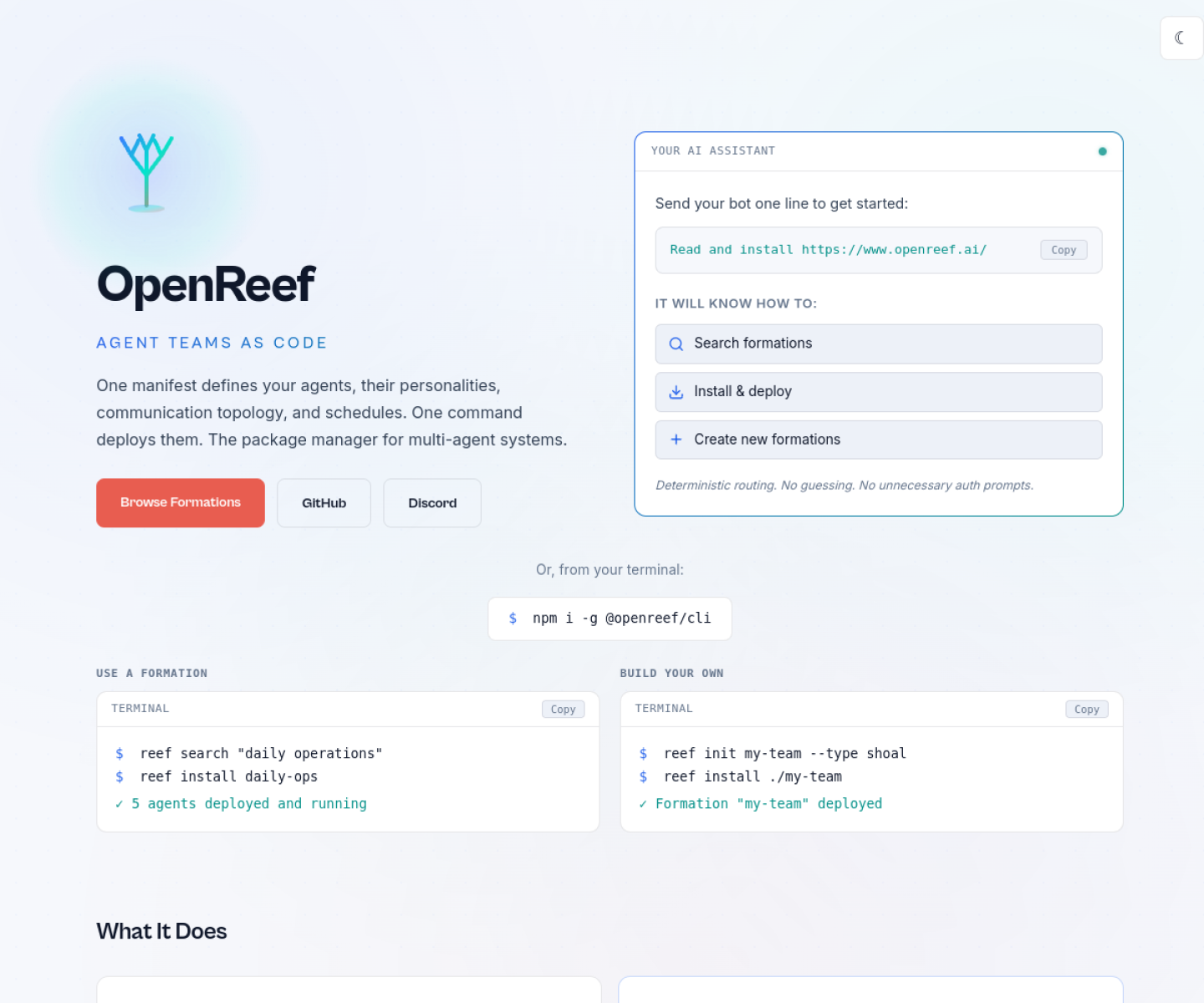
OpenReef is aimed at teams building recurring agent squads that want reproducible manifests, schedules, and topology instead of bespoke setup per deployment. The current product materials describe a workflow built around define agents, skills, schedules, variables, and topology in a reef.json package, then validate, inspect, and install the formation with the cli. That framing matters because many new AI launches still stop at a broad promise. OpenReef has a clearer job to do.
The stronger reason to care is operational fit. It treats agent teams as portable packages rather than just scripts or prompt bundles. The site is unusually specific about package contents, scheduling, topology, and integrity constraints, which makes the project easier to audit. Registry plus lockfile ideas make it more interesting than a local-only orchestration template.
How the workflow works
A sensible first pass is simple: start from the product's core entry point, validate the main loop on a representative task, and only then judge whether the surrounding automation is real. For OpenReef, that means users should define agents, skills, schedules, variables, and topology in a reef.json package, then validate, inspect, and install the formation with the cli. If that loop feels shorter, clearer, or easier to control than the alternatives, the product is doing something useful.
Where OpenReef stands out
| Evaluation angle | Fit | Why it matters |
| --- | --- | --- |
| Best-fit user | High | Teams building recurring agent squads that want reproducible manifests, schedules, and topology instead of bespoke setup per deployment. |
| Core workflow clarity | High | Define agents, skills, schedules, variables, and topology in a reef.json package, then validate, inspect, and install the formation with the CLI. |
| Switching cost reducer | Medium to high | It treats agent teams as portable packages rather than just scripts or prompt bundles. |
| Adoption risk | Medium | The concept makes the most sense once a team has enough recurring multi-agent structure to benefit from packaging and reuse. |
Practical use cases
- Packaging recurring multi-agent teams
- Deploying scheduled agent formations with one command
- Sharing reproducible team topologies across environments
Limits and buying notes
The concept makes the most sense once a team has enough recurring multi-agent structure to benefit from packaging and reuse. Adoption depends on whether the target runtime ecosystem actually embraces the formation format over time. Pricing status today: The project exposes an open CLI and registry workflow; no paid pricing is visible on the public site.
FAQ
What is OpenReef best for?
OpenReef is strongest when packaging recurring multi-agent teams matters more than a generic AI demo. The official product materials position it around a concrete workflow rather than a blank chatbot shell.
Who should try OpenReef first?
Teams building recurring agent squads that want reproducible manifests, schedules, and topology instead of bespoke setup per deployment. Teams with a real workflow match will get value faster than general curiosity users.
What should buyers verify before adopting OpenReef?
The concept makes the most sense once a team has enough recurring multi-agent structure to benefit from packaging and reuse. Adoption depends on whether the target runtime ecosystem actually embraces the formation format over time. Pricing, privacy, and workflow fit should be checked directly on the current product before rollout.
Reviewed sources
- https://www.openreef.ai/
- https://tide.openreef.ai/
- https://github.com/openreef-ai
FAQ
What is OpenReef best for?
OpenReef is strongest when packaging recurring multi-agent teams matters more than a generic AI demo. The official product materials position it around a concrete workflow rather than a blank chatbot shell.
Who should try OpenReef first?
Teams building recurring agent squads that want reproducible manifests, schedules, and topology instead of bespoke setup per deployment. Teams with a real workflow match will get value faster than general curiosity users.
What should buyers verify before adopting OpenReef?
The concept makes the most sense once a team has enough recurring multi-agent structure to benefit from packaging and reuse. Adoption depends on whether the target runtime ecosystem actually embraces the formation format over time. Pricing, privacy, and workflow fit should be checked directly on the current product before rollout.