
Loomcycle
Agent runtime sidecar that packages a hardened agent loop, multi-provider model support, and MCP connectivity into one Go binary that runs alongside an application.
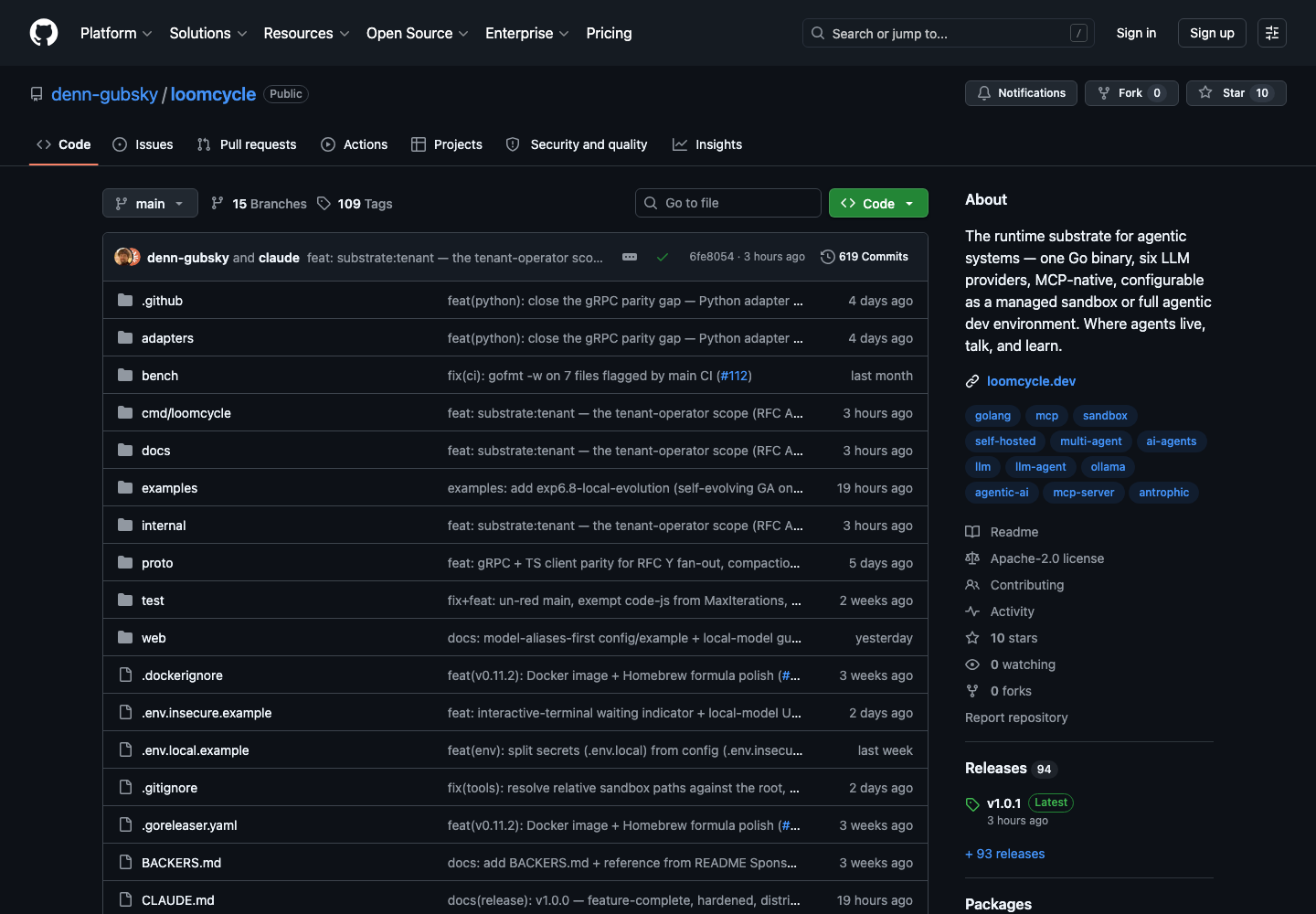
AI Project Details
Loomcycle review: Agent runtime sidecar that packages a hardened agent loop, multi-provider model support, and MCP connectivity into one Go binary that runs alongside an application.
Loomcycle stands out because it is not just another chat shell. The product materials describe a system centered on run the go binary next to an application, connect the chosen model providers and mcp surfaces, then let the sidecar own the agent loop and execution lifecycle beside the main service. That matters because the mechanism is the product, not a thin wrapper around a frontier model.
Why the architecture matters
Loomcycle frames itself as runtime infrastructure, not an assistant UI, which makes the product boundary easier to evaluate. The repository is concrete about the sidecar deployment model, provider support, and MCP on both sides of the runtime. A single binary with HA-oriented positioning gives it a more operational story than many experimental agent runtimes.
How to evaluate the core loop
Start by testing the narrowest real workflow the product claims to improve. For Loomcycle, that means users should run the go binary next to an application, connect the chosen model providers and mcp surfaces, then let the sidecar own the agent loop and execution lifecycle beside the main service. The result should be easier to inspect, integrate, or control than a direct agent session.
Where it stands out
| Evaluation angle | Fit | Why it matters | | --- | --- | --- | | Best-fit user | High | Engineers who want a real runtime substrate for agentic systems instead of gluing model calls, loops, and tool wiring together inside the application itself. | | Core workflow clarity | High | Run the Go binary next to an application, connect the chosen model providers and MCP surfaces, then let the sidecar own the agent loop and execution lifecycle beside the main service. | | Switching cost reducer | Medium to high | Loomcycle frames itself as runtime infrastructure, not an assistant UI, which makes the product boundary easier to evaluate. | | Adoption risk | Medium | Teams still need to decide whether a sidecar runtime fits their deployment model better than embedding logic directly in the app. |
Practical use cases
- Running agent loops beside an application instead of inside request handlers
- Standardizing MCP and model-provider wiring in one runtime sidecar
- Testing a more operational agent substrate before building custom orchestration
Limits and buying notes
Teams still need to decide whether a sidecar runtime fits their deployment model better than embedding logic directly in the app. The value increases with system complexity; simple prototypes may not need another runtime layer. Pricing status today: Loomcycle is published as an Apache-2.0 open-source runtime, and the reviewed public materials did not show a separate hosted pricing plan.
FAQ
What is Loomcycle best for?
Loomcycle is strongest when running agent loops beside an application instead of inside request handlers matters more than a generic AI demo. The official product materials position it around a concrete workflow rather than a blank chatbot shell.
Who should try Loomcycle first?
Engineers who want a real runtime substrate for agentic systems instead of gluing model calls, loops, and tool wiring together inside the application itself. Teams with a real workflow match will get value faster than general curiosity users.
What should buyers verify before adopting Loomcycle?
Teams still need to decide whether a sidecar runtime fits their deployment model better than embedding logic directly in the app. The value increases with system complexity; simple prototypes may not need another runtime layer. Pricing, privacy, and workflow fit should be checked directly on the current product before rollout.
Reviewed sources
- https://github.com/denn-gubsky/loomcycle
- https://loomcycle.dev/
- https://news.ycombinator.com/item?id=48558481
FAQ
What is Loomcycle best for?
Loomcycle is strongest when running agent loops beside an application instead of inside request handlers matters more than a generic AI demo. The official product materials position it around a concrete workflow rather than a blank chatbot shell.
Who should try Loomcycle first?
Engineers who want a real runtime substrate for agentic systems instead of gluing model calls, loops, and tool wiring together inside the application itself. Teams with a real workflow match will get value faster than general curiosity users.
What should buyers verify before adopting Loomcycle?
Teams still need to decide whether a sidecar runtime fits their deployment model better than embedding logic directly in the app. The value increases with system complexity; simple prototypes may not need another runtime layer. Pricing, privacy, and workflow fit should be checked directly on the current product before rollout.