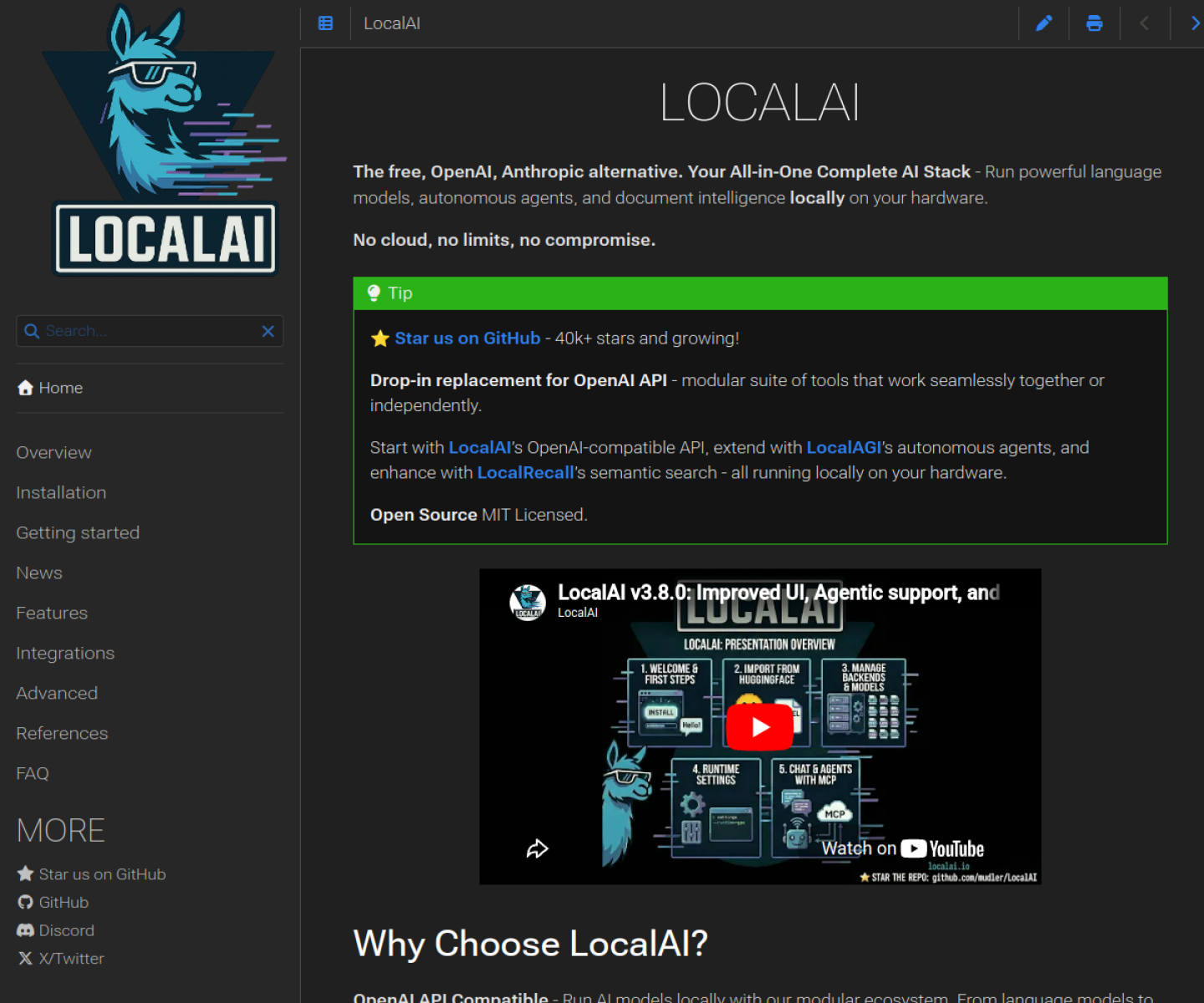
LocalAI
Open-source local AI engine for running language, vision, voice, image, and video models on your own hardware.
AI Project Details
LocalAI review: Open-source local AI engine for running language, vision, voice, image, and video models on your own hardware.
LocalAI is aimed at developers and teams that want local or self-hosted model execution without handing every workflow to a managed api provider. The current product materials describe a workflow built around deploy the engine on local or server hardware, load supported models and backends, expose apis or ui, and run multimodal or agent workflows without a required cloud dependency. That matters because many new AI launches still sound broad until you try to map them to an actual job.
The reason this tool stands out is practical fit. LocalAI has moved beyond a simple local LLM wrapper into a broader engine with voice, vision, video, and agent features. The official project materials surface a rapid release cadence and wide backend support instead of a narrow one-model demo. It remains newly notable because the 2026 release cycle materially expanded what the platform can run and manage.
How the workflow works
The fastest way to judge LocalAI is to walk the main loop on one real task. For this product, users should deploy the engine on local or server hardware, load supported models and backends, expose apis or ui, and run multimodal or agent workflows without a required cloud dependency. If that loop feels clearer, more controllable, or easier to repeat than the alternatives, the product is doing useful work.
Where LocalAI stands out
| Evaluation angle | Fit | Why it matters | | --- | --- | --- | | Best-fit user | High | Developers and teams that want local or self-hosted model execution without handing every workflow to a managed API provider. | | Core workflow clarity | High | Deploy the engine on local or server hardware, load supported models and backends, expose APIs or UI, and run multimodal or agent workflows without a required cloud dependency. | | Switching cost reducer | Medium to high | LocalAI has moved beyond a simple local LLM wrapper into a broader engine with voice, vision, video, and agent features. | | Adoption risk | Medium | Teams should validate hardware efficiency, operational complexity, and model quality against their actual workloads before committing. |
Practical use cases
- Running local or self-hosted multimodal models
- Building private agent workflows without mandatory cloud inference
- Testing multiple open-source backends behind one engine
Limits and buying notes
Teams should validate hardware efficiency, operational complexity, and model quality against their actual workloads before committing. LocalAI is best when self-hosting and control matter; it is not the fastest path for teams that just want a managed API with less ops. Pricing status today: LocalAI is open source and self-hosted; no separate paid pricing was required to evaluate the core engine.
FAQ
What is LocalAI best for?
LocalAI works best when running local or self-hosted multimodal models matters more than using a generic assistant. The official materials point to a more concrete workflow than a blank AI shell.
Who should try LocalAI first?
Developers and teams that want local or self-hosted model execution without handing every workflow to a managed API provider. Teams with that exact workflow will learn faster than broad curiosity users.
What should users verify before adopting LocalAI?
Teams should validate hardware efficiency, operational complexity, and model quality against their actual workloads before committing. LocalAI is best when self-hosting and control matter; it is not the fastest path for teams that just want a managed API with less ops. Users should also check the current docs, pricing, and release status before rollout.
Reviewed sources
- https://localai.io/
- https://github.com/mudler/LocalAI
FAQ
What is LocalAI best for?
LocalAI works best when running local or self-hosted multimodal models matters more than using a generic assistant. The official materials point to a more concrete workflow than a blank AI shell.
Who should try LocalAI first?
Developers and teams that want local or self-hosted model execution without handing every workflow to a managed API provider. Teams with that exact workflow will learn faster than broad curiosity users.
What should users verify before adopting LocalAI?
Teams should validate hardware efficiency, operational complexity, and model quality against their actual workloads before committing. LocalAI is best when self-hosting and control matter; it is not the fastest path for teams that just want a managed API with less ops. Users should also check the current docs, pricing, and release status before rollout.