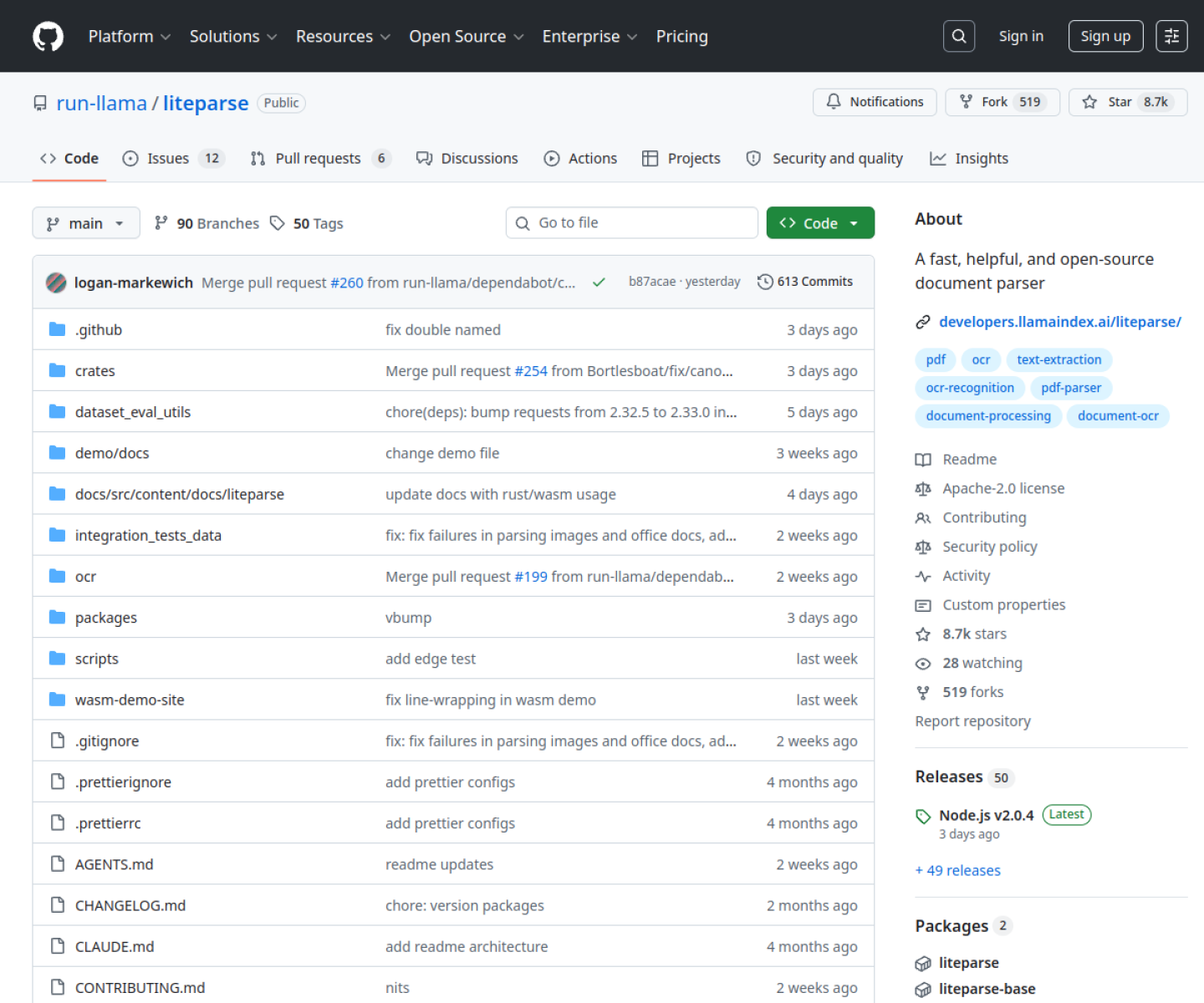
LiteParse
Open-source local document parser from LlamaIndex for PDFs, Office files, and images with layout-aware output.
AI Project Details
LiteParse review: Open-source local document parser from LlamaIndex for PDFs, Office files, and images with layout-aware output.
LiteParse is aimed at developers building document ingestion, rag, or agent workflows that need faster local parsing before model calls. The current product materials describe a workflow built around install liteparse, run local parsing on pdfs or office documents, extract spatial text and ocr output, then feed the structured result into retrieval or agent pipelines. That matters because many new AI launches still sound broad until you try to map them to an actual job.
The reason this tool stands out is practical fit. The official product page makes local execution the point: no cloud dependency, no LLM tokens, and layout-aware output. LiteParse sits in a stronger product context than many parser repos because LlamaIndex exposes both the managed and open-source paths clearly. It is newly notable because the project moved from fresh launch visibility into a faster v2 cycle during late May 2026.
How the workflow works
The fastest way to judge LiteParse is to walk the main loop on one real task. For this product, users should install liteparse, run local parsing on pdfs or office documents, extract spatial text and ocr output, then feed the structured result into retrieval or agent pipelines. If that loop feels clearer, more controllable, or easier to repeat than the alternatives, the product is doing useful work.
Where LiteParse stands out
| Evaluation angle | Fit | Why it matters | | --- | --- | --- | | Best-fit user | High | Developers building document ingestion, RAG, or agent workflows that need faster local parsing before model calls. | | Core workflow clarity | High | Install LiteParse, run local parsing on PDFs or office documents, extract spatial text and OCR output, then feed the structured result into retrieval or agent pipelines. | | Switching cost reducer | Medium to high | The official product page makes local execution the point: no cloud dependency, no LLM tokens, and layout-aware output. | | Adoption risk | Medium | Teams should validate parsing accuracy on their own document mix because public benchmark framing is stronger than public side-by-side evidence. |
Practical use cases
- Parsing complex PDFs locally before RAG indexing
- Adding layout-aware OCR to agent document workflows
- Replacing cloud parsing steps in privacy-sensitive ingestion pipelines
Limits and buying notes
Teams should validate parsing accuracy on their own document mix because public benchmark framing is stronger than public side-by-side evidence. LiteParse is best for local parsing speed and control, not for teams that want a managed extraction platform with enterprise support. Pricing status today: LiteParse is presented as an open-source local parser on the official LlamaIndex site and GitHub; no separate hosted LiteParse pricing page was visible.
FAQ
What is LiteParse best for?
LiteParse works best when parsing complex pdfs locally before rag indexing matters more than using a generic assistant. The official materials point to a more concrete workflow than a blank AI shell.
Who should try LiteParse first?
Developers building document ingestion, RAG, or agent workflows that need faster local parsing before model calls. Teams with that exact workflow will learn faster than broad curiosity users.
What should users verify before adopting LiteParse?
Teams should validate parsing accuracy on their own document mix because public benchmark framing is stronger than public side-by-side evidence. LiteParse is best for local parsing speed and control, not for teams that want a managed extraction platform with enterprise support. Users should also check the current docs, pricing, and release status before rollout.
Reviewed sources
- https://www.llamaindex.cloud/
- https://github.com/run-llama/liteparse
FAQ
What is LiteParse best for?
LiteParse works best when parsing complex pdfs locally before rag indexing matters more than using a generic assistant. The official materials point to a more concrete workflow than a blank AI shell.
Who should try LiteParse first?
Developers building document ingestion, RAG, or agent workflows that need faster local parsing before model calls. Teams with that exact workflow will learn faster than broad curiosity users.
What should users verify before adopting LiteParse?
Teams should validate parsing accuracy on their own document mix because public benchmark framing is stronger than public side-by-side evidence. LiteParse is best for local parsing speed and control, not for teams that want a managed extraction platform with enterprise support. Users should also check the current docs, pricing, and release status before rollout.