Kaedim
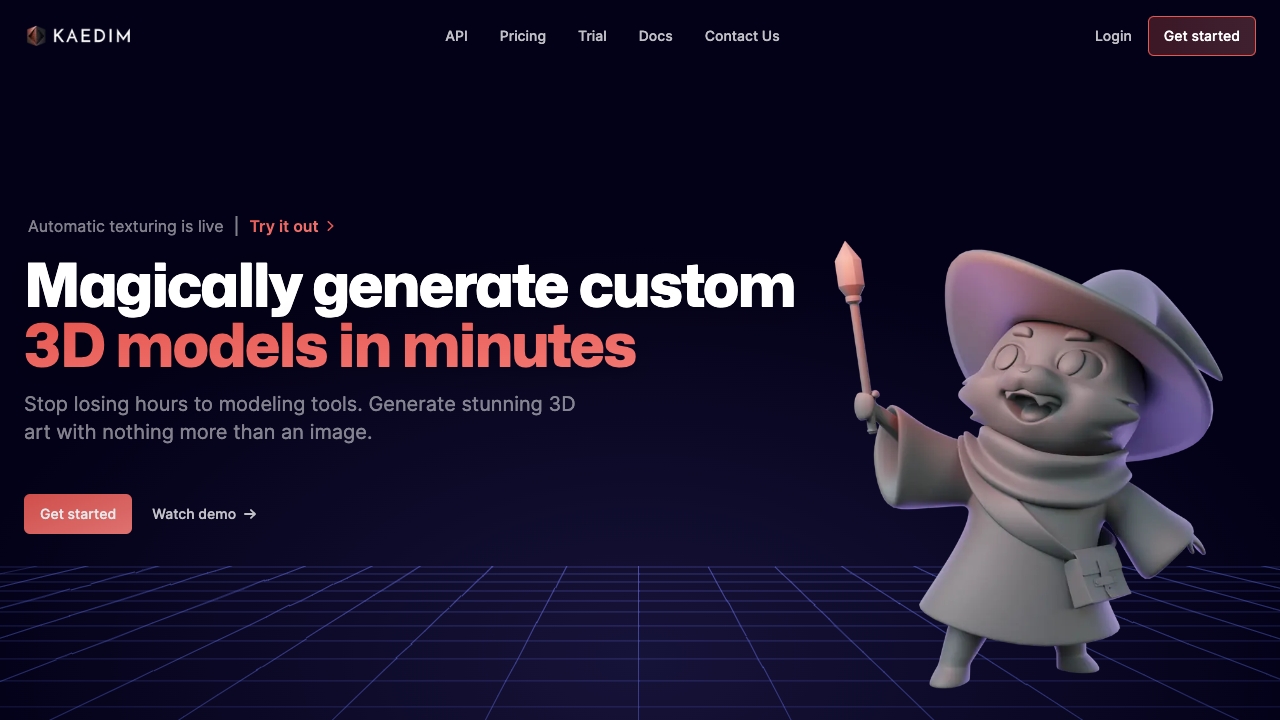
Kaedim enables users to effortlessly transform 2D images into detailed 3D models through its intuitive platform.
AI Project Details
Kaedim review: AI-assisted 3D model production from images and prompts
Kaedim is a 3D asset production platform that helps teams turn 2D references into 3D models. Its official site and documentation position the product around game-ready 3D asset creation, with AI-assisted generation and a workflow that can support production teams that need many assets faster than a fully manual modeling process.
Kaedim should be evaluated differently from a casual 3D toy. Its value is strongest when a studio has clear references, style standards, and a review workflow for imported assets.
Best-fit use cases
| Use case | Kaedim fit | Notes | |---|---:|---| | Game asset production | High | Strong when teams need many props or environment assets. | | 2D concept to 3D workflow | High | Useful when references are clear and art direction is defined. | | Prototype asset creation | Medium to high | Good for speed before final polish. | | Exact hero character work | Medium | May still need specialist modeling and rigging. | | Unstructured prompts with no references | Low to medium | Better references usually produce better assets. |
What teams should verify
Teams should test topology, poly count, UVs, texture quality, scale, rigging needs, file formats, engine import behavior, IP rights, and how much cleanup artists still need to do. The key question is not "can it make a model?" but "does it reduce total production time after QA and cleanup?"
For studios, the best pilot is a narrow asset category such as props, buildings, weapons, or environment pieces, then compare Kaedim output against the existing art pipeline.
Strengths
- Strong fit for teams that already work from 2D references or concept art.
- Can accelerate repetitive 3D asset production.
- Documentation and app access make it easier to evaluate workflow fit.
- Useful for game studios, prototyping, and 3D content teams.
Limitations
- Final production quality still depends on QA and artist review.
- Rigged characters, hero assets, and exact brand objects may require manual work.
- Poor references can create inconsistent output.
- Teams should verify commercial rights, file formats, and engine behavior.
Bottom line
Kaedim should be indexed as an AI-assisted 3D asset production tool. It is strongest for teams that want to turn clear 2D references into usable 3D assets faster, with human review still built into the pipeline.
Sources reviewed: Kaedim homepage, Kaedim documentation, Kaedim app.
FAQ
What is Kaedim best for?
Kaedim is best for teams that want to accelerate 3D asset production from clear 2D references, especially for games, prototypes, and environment props.
Can Kaedim replace a 3D art team?
No. It can speed parts of the asset pipeline, but topology, style matching, rigging, QA, and final polish still need human review.
What should studios test before using Kaedim?
Test file formats, topology, poly count, textures, UVs, scale, engine import, cleanup time, IP rights, and how well outputs match the studio's art direction.