Junia AI
Title: Unlocking the Power of AI for In-Depth SEO Content Meta Description: Discover how AI can enhance your SEO content strategy, improve search engine rankings, and engage your audience effectively. In today's digital landscape, leveraging AI for in-depth SEO content is essential for businesses aiming to boost their online presence. By integrating AI tools, you can streamline your content creation process while ensuring that your articles are optimized for search engines. 1. **Understanding SEO Content** SEO content refers to any content created with the intention of ranking higher in search engine results. This includes blog posts, articles, and web pages that are rich in keywords and valuable information. 2. **The Role of AI in SEO** AI can analyze vast amounts of data to identify trending topics and relevant keywords. This allows content creators to produce articles that not only resonate with their audience but also meet search engine algorithms' requirements. 3. **Creating Engaging Content** To keep readers engaged, it's crucial to write in a clear and concise manner. Use short paragraphs and bullet points to break down complex information, making it easier for readers to digest. 4. **Optimizing for Keywords** Strategically placing keywords throughout your content is vital. However, it's important to ensure that their usage feels natural and enhances the overall quality of the writing. 5. **Enhancing Click-Through Rates** Crafting compelling titles and meta descriptions can significantly improve your content's visibility. A well-optimized title grabs attention, while a descriptive meta description encourages users to click through to your site. By harnessing the capabilities of AI in your SEO content strategy, you can create informative, engaging, and optimized articles that not only attract traffic but also retain readers, ultimately leading to higher conversion rates.
AI Project Details
Junia AI review: automated SEO articles, research, and publishing
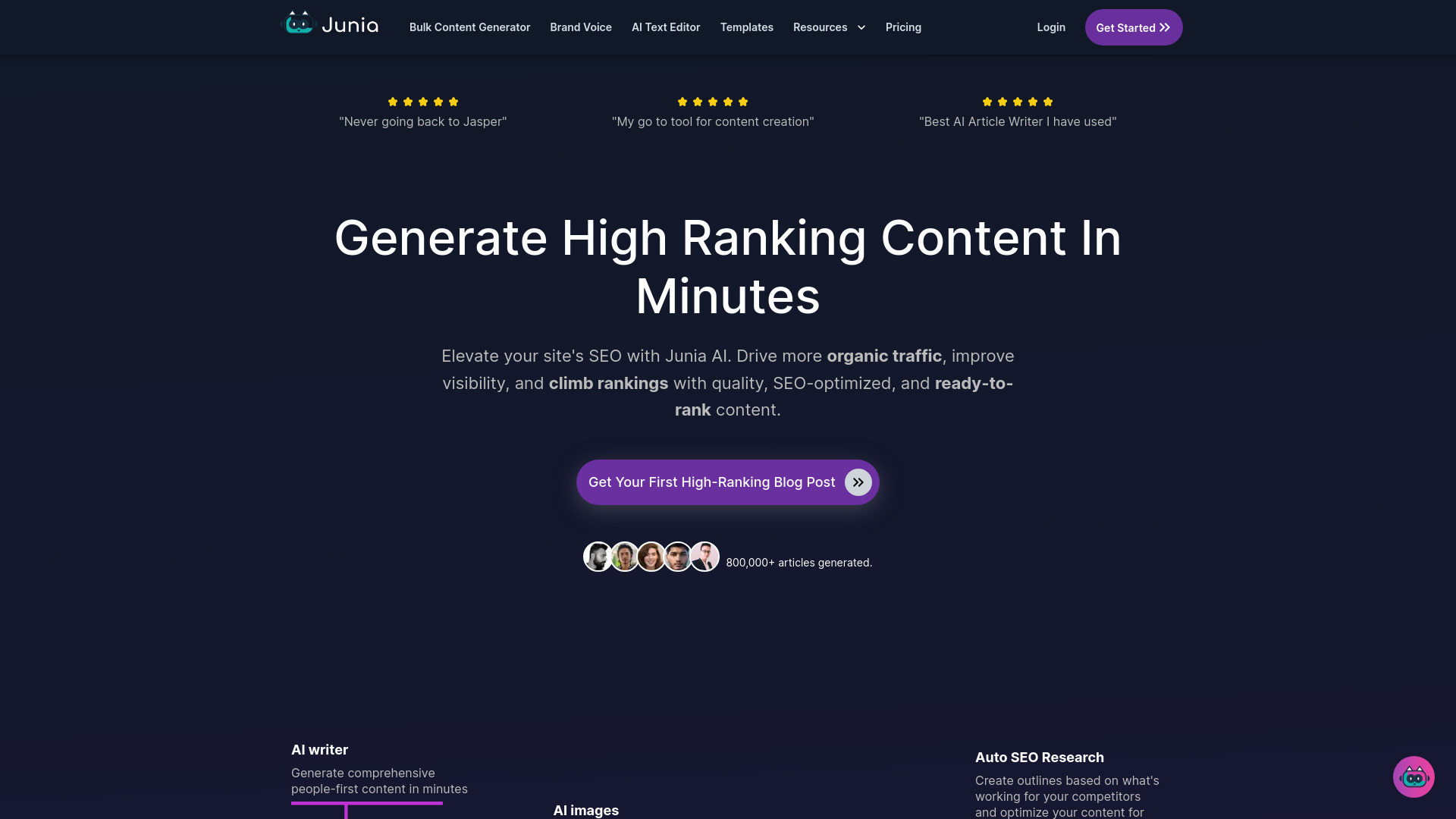
Junia AI is an AI SEO writing and autoblogging platform for creating, optimizing, and publishing articles at a scheduled cadence. The current homepage positions it around ranking on Google and being cited by AI search, with competitor analysis, content gaps, keyword research, full-length articles, headings, images, links, meta tags, schema markup, WordPress publishing, brand voice, multilingual content, and auto-linking. The pricing page lists Growth and Scale plans with monthly article volumes, automatic SEO optimization, web research, internal and external linking, integrations, knowledge bases, auto keyword research, images, multilingual SEO, Google indexing, collaboration, API access, and priority support.
The strongest fit is a site owner or content team that needs a steady editorial pipeline and already has clear positioning, source material, and review standards. Junia AI is risky if used as unattended mass publishing. It can create scale, but scale only helps if each article has a real reason to exist, accurate sources, and a helpful angle beyond copied SERP patterns.
Best-fit use cases
| Use case | Fit | Notes | |---|---:|---| | SEO article drafting | High | Homepage focuses on full-length optimized articles. | | Autoblogging pipeline | High | Scheduling and auto-publishing are major positioning points. | | Multilingual content | Medium to high | Pricing mentions many supported languages and translation. | | WordPress publishing | Medium to high | Website publishing integrations are highlighted. | | Expert-led technical content | Medium | Expert review and original examples remain necessary. |
Core workflow
A responsible Junia workflow starts with keyword selection, competitor research, and content-gap validation. The AI draft should then be edited for first-hand examples, product screenshots, named sources, internal links, schema accuracy, and claims that can be verified. Auto-publishing should be reserved for low-risk updates or heavily templated sites with a strong review process.
What users should verify
Users should test article originality, factual accuracy, citation quality, image generation rights, schema output, meta tags, internal and external links, WordPress integration, knowledge-base controls, multilingual quality, indexing features, API access, team permissions, and cancellation terms. Sites recovering from indexing problems should publish slower and audit every page before submitting sitemaps.
Strengths
- Strong end-to-end positioning from research to article generation and publishing.
- Pricing page clearly describes article volumes and SEO automation features.
- Useful for teams that need consistent output across many related topics.
- Includes practical SEO features such as links, meta tags, schema, images, and integrations.
Limitations
- Autoblogging can create thin content if topics are weak or review is skipped.
- AI-search citation claims still depend on authority, sources, and content usefulness.
- Multilingual output needs native-level review for important markets.
- Search performance depends on technical SEO, backlinks, crawlability, and domain trust.
Bottom line
Junia AI is best for teams that want an automated SEO content pipeline but are willing to keep human editorial control. It can accelerate drafts and publishing, but every article still needs evidence, originality, and a real reader benefit.
Sources reviewed: Junia AI homepage, Junia AI pricing.
FAQ
What is Junia AI best for?
Junia AI is best for generating, optimizing, scheduling, and publishing SEO articles as part of a controlled content pipeline.
Should Junia AI be used for unattended autoblogging?
Unattended publishing is risky. Teams should review facts, sources, originality, links, images, schema, and search intent before sending pages live.
What should users test before choosing Junia AI?
Users should test draft quality, keyword research, web research, links, metadata, schema, image rights, WordPress publishing, multilingual output, indexing features, team controls, and plan limits.