effGen
Open-source production agent framework built to make smaller and local language models more usable in autonomous workflows.
AI Project Details
effGen review: Open-source production agent framework built to make smaller and local language models more usable in autonomous workflows.
effGen is aimed at developers who want a framework that supports local or smaller models, built-in tools, and production-style observability without assuming frontier-model budgets. The current product materials describe a workflow built around install the framework, choose a local or cloud backend, create agents from presets or sdks, add tools and guardrails, then evaluate and observe runs through the bundled utilities. That framing matters because many new AI launches still stop at a broad promise. effGen has a clearer job to do.
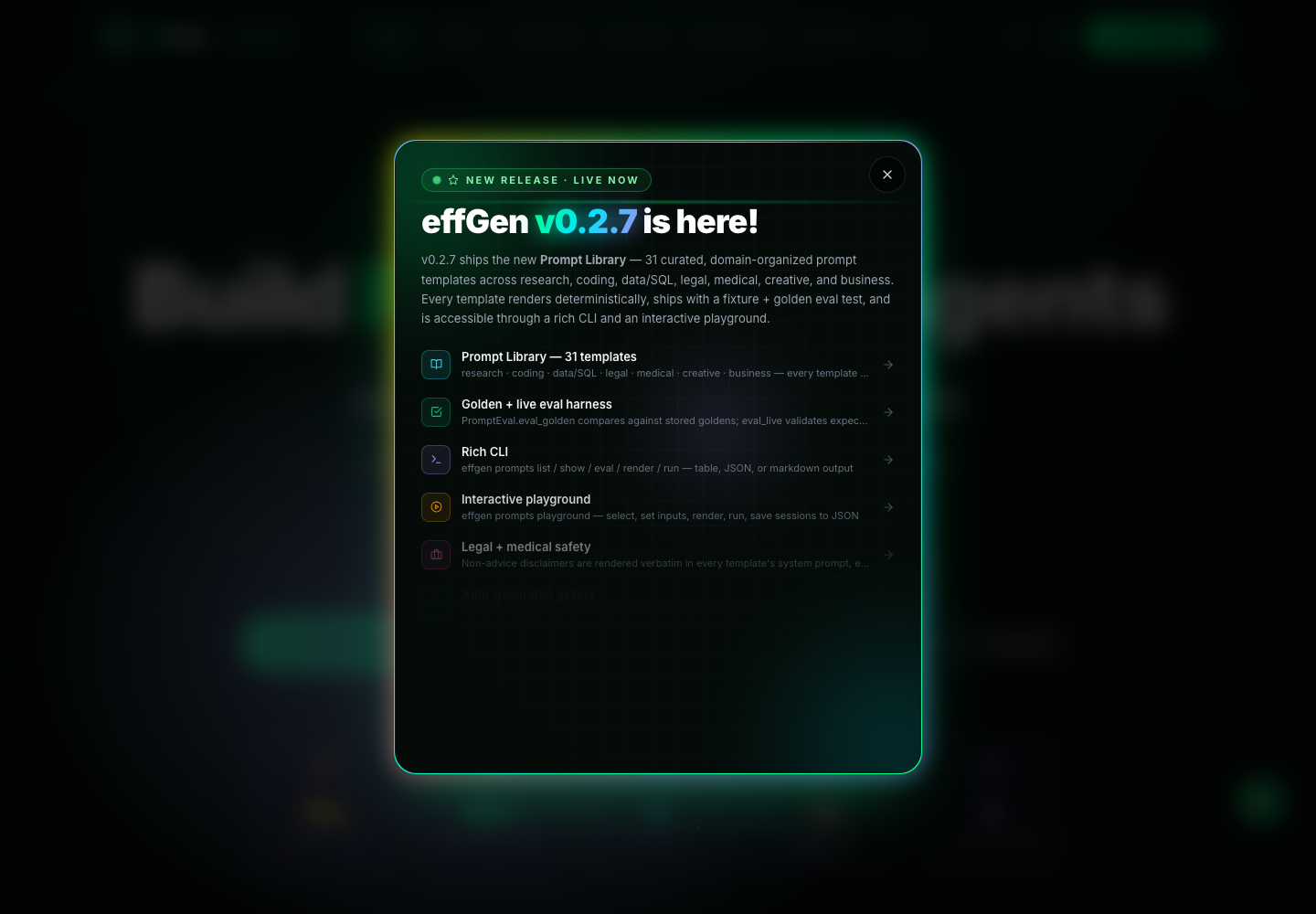
The stronger reason to care is operational fit. The framework is unusually explicit about serving small or local model setups rather than assuming the biggest hosted models. Its public update log is dense with current release detail, including multimodal input, reliability work, and tool expansion in May 2026. The linked paper and repo make it easier to verify the research angle and the shipped implementation together.
How the workflow works
A sensible first pass is simple: start from the product's core entry point, validate the main loop on a representative task, and only then judge whether the surrounding automation is real. For effGen, that means users should install the framework, choose a local or cloud backend, create agents from presets or sdks, add tools and guardrails, then evaluate and observe runs through the bundled utilities. If that loop feels shorter, clearer, or easier to control than the alternatives, the product is doing something useful.
Where effGen stands out
| Evaluation angle | Fit | Why it matters | | --- | --- | --- | | Best-fit user | High | Developers who want a framework that supports local or smaller models, built-in tools, and production-style observability without assuming frontier-model budgets. | | Core workflow clarity | High | Install the framework, choose a local or cloud backend, create agents from presets or SDKs, add tools and guardrails, then evaluate and observe runs through the bundled utilities. | | Switching cost reducer | Medium to high | The framework is unusually explicit about serving small or local model setups rather than assuming the biggest hosted models. | | Adoption risk | Medium | Teams should benchmark real task quality on their own model mix before assuming smaller models are good enough for production work. |
Practical use cases
- Building autonomous workflows on local or cost-sensitive model stacks
- Adding multimodal tools and reliability controls to agent apps
- Testing whether smaller models can handle structured agent tasks with the right framework support
Limits and buying notes
Teams should benchmark real task quality on their own model mix before assuming smaller models are good enough for production work. The feature surface is broad and moving quickly, so adopters should verify maturity on the exact backends they need. Pricing status today: The framework is open source. The reviewed public materials do not present a separate commercial pricing tier.
FAQ
What is effGen best for?
effGen is strongest when building autonomous workflows on local or cost-sensitive model stacks matters more than a generic AI demo. The official product materials position it around a concrete workflow rather than a blank chatbot shell.
Who should try effGen first?
Developers who want a framework that supports local or smaller models, built-in tools, and production-style observability without assuming frontier-model budgets. Teams with a real workflow match will get value faster than general curiosity users.
What should buyers verify before adopting effGen?
Teams should benchmark real task quality on their own model mix before assuming smaller models are good enough for production work. The feature surface is broad and moving quickly, so adopters should verify maturity on the exact backends they need. Pricing, privacy, and workflow fit should be checked directly on the current product before rollout.
Reviewed sources
- https://effgen.org/
- https://github.com/ctrl-gaurav/effGen
- https://arxiv.org/abs/2602.00887
FAQ
What is effGen best for?
effGen is strongest when building autonomous workflows on local or cost-sensitive model stacks matters more than a generic AI demo. The official product materials position it around a concrete workflow rather than a blank chatbot shell.
Who should try effGen first?
Developers who want a framework that supports local or smaller models, built-in tools, and production-style observability without assuming frontier-model budgets. Teams with a real workflow match will get value faster than general curiosity users.
What should buyers verify before adopting effGen?
Teams should benchmark real task quality on their own model mix before assuming smaller models are good enough for production work. The feature surface is broad and moving quickly, so adopters should verify maturity on the exact backends they need. Pricing, privacy, and workflow fit should be checked directly on the current product before rollout.