Durable AI
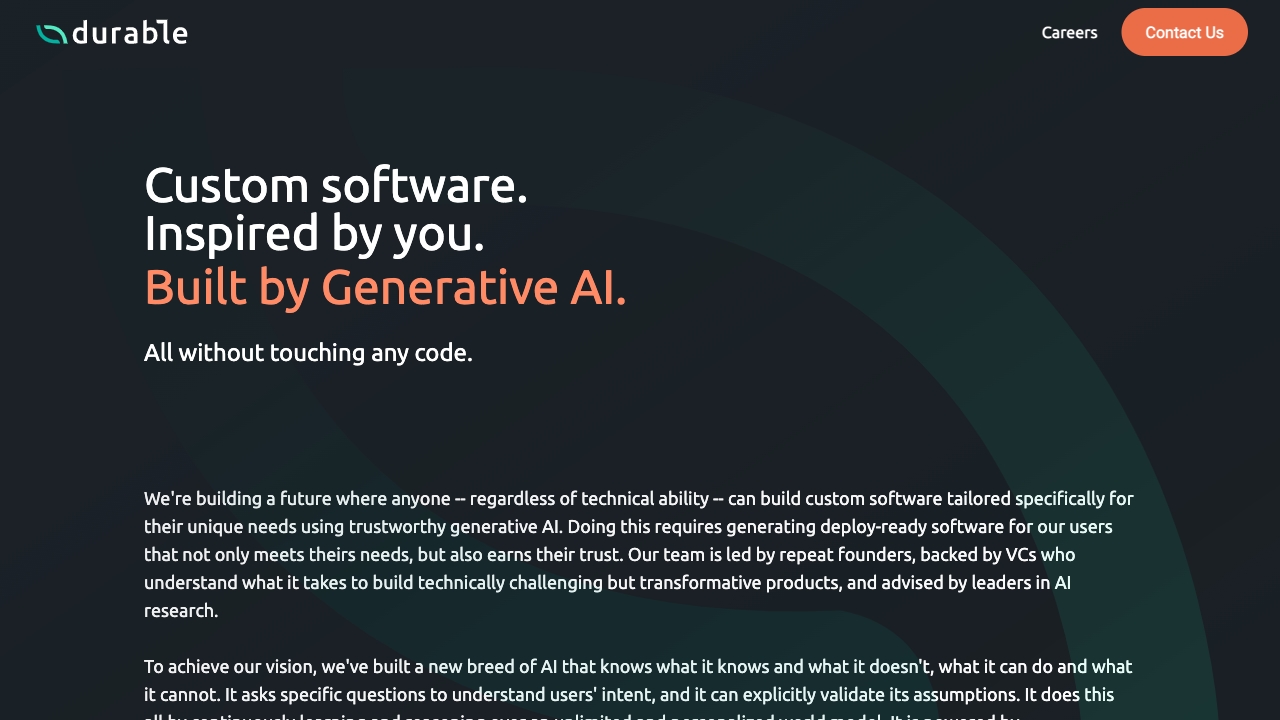
Durable: Empowering Personalized Software Creation with Generative AI In today's fast-paced digital world, the ability to create personalized software without any coding knowledge is a game-changer. Durable harnesses the power of generative AI, allowing users from all backgrounds to design and develop custom software solutions effortlessly. Why Choose Durable? 1. **User-Friendly Interface**: Durable's intuitive platform makes it easy for anyone to get started, regardless of technical expertise. 2. **Generative AI Technology**: Leverage advanced AI capabilities to generate software tailored to your specific needs, saving time and resources. 3. **Customization Options**: Personalize your software with a variety of features and functionalities, ensuring it meets your unique requirements. 4. **No Coding Required**: Focus on your ideas and creativity without the barriers of traditional coding, making software development accessible to everyone. Join the revolution in software creation with Durable and unlock your potential to innovate without limits. Experience the future of personalized software today!
AI Project Details
Durable review: AI-built production automation software
Durable has changed from the older broad "personalized software creation" framing into a more enterprise-focused automation product. The current site says Durable turns enterprise problems into production automations that are scoped, built, deployed, and maintained as systems and requirements evolve. Its "what's different" page is especially important: Durable says it writes real production code rather than only wiring together agent chains or prompt wrappers. The integrations page lists production-ready integrations across communication, productivity, CRM, sales, data, development, finance, AI, and workflow categories.
This should be evaluated as an automation engineering layer for businesses, not as a simple no-code website builder.
Best-fit use cases
| Use case | Fit | Notes | |---|---:|---| | Enterprise workflow automation | High | Durable focuses on production automations that maintain themselves. | | System-to-system integrations | High | The integration library covers common business systems. | | Requirements-to-code workflows | High | Durable emphasizes requirements as the source of truth. | | Simple personal productivity tasks | Low | The product is too heavy for small one-off automations. | | Consumer website creation | Low | The current positioning is production software automation. |
What users should verify
Teams should test security review, integration coverage, code ownership, monitoring, rollback process, change management, requirements quality, data permissions, audit logs, deployment environment, and how Durable handles edge cases when upstream APIs change. Procurement should review trust, privacy, support, and enterprise terms before connecting core systems.
Strengths
- Clear distinction from generic agent-chain automation tools.
- Requirements-first workflow can reduce ambiguity before code is generated.
- Integration library suggests practical business-system coverage.
- Better aligned with durable operations than throwaway scripts.
Limitations
- Public pricing is not obvious from the pages reviewed.
- Enterprise automations still require security, QA, and change governance.
- Teams must understand what code and infrastructure they own or can export.
- Small teams may prefer simpler workflow automation tools.
Bottom line
Durable is most compelling for teams that need AI-assisted production automations connected to real business systems. It should be piloted on a contained workflow with clear requirements, monitoring, and rollback expectations.
Sources reviewed: Durable homepage, What's Different, Durable integrations.
FAQ
What is Durable used for now?
Durable is used to turn enterprise workflow problems into production automations that are scoped, built, deployed, and maintained as systems and requirements change.
Is Durable just another AI agent builder?
Durable says its approach is different because it writes production code and uses AI where useful, rather than only chaining agents or prompt wrappers.
What should enterprises verify before using Durable?
Enterprises should verify security, integrations, code ownership, monitoring, rollback, audit logs, support terms, data access, and how requirement changes update deployed automations.