deepsec
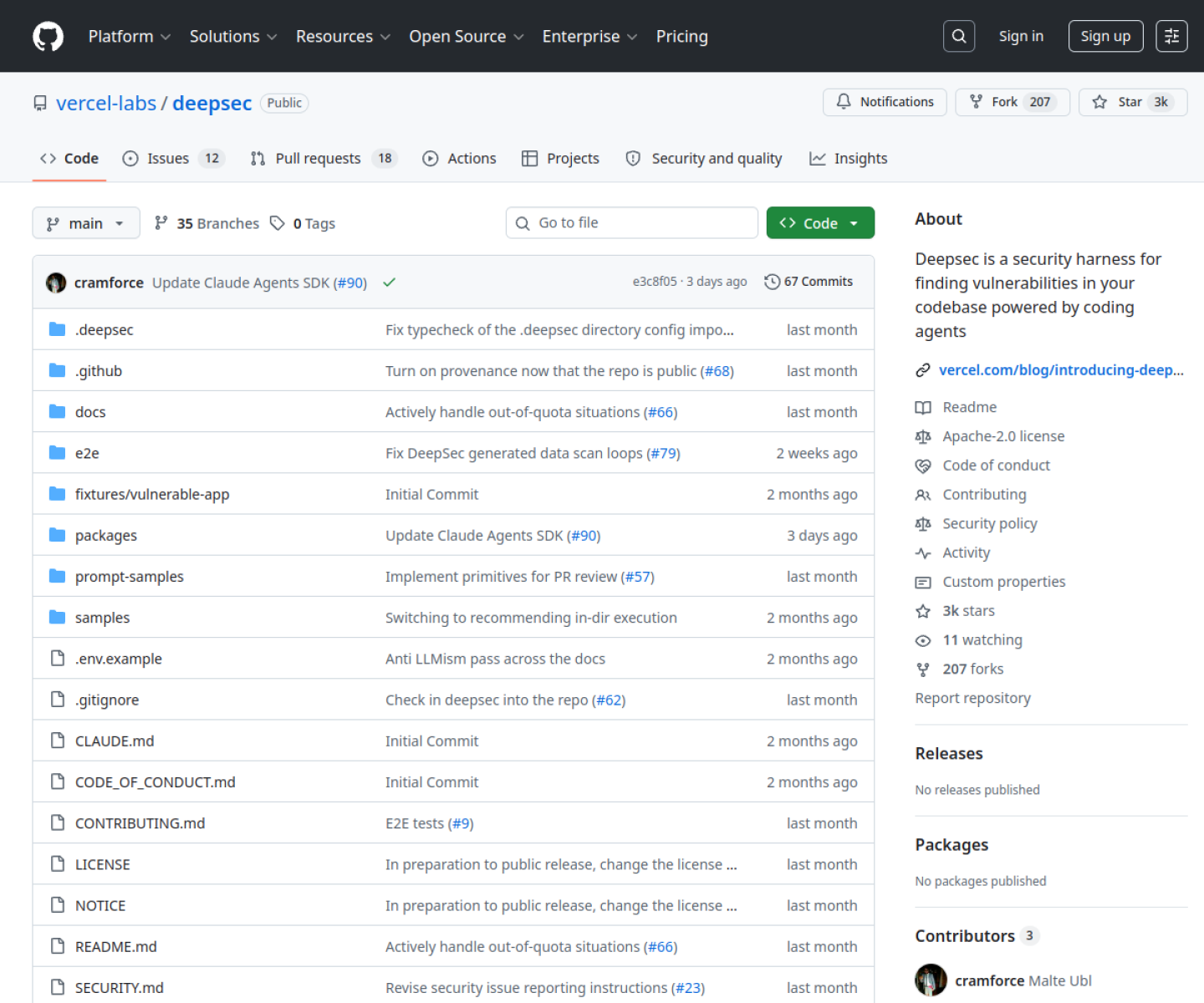
Security harness from Vercel Labs for using coding agents to find vulnerabilities in a codebase with more structure than ad hoc prompt-based review.
AI Project Details
deepsec review: Security harness from Vercel Labs for using coding agents to find vulnerabilities in a codebase with more structure than ad hoc prompt-based review.
deepsec is aimed at developers and security-minded engineering teams that want agent-assisted vulnerability discovery as part of code review or pre-release testing. The current product materials describe a workflow built around point deepsec at a repository, let the harness coordinate coding-agent analysis around security checks, then review findings before remediation. That matters because many new AI launches still sound broad until you try to map them to an actual job.
The reason this tool stands out is practical fit. The project frames security review as a harnessed workflow rather than as a loose prompt to a coding model. Because it comes from Vercel Labs, the repo is easier to inspect for intent and current activity than an anonymous experimental launch. It is newly notable because coding-agent security evaluation is becoming its own tooling category instead of a side effect of general code generation.
How the workflow works
The fastest way to judge deepsec is to walk the main loop on one real task. For this product, users should point deepsec at a repository, let the harness coordinate coding-agent analysis around security checks, then review findings before remediation. If that loop feels clearer, more controllable, or easier to repeat than the alternatives, the product is doing useful work.
Where deepsec stands out
| Evaluation angle | Fit | Why it matters | | --- | --- | --- | | Best-fit user | High | Developers and security-minded engineering teams that want agent-assisted vulnerability discovery as part of code review or pre-release testing. | | Core workflow clarity | High | Point deepsec at a repository, let the harness coordinate coding-agent analysis around security checks, then review findings before remediation. | | Switching cost reducer | Medium to high | The project frames security review as a harnessed workflow rather than as a loose prompt to a coding model. | | Adoption risk | Medium | Teams should treat findings as analyst output that still needs human validation, not as a drop-in replacement for a mature AppSec program. |
Practical use cases
- Running structured agent-assisted vulnerability checks on a repository
- Adding security-oriented coding-agent review before shipping code changes
- Experimenting with a repeatable harness for AI security analysis
Limits and buying notes
Teams should treat findings as analyst output that still needs human validation, not as a drop-in replacement for a mature AppSec program. The project is early and focused on agent-driven review, so coverage and false-positive rates need validation on a real codebase. Pricing status today: deepsec is open source on GitHub and the reviewed official materials do not show a separate commercial pricing plan.
FAQ
What is deepsec best for?
deepsec works best when running structured agent-assisted vulnerability checks on a repository matters more than using a generic assistant. The official materials point to a more concrete workflow than a blank AI shell.
Who should try deepsec first?
Developers and security-minded engineering teams that want agent-assisted vulnerability discovery as part of code review or pre-release testing. Teams with that exact workflow will learn faster than broad curiosity users.
What should users verify before adopting deepsec?
Teams should treat findings as analyst output that still needs human validation, not as a drop-in replacement for a mature AppSec program. The project is early and focused on agent-driven review, so coverage and false-positive rates need validation on a real codebase. Users should also check the current docs, pricing, and release status before rollout.
Reviewed sources
- https://github.com/vercel-labs/deepsec
- https://github.com/vercel-labs/deepsec/releases
FAQ
What is deepsec best for?
deepsec works best when running structured agent-assisted vulnerability checks on a repository matters more than using a generic assistant. The official materials point to a more concrete workflow than a blank AI shell.
Who should try deepsec first?
Developers and security-minded engineering teams that want agent-assisted vulnerability discovery as part of code review or pre-release testing. Teams with that exact workflow will learn faster than broad curiosity users.
What should users verify before adopting deepsec?
Teams should treat findings as analyst output that still needs human validation, not as a drop-in replacement for a mature AppSec program. The project is early and focused on agent-driven review, so coverage and false-positive rates need validation on a real codebase. Users should also check the current docs, pricing, and release status before rollout.