Data Analyst AI
AI-Driven Analytics: Unlocking eCommerce Success In today's competitive eCommerce landscape, leveraging AI-driven analytics is essential for achieving success. By harnessing the power of artificial intelligence, businesses can gain valuable insights into customer behavior, optimize their marketing strategies, and enhance overall performance. Understanding Customer Behavior AI-driven analytics allows eCommerce businesses to analyze vast amounts of data to understand customer preferences and purchasing patterns. This knowledge enables companies to tailor their offerings, improving customer satisfaction and loyalty. Optimizing Marketing Strategies With AI analytics, businesses can identify the most effective marketing channels and campaigns. By analyzing data in real-time, companies can adjust their strategies to maximize ROI and reach their target audience more effectively. Enhancing Performance AI-driven analytics not only helps in understanding customers but also in streamlining operations. By predicting trends and demand, businesses can manage inventory more efficiently, reducing costs and increasing profitability. Conclusion Incorporating AI-driven analytics into your eCommerce strategy is crucial for staying ahead in the market. By understanding customer behavior, optimizing marketing efforts, and enhancing overall performance, businesses can achieve sustainable success in the ever-evolving eCommerce environment.
AI Project Details
Data Analyst AI review: ecommerce analytics reports from Scandilytics AI
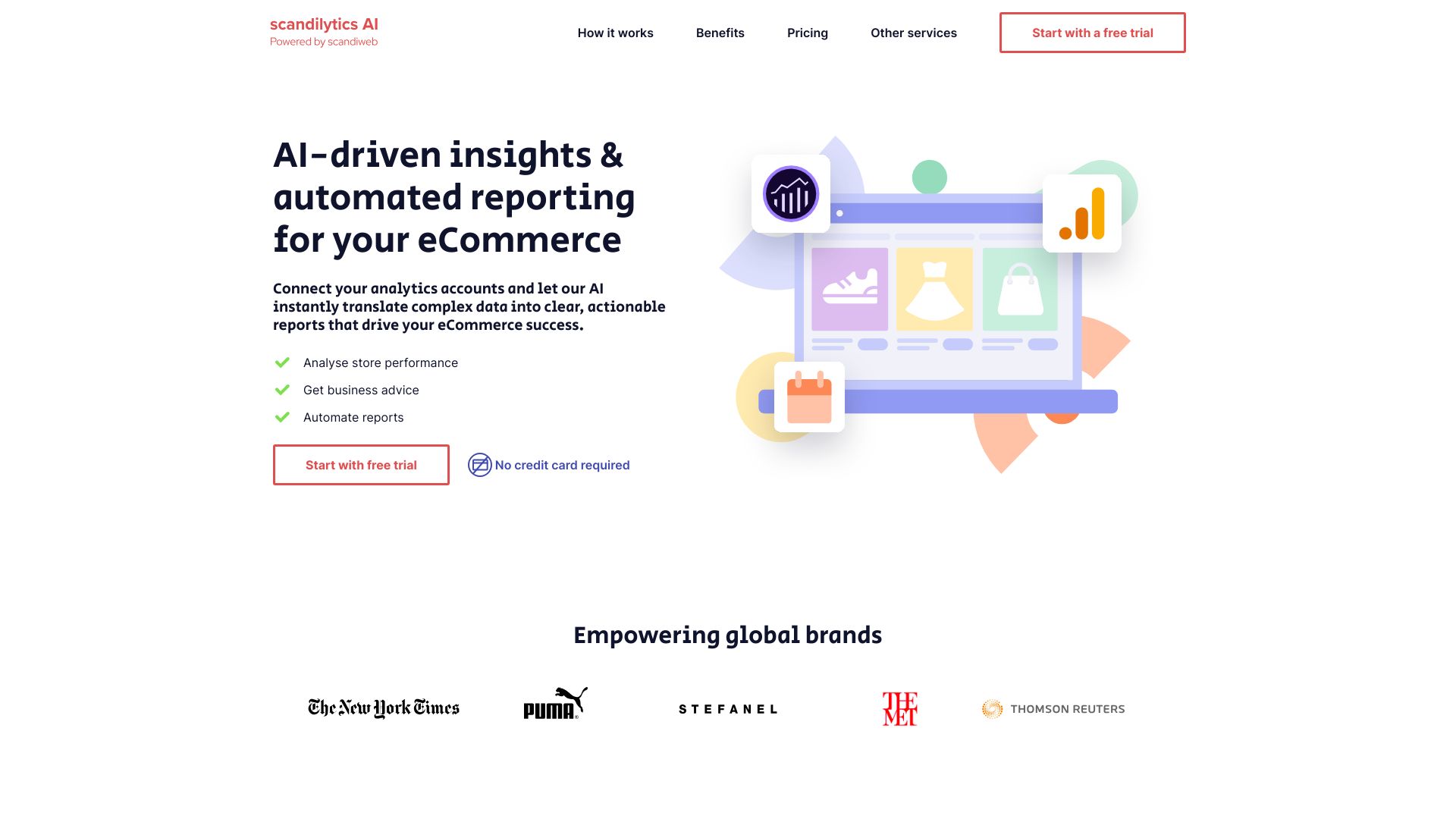
Data Analyst AI is part of the Scandilytics AI product suite from scandiweb. The official page positions it as AI-driven insights and automated reporting for ecommerce: connect analytics accounts, translate complex data into actionable reports, analyze store performance, identify anomalies, automate weekly or monthly reports, and support decisions across sales funnels, organic traffic, paid marketing, customer behavior, retention, product performance, and category performance.
This is not a general spreadsheet chatbot. Its strongest fit is ecommerce teams that already collect GA4, Adobe Analytics, or similar store data but do not consistently turn that data into decisions.
Best-fit use cases
| Use case | Data Analyst AI fit | Notes | |---|---:|---| | Ecommerce performance reporting | High | Strong fit for recurring store-performance summaries. | | Analytics anomaly detection | Medium to high | Useful for spotting weak points and patterns for review. | | Marketing and funnel analysis | Medium to high | Relevant for paid, organic, retention, and product performance questions. | | General BI replacement | Medium | BI tools may still be needed for custom dashboards. | | Bad tracking setups | Medium | The tool can flag issues, but implementation fixes may need humans. |
What ecommerce teams should verify
Teams should review which analytics platforms are supported, how data access is granted, where data is processed, report frequency, report customization, anomaly quality, KPI definitions, privacy posture, tracking accuracy, and whether the recommendations are specific enough to act on. The official FAQ notes that data quality issues may still require manual services or implementation work.
The most practical pilot is to connect one store, run a weekly report, compare insights with a human analyst, and check whether the recommendations lead to measurable fixes in traffic, conversion, retention, or product merchandising.
Strengths
- Focused on ecommerce analytics rather than generic dashboards.
- Covers reporting, trends, anomalies, marketing, funnels, customers, and product performance.
- Can save time for teams that lack regular analyst capacity.
Limitations
- Recommendations depend on clean tracking and reliable analytics data.
- Custom BI needs may require dashboards or human analyst work.
- Privacy, data access, and processing model should be reviewed before connecting accounts.
Bottom line
Data Analyst AI should be indexed as an ecommerce analytics and automated reporting assistant. It is most useful when teams have data but lack recurring analysis discipline; it is less useful when tracking is broken or the business needs fully custom BI.
Sources reviewed: Scandilytics AI homepage.
FAQ
What is Data Analyst AI best for?
Data Analyst AI is best for ecommerce teams that need automated analytics reports, KPI analysis, funnel insights, anomaly detection, and actionable recommendations from store data.
Does Data Analyst AI fix broken tracking?
Not by itself. It can help identify data problems or discrepancies, but tracking fixes may require analytics implementation work or manual support.
What should teams check before connecting ecommerce data?
Check supported analytics platforms, permissions, data processing, privacy, report customization, KPI definitions, anomaly quality, and whether recommendations are actionable.