CreateOS
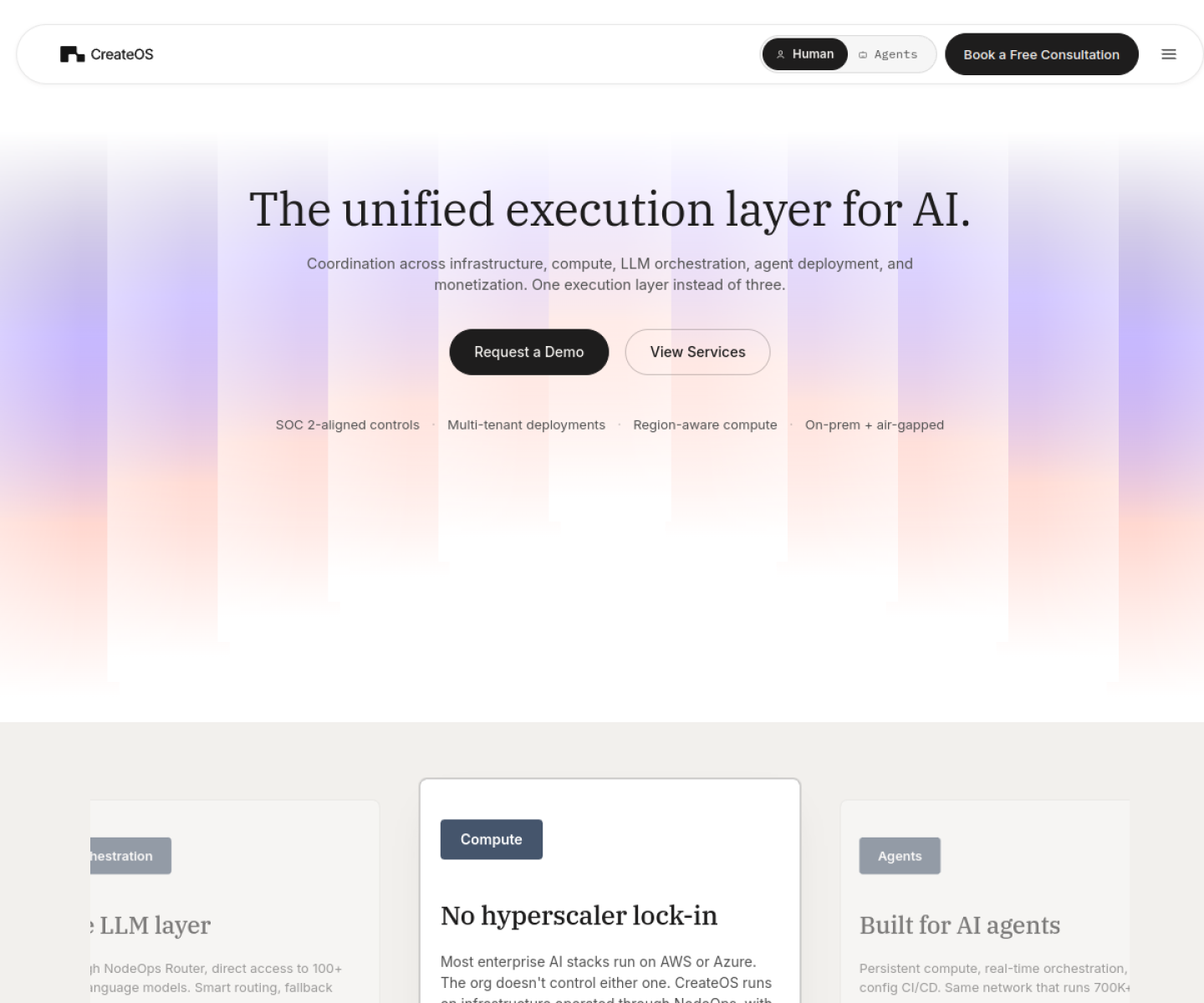
Unified execution layer for AI that combines infrastructure, persistent compute, LLM orchestration, agent deployment, and distribution surfaces such as templates and an app store.
AI Project Details
CreateOS review: Unified execution layer for AI that combines infrastructure, persistent compute, LLM orchestration, agent deployment, and distribution surfaces such as templates and an app store.
CreateOS is aimed at builders and operators who want to ship ai systems on one platform instead of stitching together separate clouds, model routers, deployment layers, and monetization tooling. The current product materials describe a workflow built around build or import the application, run it on createos-managed compute, attach model routing and persistent execution, then deploy and distribute the result through the same stack. That framing matters because many new AI launches still stop at a broad promise. CreateOS has a clearer job to do.
The stronger reason to care is operational fit. CreateOS is unusually ambitious in scope, but the public site does at least make the stack boundaries explicit: compute, orchestration, agents, and monetization. The platform's pitch is broader than a standard app host because it ties persistent agent execution to a go-to-market layer from day one. Recent pricing and capability materials make it easier to judge whether the all-in-one promise has real product structure behind it.
How the workflow works
A sensible first pass is simple: start from the product's core entry point, validate the main loop on a representative task, and only then judge whether the surrounding automation is real. For CreateOS, that means users should build or import the application, run it on createos-managed compute, attach model routing and persistent execution, then deploy and distribute the result through the same stack. If that loop feels shorter, clearer, or easier to control than the alternatives, the product is doing something useful.
Where CreateOS stands out
| Evaluation angle | Fit | Why it matters | | --- | --- | --- | | Best-fit user | High | Builders and operators who want to ship AI systems on one platform instead of stitching together separate clouds, model routers, deployment layers, and monetization tooling. | | Core workflow clarity | High | Build or import the application, run it on CreateOS-managed compute, attach model routing and persistent execution, then deploy and distribute the result through the same stack. | | Switching cost reducer | Medium to high | CreateOS is unusually ambitious in scope, but the public site does at least make the stack boundaries explicit: compute, orchestration, agents, and monetization. | | Adoption risk | Medium | An all-in-one platform can reduce setup work, but it also concentrates infrastructure dependency, so buyers should examine portability carefully. |
Practical use cases
- Deploying AI applications on a stack that bundles compute, routing, and distribution
- Running persistent agent workloads without assembling multiple infrastructure vendors
- Shipping reusable templates or apps with a built-in monetization surface
Limits and buying notes
An all-in-one platform can reduce setup work, but it also concentrates infrastructure dependency, so buyers should examine portability carefully. The promise is broad enough that teams should test a narrow real workload before assuming the full stack is mature. Pricing status today: CreateOS publishes plan and capability guidance in its pricing materials, but the reviewed public pages emphasize capability tiers more than a simple self-serve monthly table.
FAQ
What is CreateOS best for?
CreateOS is strongest when deploying ai applications on a stack that bundles compute, routing, and distribution matters more than a generic AI demo. The official product materials position it around a concrete workflow rather than a blank chatbot shell.
Who should try CreateOS first?
Builders and operators who want to ship AI systems on one platform instead of stitching together separate clouds, model routers, deployment layers, and monetization tooling. Teams with a real workflow match will get value faster than general curiosity users.
What should buyers verify before adopting CreateOS?
An all-in-one platform can reduce setup work, but it also concentrates infrastructure dependency, so buyers should examine portability carefully. The promise is broad enough that teams should test a narrow real workload before assuming the full stack is mature. Pricing, privacy, and workflow fit should be checked directly on the current product before rollout.
Reviewed sources
- https://createos.sh/
- https://createos.sh/about
- https://createos.sh/blogs/createos-pricing-capabilities-every-workflow
FAQ
What is CreateOS best for?
CreateOS is strongest when deploying ai applications on a stack that bundles compute, routing, and distribution matters more than a generic AI demo. The official product materials position it around a concrete workflow rather than a blank chatbot shell.
Who should try CreateOS first?
Builders and operators who want to ship AI systems on one platform instead of stitching together separate clouds, model routers, deployment layers, and monetization tooling. Teams with a real workflow match will get value faster than general curiosity users.
What should buyers verify before adopting CreateOS?
An all-in-one platform can reduce setup work, but it also concentrates infrastructure dependency, so buyers should examine portability carefully. The promise is broad enough that teams should test a narrow real workload before assuming the full stack is mature. Pricing, privacy, and workflow fit should be checked directly on the current product before rollout.