ComplyEdge
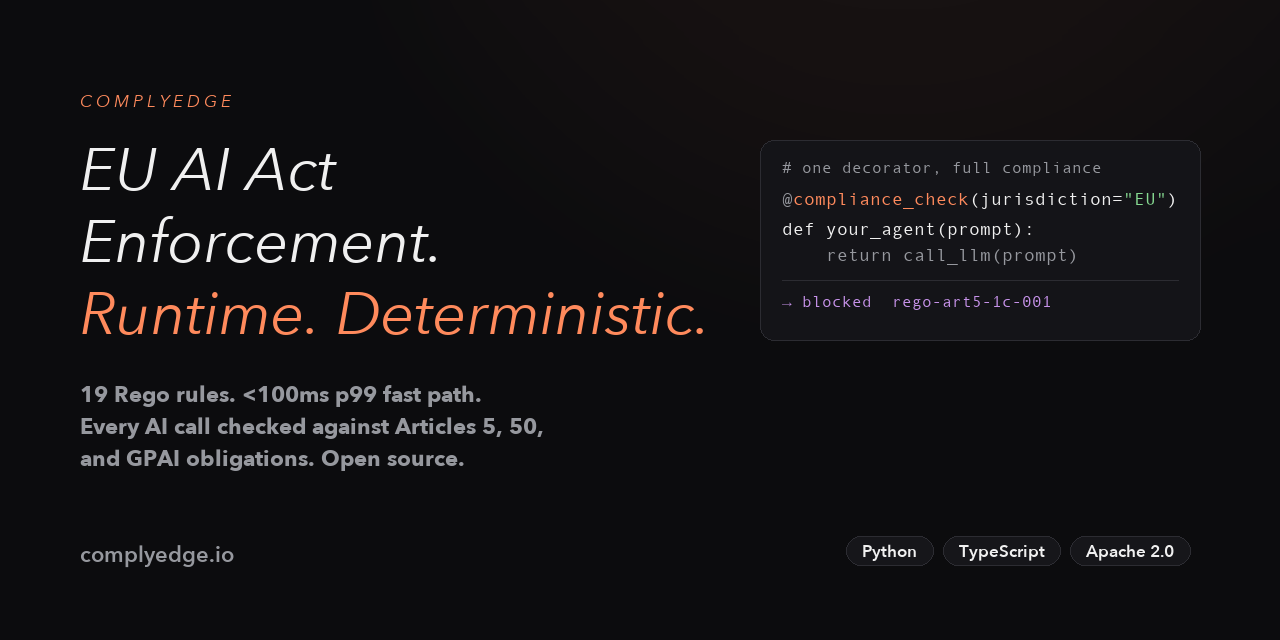
Runtime compliance enforcement layer for AI agents that checks every prompt or response against legal rule corpora and returns article citations, rule IDs, timestamps, and block decisions instead of a generic safety score.
AI Project Details
ComplyEdge review: Runtime compliance enforcement layer for AI agents that checks every prompt or response against legal rule corpora and returns article citations, rule IDs, timestamps, and block decisions instead of a generic safety score.
ComplyEdge stands out because it is not just another chat shell. The product materials describe a system centered on install the python sdk or offline linter, wrap the agent entry point with the compliance decorator or explicit checks, then let the rule engine block prohibited or non-compliant inputs and outputs before they reach users or downstream systems. That matters because the mechanism is the product, not a thin wrapper around a frontier model.
Why the architecture matters
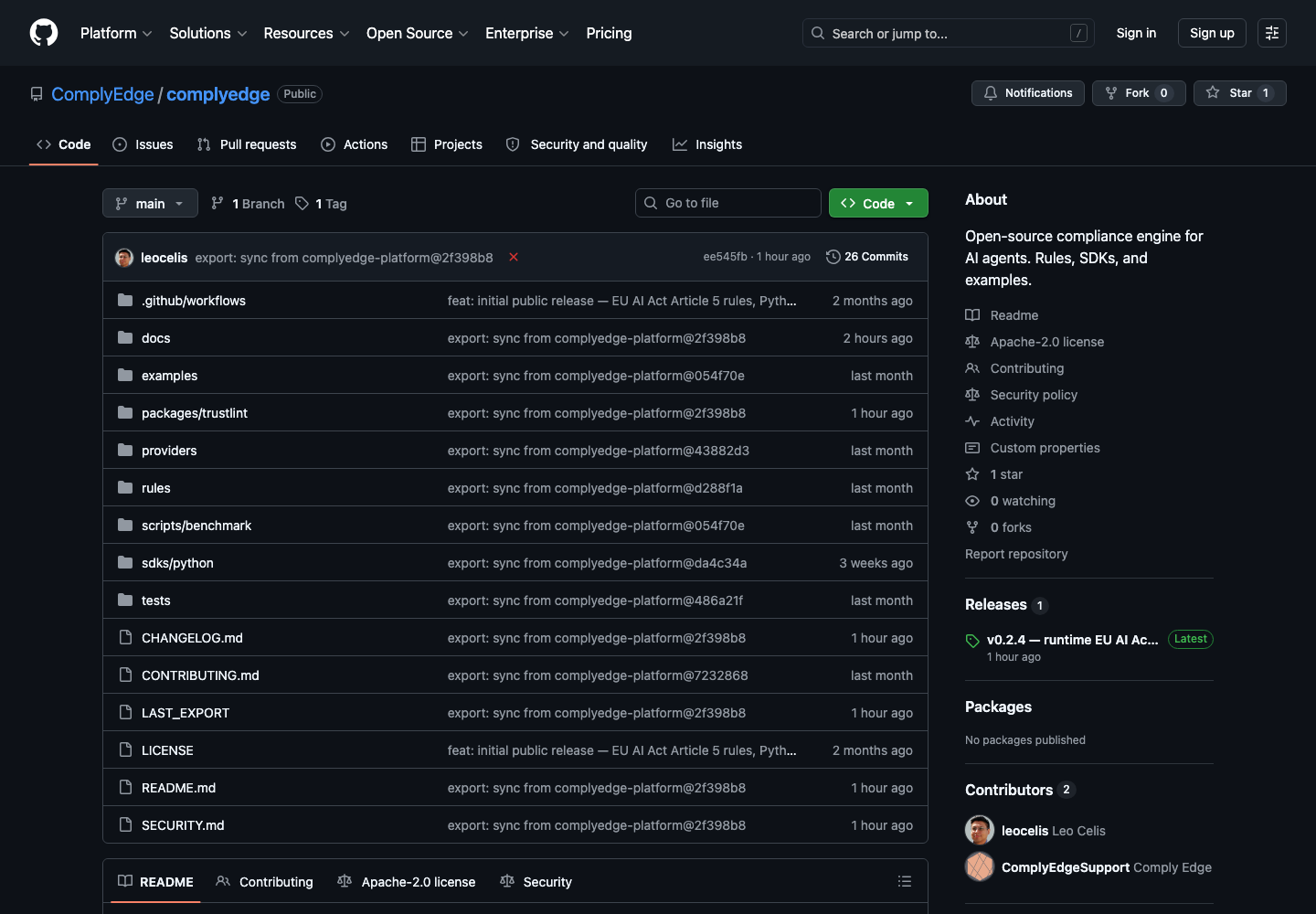
ComplyEdge is explicit that the product is runtime enforcement, not another compliance dashboard or retrospective scanner. The README is concrete about rule IDs, article citations, the offline TrustLint linter, and the distinction between deterministic hot-path checks and optional semantic fallback. The interesting part is the audit trail: blocked actions come back with legal references and timestamps instead of a probabilistic model judgment that is hard to defend later.
How to evaluate the core loop
Start by testing the narrowest real workflow the product claims to improve. For ComplyEdge, that means users should install the python sdk or offline linter, wrap the agent entry point with the compliance decorator or explicit checks, then let the rule engine block prohibited or non-compliant inputs and outputs before they reach users or downstream systems. The result should be easier to inspect, integrate, or control than a direct agent session.
Where it stands out
| Evaluation angle | Fit | Why it matters | | --- | --- | --- | | Best-fit user | High | Teams deploying AI agents in regulated contexts who want production-time legal controls rather than one-off audits or static documentation checks. | | Core workflow clarity | High | Install the Python SDK or offline linter, wrap the agent entry point with the compliance decorator or explicit checks, then let the rule engine block prohibited or non-compliant inputs and outputs before they reach users or downstream systems. | | Switching cost reducer | Medium to high | ComplyEdge is explicit that the product is runtime enforcement, not another compliance dashboard or retrospective scanner. | | Adoption risk | Medium | Teams still need legal review for policy coverage and interpretation, because a rule corpus can only enforce what has been encoded and tested. |
Practical use cases
- Blocking legally risky agent prompts or outputs at runtime
- Adding EU AI Act or sector-specific rules to production AI workflows
- Running offline compliance linting in CI before agent changes ship
Limits and buying notes
Teams still need legal review for policy coverage and interpretation, because a rule corpus can only enforce what has been encoded and tested. The strongest value is in regulated production paths, so lightweight side projects may find the operational overhead unnecessary. Pricing status today: The reviewed public sources describe an API-key-backed product and an open-source offline linter, but they did not expose a stable public pricing page for the runtime service.
FAQ
What is ComplyEdge best for?
ComplyEdge is strongest when blocking legally risky agent prompts or outputs at runtime matters more than a generic AI demo. The official product materials position it around a concrete workflow rather than a blank chatbot shell.
Who should try ComplyEdge first?
Teams deploying AI agents in regulated contexts who want production-time legal controls rather than one-off audits or static documentation checks. Teams with a real workflow match will get value faster than general curiosity users.
What should buyers verify before adopting ComplyEdge?
Teams still need legal review for policy coverage and interpretation, because a rule corpus can only enforce what has been encoded and tested. The strongest value is in regulated production paths, so lightweight side projects may find the operational overhead unnecessary. Pricing, privacy, and workflow fit should be checked directly on the current product before rollout.
Reviewed sources
- https://complyedge.io/
- https://github.com/ComplyEdge/complyedge
- https://news.ycombinator.com/item?id=48528667
FAQ
What is ComplyEdge best for?
ComplyEdge is strongest when blocking legally risky agent prompts or outputs at runtime matters more than a generic AI demo. The official product materials position it around a concrete workflow rather than a blank chatbot shell.
Who should try ComplyEdge first?
Teams deploying AI agents in regulated contexts who want production-time legal controls rather than one-off audits or static documentation checks. Teams with a real workflow match will get value faster than general curiosity users.
What should buyers verify before adopting ComplyEdge?
Teams still need legal review for policy coverage and interpretation, because a rule corpus can only enforce what has been encoded and tested. The strongest value is in regulated production paths, so lightweight side projects may find the operational overhead unnecessary. Pricing, privacy, and workflow fit should be checked directly on the current product before rollout.