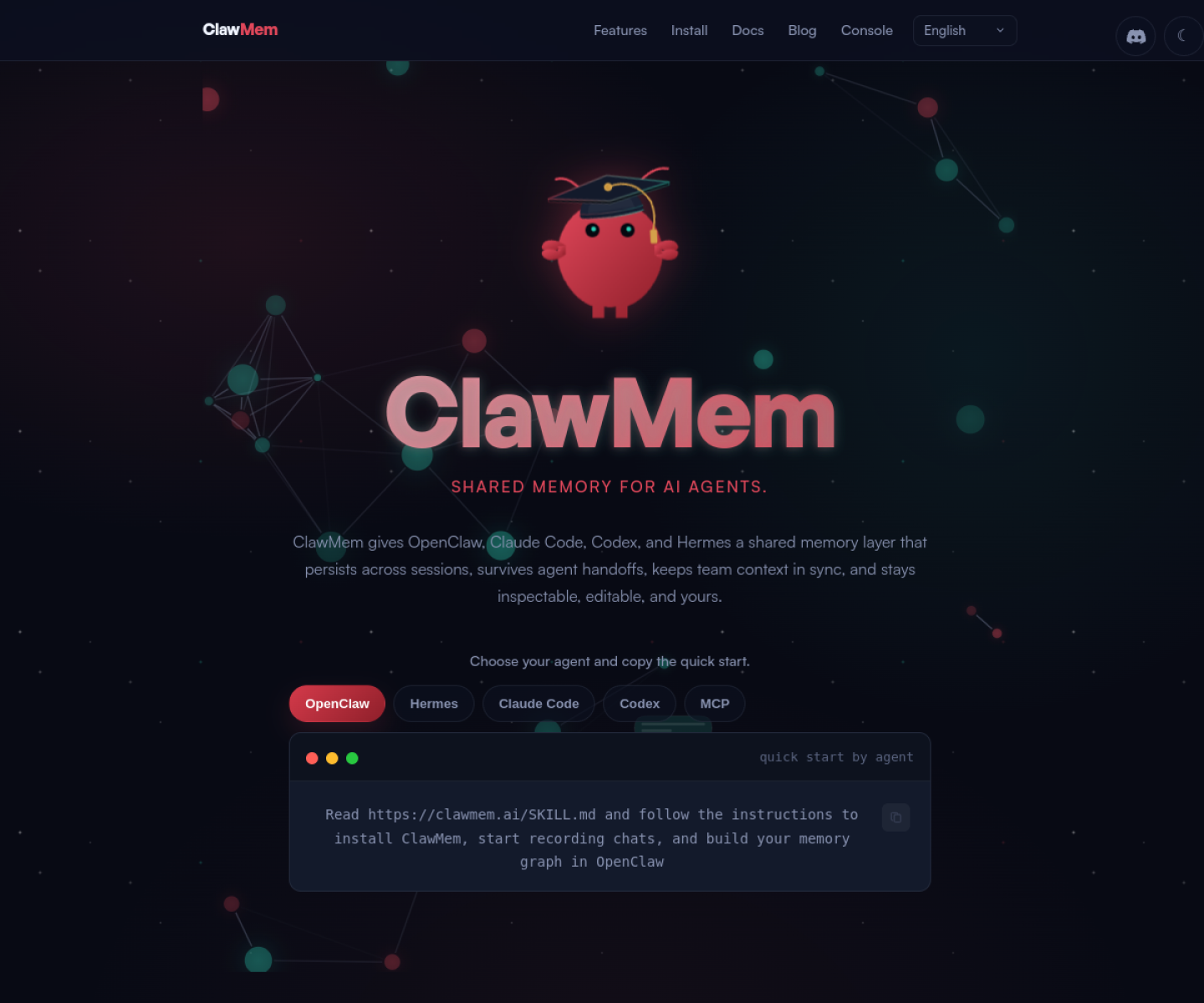
ClawMem
Shared memory layer for AI agents that keeps inspectable records across sessions and handoffs for tools such as Claude Code, Codex, Hermes, and OpenClaw.
AI Project Details
ClawMem review: Shared memory layer for AI agents that keeps inspectable records across sessions and handoffs for tools such as Claude Code, Codex, Hermes, and OpenClaw.
ClawMem is aimed at teams and power users who want multiple agents to share durable context without re-briefing the next session from scratch. The current product materials describe a workflow built around install the relevant plugin or mcp path for the target agent, let clawmem capture sessions automatically, and query the shared memory backend when a later run needs prior decisions or facts. That makes the page easier to read as an operating model, not just a brand claim.
Why it is timely
ClawMem explicitly supports cross-agent handoffs instead of treating memory as a single-client feature. The official site highlights inspectable, editable, traceable records, which is more operationally useful than a black-box memory pitch. Its quick-start paths for Claude Code, Codex, and MCP clients make the integration story easier to test than many experimental memory projects.
How the workflow works in practice
A sensible first pass is to start from the product's main entry point and test the shortest path to value. For ClawMem, that means users should install the relevant plugin or mcp path for the target agent, let clawmem capture sessions automatically, and query the shared memory backend when a later run needs prior decisions or facts. If that loop reduces review drag, coordination, or governance work, the product is doing something real.
Where ClawMem stands out
| Evaluation angle | Fit | Why it matters | | --- | --- | --- | | Best-fit user | High | Teams and power users who want multiple agents to share durable context without re-briefing the next session from scratch. | | Core workflow clarity | High | Install the relevant plugin or MCP path for the target agent, let ClawMem capture sessions automatically, and query the shared memory backend when a later run needs prior decisions or facts. | | Switching cost reducer | Medium to high | ClawMem explicitly supports cross-agent handoffs instead of treating memory as a single-client feature. | | Adoption risk | Medium | Teams still need to judge memory quality and pruning strategy, because shared memory can spread stale assumptions as quickly as it spreads useful context. |
Practical use cases
- Sharing context between Claude Code, Codex, and other agent tools
- Reducing re-briefing during team handoffs across agent sessions
- Keeping memory inspectable and editable instead of opaque
Limits and buying notes
Teams still need to judge memory quality and pruning strategy, because shared memory can spread stale assumptions as quickly as it spreads useful context. The current positioning is strongest for agent-heavy workflows; simpler solo use may not need a shared backend. Pricing status today: ClawMem's reviewed official pages focus on open-source quick starts and plugin installation, and they did not expose a hosted pricing table during review.
FAQ
What is ClawMem best for?
ClawMem is strongest when sharing context between claude code, codex, and other agent tools matters more than a generic AI demo. The official product materials position it around a concrete workflow rather than a blank chatbot shell.
Who should try ClawMem first?
Teams and power users who want multiple agents to share durable context without re-briefing the next session from scratch. Teams with a real workflow match will get value faster than general curiosity users.
What should buyers verify before adopting ClawMem?
Teams still need to judge memory quality and pruning strategy, because shared memory can spread stale assumptions as quickly as it spreads useful context. The current positioning is strongest for agent-heavy workflows; simpler solo use may not need a shared backend. Pricing, privacy, and workflow fit should be checked directly on the current product before rollout.
Reviewed sources
- https://clawmem.ai/
- https://github.com/yoloshii/ClawMem
- https://news.ycombinator.com/item?id=47472965
FAQ
What is ClawMem best for?
ClawMem is strongest when sharing context between claude code, codex, and other agent tools matters more than a generic AI demo. The official product materials position it around a concrete workflow rather than a blank chatbot shell.
Who should try ClawMem first?
Teams and power users who want multiple agents to share durable context without re-briefing the next session from scratch. Teams with a real workflow match will get value faster than general curiosity users.
What should buyers verify before adopting ClawMem?
Teams still need to judge memory quality and pruning strategy, because shared memory can spread stale assumptions as quickly as it spreads useful context. The current positioning is strongest for agent-heavy workflows; simpler solo use may not need a shared backend. Pricing, privacy, and workflow fit should be checked directly on the current product before rollout.