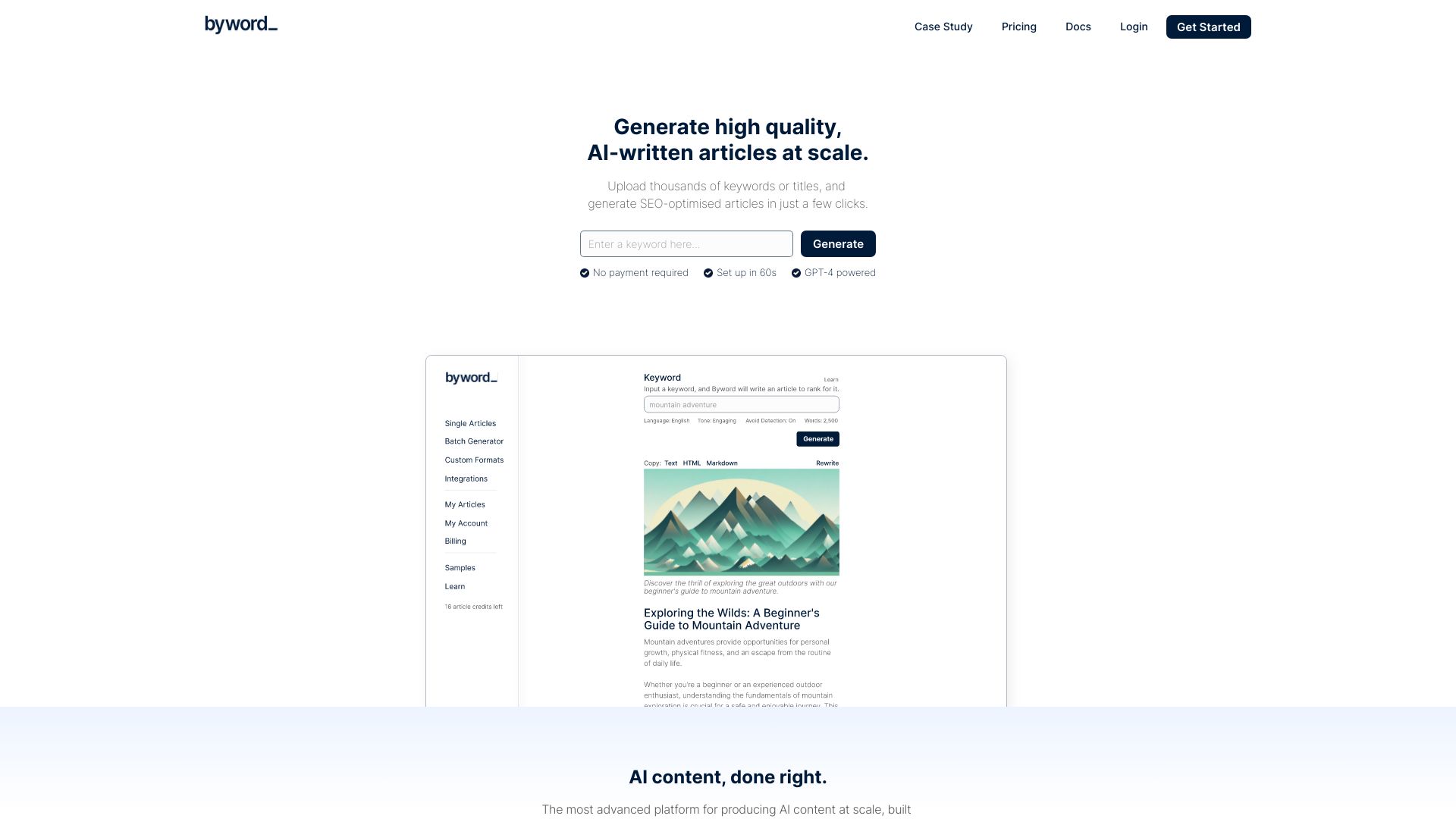
Byword AI
Byword: Harnessing Advanced AI for High-Quality Article Creation In today's fast-paced digital landscape, creating engaging and informative content is essential for success. Byword leverages cutting-edge AI technology to produce high-quality articles swiftly and at an affordable price. Why Choose Byword? 1. **Speed and Efficiency**: Our advanced AI algorithms enable rapid content generation, ensuring you meet tight deadlines without compromising quality. 2. **Cost-Effective Solutions**: Byword offers competitive pricing, making it accessible for businesses of all sizes to enhance their content marketing strategies. 3. **Top-Notch Quality**: Each article is crafted to meet high standards, ensuring that your audience receives valuable and relevant information. 4. **User-Friendly Experience**: Our platform is designed for ease of use, allowing you to focus on your core business while we handle your content needs. With Byword, you can elevate your content strategy, engage your audience, and drive traffic to your website. Experience the future of content creation today!
AI Project Details
Byword AI review: programmatic SEO content generation with real quality risk
Byword AI is an AI writing platform focused on generating SEO articles at scale. Its public positioning emphasizes article generation, keyword-driven workflows, internal linking, images, CMS publishing, and programmatic content operations. That makes Byword different from a casual writing assistant: it is built for teams that want repeatable content production, not just one draft at a time.
This category needs extra scrutiny. Programmatic SEO can be useful when it creates genuinely helpful pages from reliable inputs. It can also create thin, repetitive content that search engines ignore. Byword should therefore be evaluated as a production system with editorial controls, not as a shortcut around content quality.
Best-fit use cases
| Use case | Byword fit | Notes | |---|---:|---| | Programmatic SEO workflows | Medium to high | Works when source data, templates, and editorial review are strong. | | Blog draft generation | Medium | Useful for first drafts, but human expertise should reshape them. | | Content refresh operations | Medium | Can help scale updates when facts and structure are verified. | | YMYL or regulated advice | Low | Avoid auto-publishing without expert review. | | Thin affiliate pages | Low | High risk for indexing and quality problems. |
What to evaluate before adopting Byword
The deciding factor is not how many articles Byword can generate. The deciding factor is whether the final pages have unique value. Teams should test factual accuracy, source handling, search intent matching, repetition across templates, internal-link quality, entity coverage, metadata quality, CMS integration, and whether editors can improve drafts efficiently.
For TakeAI's own indexing recovery, Byword is also a useful cautionary example: AI-assisted content can be part of the workflow, but pages still need original judgment, transparent evaluation, and topic-specific usefulness.
Strengths
- Built for scaled SEO workflows rather than isolated writing tasks.
- Can support keyword clusters, article drafts, images, and publishing operations.
- Useful when editorial teams already have strong briefs, source material, and QA gates.
Limitations
- Auto-published generic articles can harm site quality.
- Factual review, differentiation, and expert edits remain necessary.
- Programmatic pages need a real data advantage or editorial angle to deserve indexing.
Bottom line
Byword AI is worth indexing only with a careful review angle. It is useful for teams that understand SEO operations and have strong quality gates. It is risky for teams that treat article volume as the goal. A good pilot should generate a small cluster, audit every page, measure indexation and engagement, then decide whether scale is justified.
Sources reviewed: Byword homepage, Byword pricing, Byword blog.
FAQ
What is Byword AI best for?
Byword AI is best for SEO article drafts, programmatic content workflows, keyword-driven production, and teams that already have editorial quality controls.
Is Byword safe for Google indexing?
It depends on how it is used. Helpful, verified, original pages can be indexable, but generic auto-published content can create quality problems.
What should teams test before scaling Byword?
Test factual accuracy, repetition, source quality, internal links, metadata, CMS workflow, editor time saved, indexation, and organic engagement.