Agent Gate
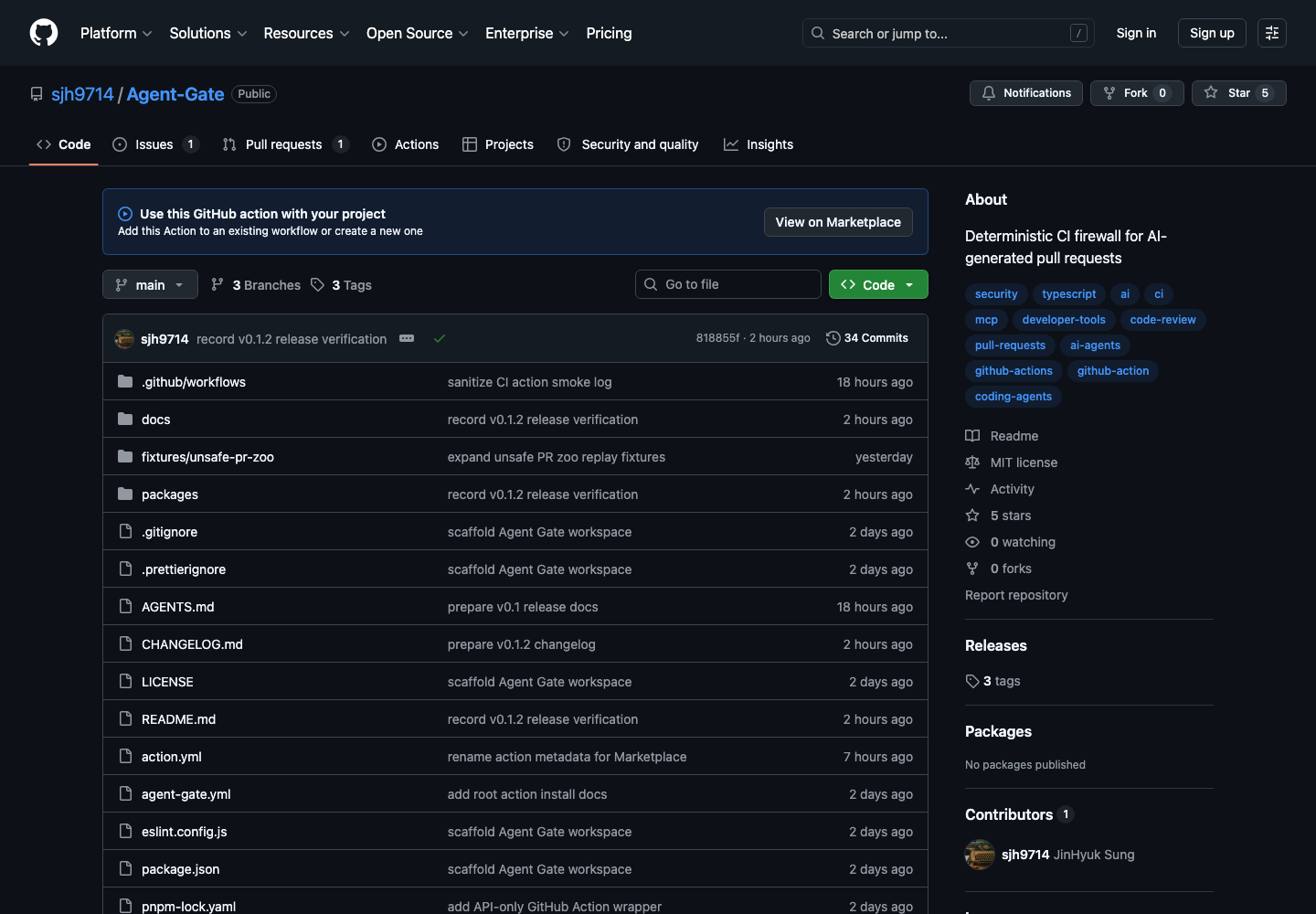
Deterministic CI firewall for AI-generated pull requests that blocks risky workflow changes, out-of-scope edits, MCP config drift, and missing test evidence without relying on runtime LLM calls.
AI Project Details
Agent Gate review: Deterministic CI firewall for AI-generated pull requests that blocks risky workflow changes, out-of-scope edits, MCP config drift, and missing test evidence without relying on runtime LLM calls.
Agent Gate is aimed at engineering teams that already let agents open pull requests and want a machine-checkable policy layer before those changes merge. The current product materials describe a workflow built around add the github action in warn mode, define the contract and high-risk paths in agent-gate.yml, let the analyzer inspect pr metadata and changed files through github apis, then tighten enforcement once the repo-specific signals are tuned. That makes the page easier to read as an operating model, not just a brand claim.
Why it is timely
Agent Gate is explicit that no AI PR should merge without proof, and it backs that claim with deterministic checks rather than another model-in-the-loop review. The README is concrete about checkout-free analysis, replay fixtures, PR contract blocks, MCP config drift detection, and policy loading from the base branch instead of the untrusted PR head. Its strongest angle is operational trust: the tool protects the control plane around agent-made changes rather than trying to judge semantic code quality with another black box.
How the workflow works in practice
A sensible first pass is to start from the product's main entry point and test the shortest path to value. For Agent Gate, that means users should add the github action in warn mode, define the contract and high-risk paths in agent-gate.yml, let the analyzer inspect pr metadata and changed files through github apis, then tighten enforcement once the repo-specific signals are tuned. If that loop reduces review drag, coordination, or governance work, the product is doing something real.
Where Agent Gate stands out
| Evaluation angle | Fit | Why it matters | | --- | --- | --- | | Best-fit user | High | Engineering teams that already let agents open pull requests and want a machine-checkable policy layer before those changes merge. | | Core workflow clarity | High | Add the GitHub Action in warn mode, define the contract and high-risk paths in agent-gate.yml, let the analyzer inspect PR metadata and changed files through GitHub APIs, then tighten enforcement once the repo-specific signals are tuned. | | Switching cost reducer | Medium to high | Agent Gate is explicit that no AI PR should merge without proof, and it backs that claim with deterministic checks rather than another model-in-the-loop review. | | Adoption risk | Medium | The product is narrow by design, so teams still need normal code review and testing for semantic or architectural correctness. |
Practical use cases
- Blocking risky AI-generated pull requests before merge
- Detecting workflow or MCP configuration drift in agent PRs
- Adding deterministic merge gates around agent contracts and test evidence
Limits and buying notes
The product is narrow by design, so teams still need normal code review and testing for semantic or architectural correctness. Because it starts from repo policy, the signal quality depends on teams writing good contracts and tuning the risk paths instead of expecting zero-configuration governance. Pricing status today: Agent Gate is an MIT-licensed open-source project in pre-release, and the reviewed public sources did not show a hosted commercial pricing page.
FAQ
What is Agent Gate best for?
Agent Gate is strongest when blocking risky ai-generated pull requests before merge matters more than a generic AI demo. The official product materials position it around a concrete workflow rather than a blank chatbot shell.
Who should try Agent Gate first?
Engineering teams that already let agents open pull requests and want a machine-checkable policy layer before those changes merge. Teams with a real workflow match will get value faster than general curiosity users.
What should buyers verify before adopting Agent Gate?
The product is narrow by design, so teams still need normal code review and testing for semantic or architectural correctness. Because it starts from repo policy, the signal quality depends on teams writing good contracts and tuning the risk paths instead of expecting zero-configuration governance. Pricing, privacy, and workflow fit should be checked directly on the current product before rollout.
Reviewed sources
- https://github.com/sjh9714/Agent-Gate
- https://raw.githubusercontent.com/sjh9714/Agent-Gate/main/README.md
- https://news.ycombinator.com/item?id=48524230
FAQ
What is Agent Gate best for?
Agent Gate is strongest when blocking risky ai-generated pull requests before merge matters more than a generic AI demo. The official product materials position it around a concrete workflow rather than a blank chatbot shell.
Who should try Agent Gate first?
Engineering teams that already let agents open pull requests and want a machine-checkable policy layer before those changes merge. Teams with a real workflow match will get value faster than general curiosity users.
What should buyers verify before adopting Agent Gate?
The product is narrow by design, so teams still need normal code review and testing for semantic or architectural correctness. Because it starts from repo policy, the signal quality depends on teams writing good contracts and tuning the risk paths instead of expecting zero-configuration governance. Pricing, privacy, and workflow fit should be checked directly on the current product before rollout.