Afterburner
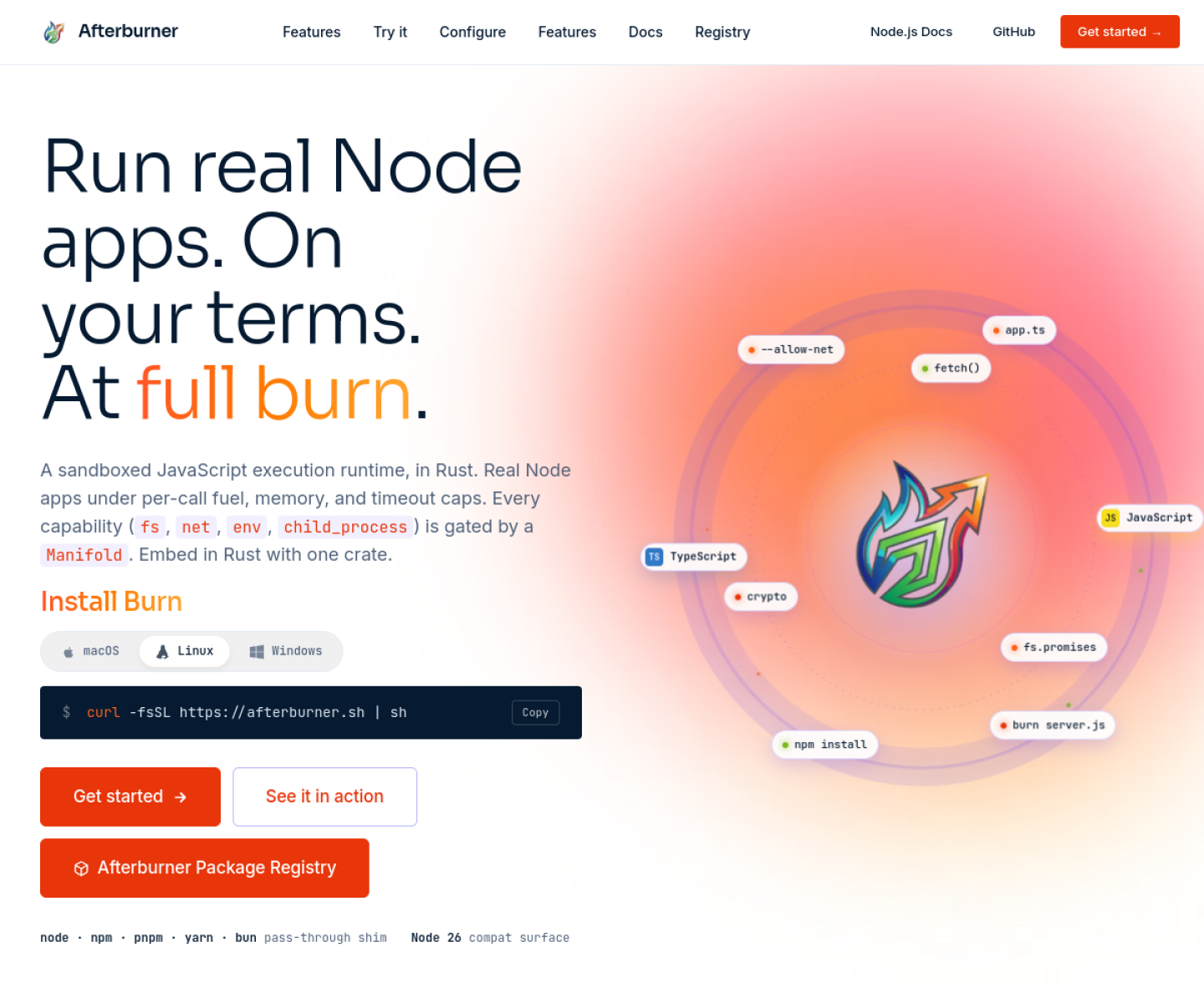
Capability-sandboxed JavaScript and TypeScript runtime for running untrusted scripts, plugins, and agent logic with explicit limits on network, filesystem, environment access, CPU, memory, and time.
AI Project Details
Afterburner review: Capability-sandboxed JavaScript and TypeScript runtime for running untrusted scripts, plugins, and agent logic with explicit limits on network, filesystem, environment access, CPU, memory, and time.
Afterburner stands out because it is not just another chat shell. The product materials describe a system centered on install the burn cli, run or embed the runtime, declare only the capabilities a script needs, then execute existing node, npm, bun, deno, or tsx workflows inside the sandbox instead of granting ambient machine access. That matters because the mechanism is the product, not a thin wrapper around a frontier model.
Why the architecture matters
Afterburner treats capability control as the main product, not a side feature on another JS runtime. Its public launch materials are concrete about default-deny execution, package manifests, digest pinning, and wrapping existing JS toolchains without requiring app rewrites. The project is interesting for agent workloads because it narrows the trust boundary around arbitrary script execution instead of assuming code should run with full host authority.
How to evaluate the core loop
Start by testing the narrowest real workflow the product claims to improve. For Afterburner, that means users should install the burn cli, run or embed the runtime, declare only the capabilities a script needs, then execute existing node, npm, bun, deno, or tsx workflows inside the sandbox instead of granting ambient machine access. The result should be easier to inspect, integrate, or control than a direct agent session.
Where it stands out
| Evaluation angle | Fit | Why it matters | | --- | --- | --- | | Best-fit user | High | Developers and platform teams that want agents or user-supplied code to run with tighter runtime guarantees than a normal Node or Bun process gives them. | | Core workflow clarity | High | Install the burn CLI, run or embed the runtime, declare only the capabilities a script needs, then execute existing Node, npm, bun, deno, or TSX workflows inside the sandbox instead of granting ambient machine access. | | Switching cost reducer | Medium to high | Afterburner treats capability control as the main product, not a side feature on another JS runtime. | | Adoption risk | Medium | Teams still need to model the right capability grants carefully, because a sandbox only helps when the policy matches the workload. |
Practical use cases
- Running agent-authored scripts with explicit capability limits
- Embedding a safer JS or TS execution layer into Rust applications
- Wrapping existing Node or Bun workflows in a sandbox without rewriting the app
Limits and buying notes
Teams still need to model the right capability grants carefully, because a sandbox only helps when the policy matches the workload. The licensing model is not plain permissive open source today, so buyers should verify whether the BSL terms fit their planned commercial use. Pricing status today: Afterburner is source-available under BSL 1.1 with automatic Apache 2.0 conversion after four years, and the reviewed public sources did not show a hosted SaaS pricing page.
FAQ
What is Afterburner best for?
Afterburner is strongest when running agent-authored scripts with explicit capability limits matters more than a generic AI demo. The official product materials position it around a concrete workflow rather than a blank chatbot shell.
Who should try Afterburner first?
Developers and platform teams that want agents or user-supplied code to run with tighter runtime guarantees than a normal Node or Bun process gives them. Teams with a real workflow match will get value faster than general curiosity users.
What should buyers verify before adopting Afterburner?
Teams still need to model the right capability grants carefully, because a sandbox only helps when the policy matches the workload. The licensing model is not plain permissive open source today, so buyers should verify whether the BSL terms fit their planned commercial use. Pricing, privacy, and workflow fit should be checked directly on the current product before rollout.
Reviewed sources
- https://afterburner.sh/
- https://github.com/afterburner-sh/afterburner
- https://news.ycombinator.com/item?id=48526827
FAQ
What is Afterburner best for?
Afterburner is strongest when running agent-authored scripts with explicit capability limits matters more than a generic AI demo. The official product materials position it around a concrete workflow rather than a blank chatbot shell.
Who should try Afterburner first?
Developers and platform teams that want agents or user-supplied code to run with tighter runtime guarantees than a normal Node or Bun process gives them. Teams with a real workflow match will get value faster than general curiosity users.
What should buyers verify before adopting Afterburner?
Teams still need to model the right capability grants carefully, because a sandbox only helps when the policy matches the workload. The licensing model is not plain permissive open source today, so buyers should verify whether the BSL terms fit their planned commercial use. Pricing, privacy, and workflow fit should be checked directly on the current product before rollout.