whoburnedmore
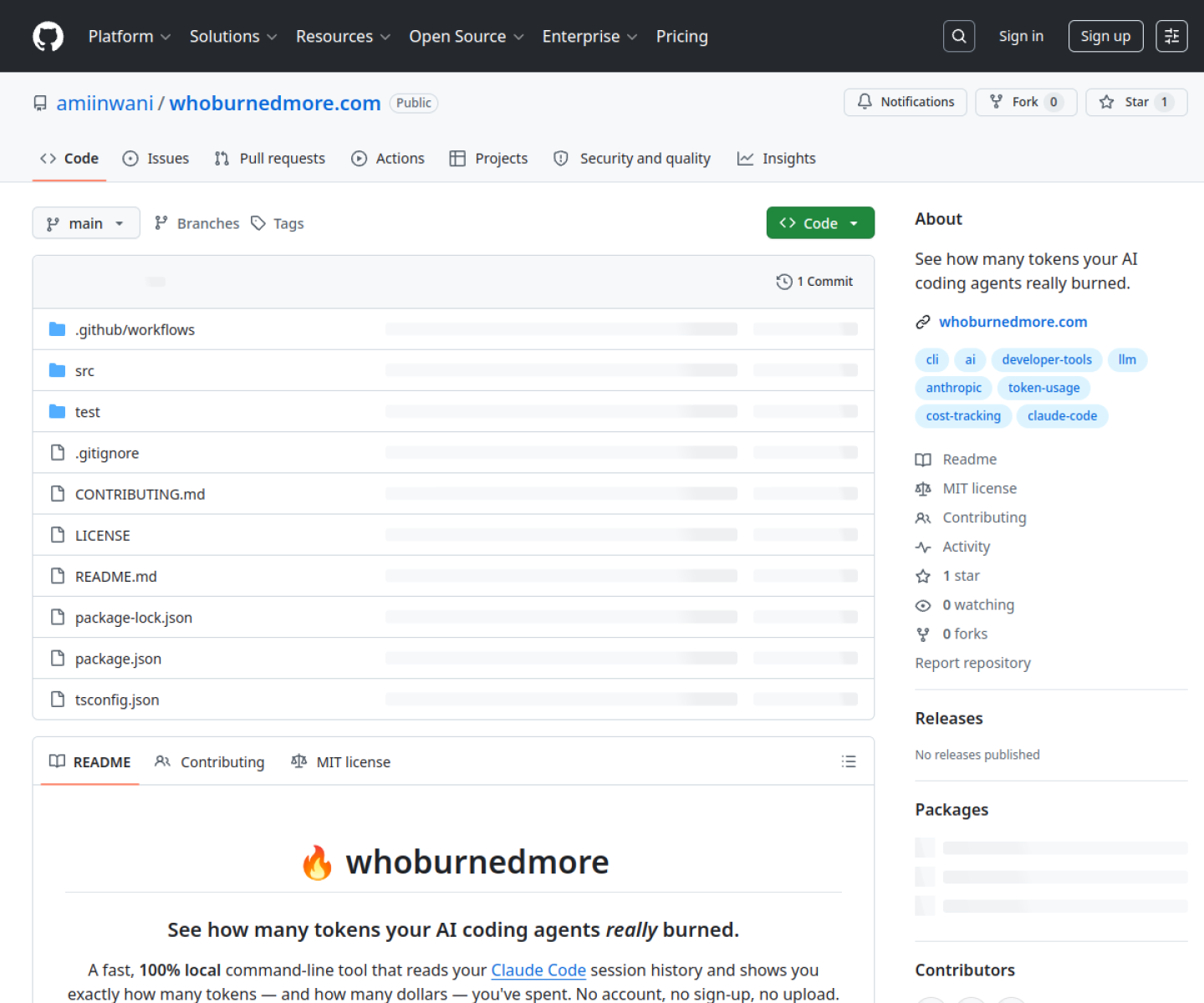
Local CLI that reads Claude Code transcripts and shows token usage, project breakdowns, cache hit rates, and estimated spend without sending data off the machine.
AI Project Details
whoburnedmore review: Local CLI that reads Claude Code transcripts and shows token usage, project breakdowns, cache hit rates, and estimated spend without sending data off the machine.
whoburnedmore is aimed at developers who want a clearer view of how much their ai coding workflows actually cost before the usage gets out of hand. The current product materials describe a workflow built around run the cli locally, point it at your transcript directory if needed, then inspect model, project, and time-range breakdowns or export an offline html dashboard. That makes the page easier to read as an operating model, not just a brand claim.
Why it is timely
whoburnedmore is unusually direct about reading local transcript files rather than depending on provider dashboards or hidden telemetry. The README exposes the exact data model, supported output formats, and pricing-table logic, which makes the tool easy to audit. Its cache-hit reporting is more useful than a simple token counter because prompt caching often changes the real cost picture.
How the workflow works in practice
A sensible first pass is to start from the product's main entry point and test the shortest path to value. For whoburnedmore, that means users should run the cli locally, point it at your transcript directory if needed, then inspect model, project, and time-range breakdowns or export an offline html dashboard. If that loop reduces review drag, coordination, or governance work, the product is doing something real.
Where whoburnedmore stands out
| Evaluation angle | Fit | Why it matters | | --- | --- | --- | | Best-fit user | High | Developers who want a clearer view of how much their AI coding workflows actually cost before the usage gets out of hand. | | Core workflow clarity | High | Run the CLI locally, point it at your transcript directory if needed, then inspect model, project, and time-range breakdowns or export an offline HTML dashboard. | | Switching cost reducer | Medium to high | whoburnedmore is unusually direct about reading local transcript files rather than depending on provider dashboards or hidden telemetry. | | Adoption risk | Medium | The current README is centered on Claude Code transcript parsing, so teams with broader tool coverage needs may need to extend it. |
Practical use cases
- Auditing Claude Code token burn before it becomes a budget problem
- Exporting an offline dashboard for local or team review
- Comparing which projects and models are really consuming the most AI spend
Limits and buying notes
The current README is centered on Claude Code transcript parsing, so teams with broader tool coverage needs may need to extend it. Cost estimates still depend on pricing tables and local logs, which means they are operationally helpful rather than billing-system truth. Pricing status today: whoburnedmore is published as an MIT-licensed open-source CLI, and the reviewed sources did not show a paid SaaS tier for the local usage-report tool.
FAQ
What is whoburnedmore best for?
whoburnedmore is strongest when auditing claude code token burn before it becomes a budget problem matters more than a generic AI demo. The official product materials position it around a concrete workflow rather than a blank chatbot shell.
Who should try whoburnedmore first?
Developers who want a clearer view of how much their AI coding workflows actually cost before the usage gets out of hand. Teams with a real workflow match will get value faster than general curiosity users.
What should buyers verify before adopting whoburnedmore?
The current README is centered on Claude Code transcript parsing, so teams with broader tool coverage needs may need to extend it. Cost estimates still depend on pricing tables and local logs, which means they are operationally helpful rather than billing-system truth. Pricing, privacy, and workflow fit should be checked directly on the current product before rollout.
Reviewed sources
- https://github.com/amiinwani/whoburnedmore.com
- https://raw.githubusercontent.com/amiinwani/whoburnedmore.com/main/README.md
- https://news.ycombinator.com/item?id=48549250
FAQ
What is whoburnedmore best for?
whoburnedmore is strongest when auditing claude code token burn before it becomes a budget problem matters more than a generic AI demo. The official product materials position it around a concrete workflow rather than a blank chatbot shell.
Who should try whoburnedmore first?
Developers who want a clearer view of how much their AI coding workflows actually cost before the usage gets out of hand. Teams with a real workflow match will get value faster than general curiosity users.
What should buyers verify before adopting whoburnedmore?
The current README is centered on Claude Code transcript parsing, so teams with broader tool coverage needs may need to extend it. Cost estimates still depend on pricing tables and local logs, which means they are operationally helpful rather than billing-system truth. Pricing, privacy, and workflow fit should be checked directly on the current product before rollout.