Velyr
AI growth agent that scans a website and analytics each week, then proposes one conversion fix as a GitHub pull request that a human approves before merge and that can auto-rollback if performance worsens.
AI Project Details
Velyr review: AI growth agent that scans a website and analytics each week, then proposes one conversion fix as a GitHub pull request that a human approves before merge and that can auto-rollback if performance worsens.
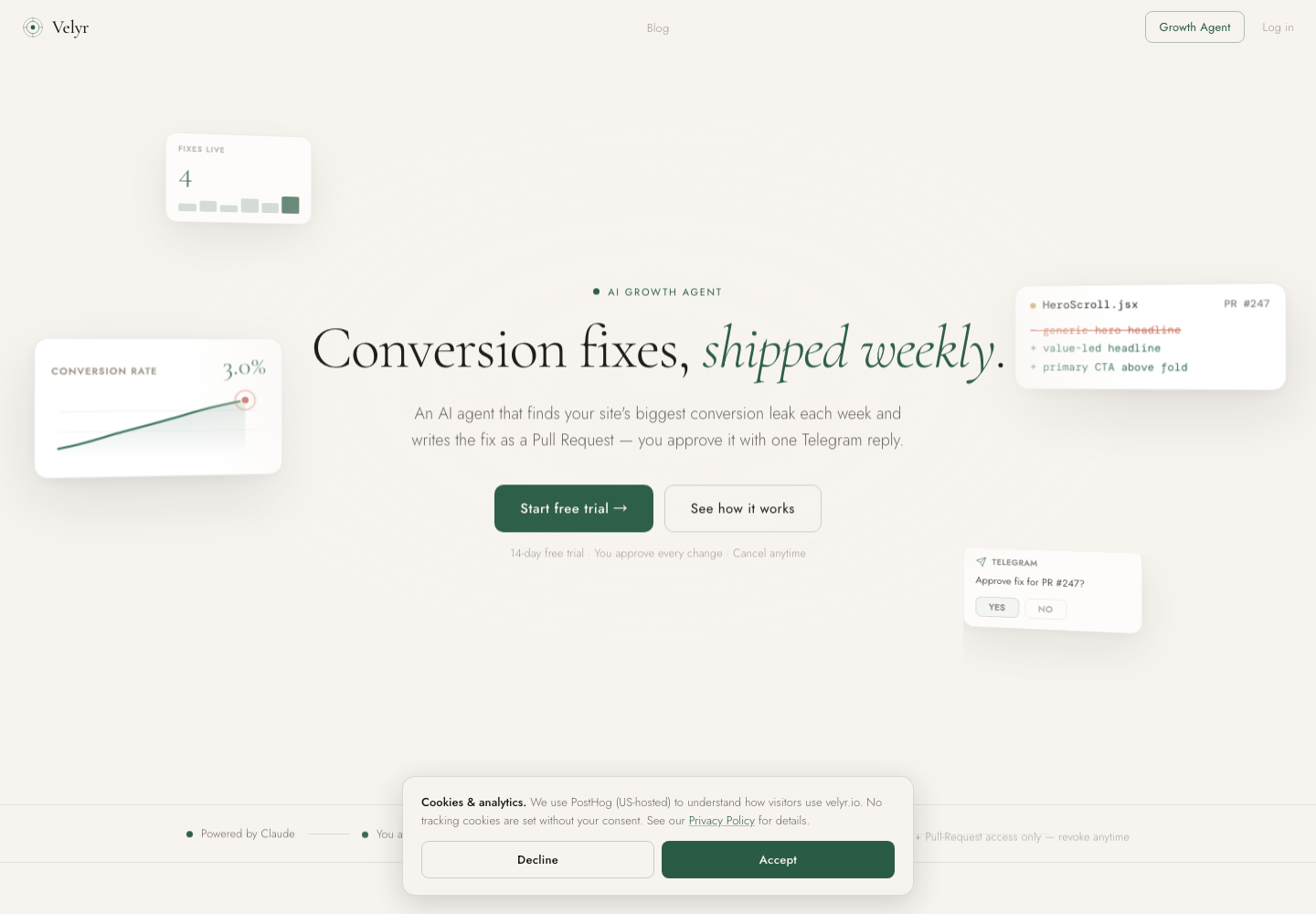
Velyr is aimed at founders and small web teams running react, next.js, or vite sites on vercel who want ongoing conversion optimization without handing everything to an agency. The current product materials describe a workflow built around connect github, vercel, and analytics, let velyr identify the biggest conversion leak across the funnel, review the generated pull request and preview, approve it over telegram if it looks right, and let the system monitor the change after deployment. That makes the page easier to read as an operating model, not just a brand claim.
Why it is timely
Velyr is unusually specific about shipping one weekly fix as code instead of leaving the user with a dashboard full of suggestions. The public materials are direct about the approval gate, 48-hour rollback rule, and supported frontend stack, which makes the operating model easier to judge. The product stands out because it sits inside an existing GitHub and Vercel workflow rather than forcing marketers into a separate experimentation suite.
How the workflow works in practice
A sensible first pass is to start from the product's main entry point and test the shortest path to value. For Velyr, that means users should connect github, vercel, and analytics, let velyr identify the biggest conversion leak across the funnel, review the generated pull request and preview, approve it over telegram if it looks right, and let the system monitor the change after deployment. If that loop reduces review drag, coordination, or governance work, the product is doing something real.
Where Velyr stands out
| Evaluation angle | Fit | Why it matters | | --- | --- | --- | | Best-fit user | High | Founders and small web teams running React, Next.js, or Vite sites on Vercel who want ongoing conversion optimization without handing everything to an agency. | | Core workflow clarity | High | Connect GitHub, Vercel, and analytics, let Velyr identify the biggest conversion leak across the funnel, review the generated pull request and preview, approve it over Telegram if it looks right, and let the system monitor the change after deployment. | | Switching cost reducer | Medium to high | Velyr is unusually specific about shipping one weekly fix as code instead of leaving the user with a dashboard full of suggestions. | | Adoption risk | Medium | The current fit is narrow: sites need a compatible codebase and hosting setup, so no-code stacks and unsupported platforms are out of scope. |
Practical use cases
- Shipping recurring conversion fixes as reviewable pull requests
- Using analytics-driven growth suggestions without leaving GitHub workflows
- Adding an approval and rollback layer to AI-driven CRO experiments
Limits and buying notes
The current fit is narrow: sites need a compatible codebase and hosting setup, so no-code stacks and unsupported platforms are out of scope. Automated conversion work still depends on analytics quality and thoughtful review, because not every measurable drop-off should be fixed by the same style of UI change. Pricing status today: Velyr's official site lists a 14-day free trial and a starting price of EUR 29 per month, with every reviewed public source describing the approval and rollback flow as part of the core plan.
FAQ
What is Velyr best for?
Velyr is strongest when shipping recurring conversion fixes as reviewable pull requests matters more than a generic AI demo. The official product materials position it around a concrete workflow rather than a blank chatbot shell.
Who should try Velyr first?
Founders and small web teams running React, Next.js, or Vite sites on Vercel who want ongoing conversion optimization without handing everything to an agency. Teams with a real workflow match will get value faster than general curiosity users.
What should buyers verify before adopting Velyr?
The current fit is narrow: sites need a compatible codebase and hosting setup, so no-code stacks and unsupported platforms are out of scope. Automated conversion work still depends on analytics quality and thoughtful review, because not every measurable drop-off should be fixed by the same style of UI change. Pricing, privacy, and workflow fit should be checked directly on the current product before rollout.
Reviewed sources
- https://velyr.io/
- https://velyr.io/faq
- https://news.ycombinator.com/item?id=48525761
FAQ
What is Velyr best for?
Velyr is strongest when shipping recurring conversion fixes as reviewable pull requests matters more than a generic AI demo. The official product materials position it around a concrete workflow rather than a blank chatbot shell.
Who should try Velyr first?
Founders and small web teams running React, Next.js, or Vite sites on Vercel who want ongoing conversion optimization without handing everything to an agency. Teams with a real workflow match will get value faster than general curiosity users.
What should buyers verify before adopting Velyr?
The current fit is narrow: sites need a compatible codebase and hosting setup, so no-code stacks and unsupported platforms are out of scope. Automated conversion work still depends on analytics quality and thoughtful review, because not every measurable drop-off should be fixed by the same style of UI change. Pricing, privacy, and workflow fit should be checked directly on the current product before rollout.