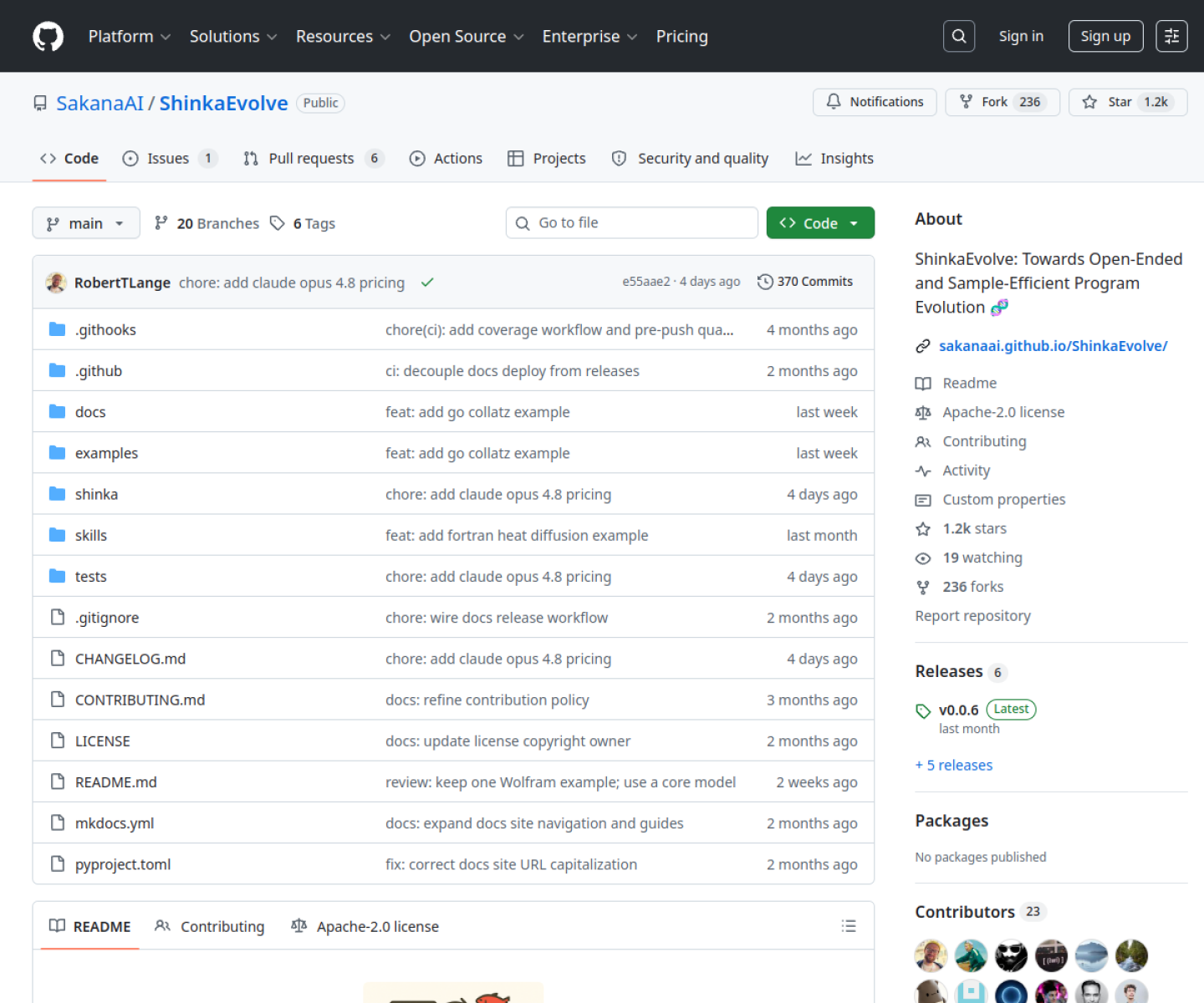
ShinkaEvolve
Open-source framework from Sakana AI for evolving scientific or programming code with LLM-guided mutation and evaluation loops.
AI Project Details
ShinkaEvolve review: Open-source framework from Sakana AI for evolving scientific or programming code with LLM-guided mutation and evaluation loops.
ShinkaEvolve is aimed at researchers and advanced developers exploring automated program improvement rather than simple single-pass code generation. The current product materials describe a workflow built around define a target program and evaluation setup, let the system maintain evolving program populations, and use llm-driven mutations to search for better variants over time. That matters because many new AI launches still sound broad until you try to map them to an actual job.
The reason this tool stands out is practical fit. ShinkaEvolve is built around iterative evolution and evaluation, which is materially different from prompt-once code generation tools. The project carries more technical credibility than a typical launch repo because Sakana AI ties it to a concrete research direction. It became newly notable as the May 2026 update expanded headless model support for more practical agent use.
How the workflow works
The fastest way to judge ShinkaEvolve is to walk the main loop on one real task. For this product, users should define a target program and evaluation setup, let the system maintain evolving program populations, and use llm-driven mutations to search for better variants over time. If that loop feels clearer, more controllable, or easier to repeat than the alternatives, the product is doing useful work.
Where ShinkaEvolve stands out
| Evaluation angle | Fit | Why it matters | | --- | --- | --- | | Best-fit user | High | Researchers and advanced developers exploring automated program improvement rather than simple single-pass code generation. | | Core workflow clarity | High | Define a target program and evaluation setup, let the system maintain evolving program populations, and use LLM-driven mutations to search for better variants over time. | | Switching cost reducer | Medium to high | ShinkaEvolve is built around iterative evolution and evaluation, which is materially different from prompt-once code generation tools. | | Adoption risk | Medium | This is not a general-purpose assistant; it is best for users who can define strong evaluation loops and tolerate experimental workflows. |
Practical use cases
- Exploring automated code evolution for research problems
- Running iterative mutation-and-evaluation loops with LLMs
- Testing open-ended search workflows beyond one-shot code generation
Limits and buying notes
This is not a general-purpose assistant; it is best for users who can define strong evaluation loops and tolerate experimental workflows. Teams should expect more setup and domain-specific tuning than they would with a conventional coding agent or notebook helper. Pricing status today: ShinkaEvolve is open source on GitHub; no separate commercial pricing page was visible during review.
FAQ
What is ShinkaEvolve best for?
ShinkaEvolve works best when exploring automated code evolution for research problems matters more than using a generic assistant. The official materials point to a more concrete workflow than a blank AI shell.
Who should try ShinkaEvolve first?
Researchers and advanced developers exploring automated program improvement rather than simple single-pass code generation. Teams with that exact workflow will learn faster than broad curiosity users.
What should users verify before adopting ShinkaEvolve?
This is not a general-purpose assistant; it is best for users who can define strong evaluation loops and tolerate experimental workflows. Teams should expect more setup and domain-specific tuning than they would with a conventional coding agent or notebook helper. Users should also check the current docs, pricing, and release status before rollout.
Reviewed sources
- https://github.com/SakanaAI/ShinkaEvolve
- https://arxiv.org/abs/2506.11957
FAQ
What is ShinkaEvolve best for?
ShinkaEvolve works best when exploring automated code evolution for research problems matters more than using a generic assistant. The official materials point to a more concrete workflow than a blank AI shell.
Who should try ShinkaEvolve first?
Researchers and advanced developers exploring automated program improvement rather than simple single-pass code generation. Teams with that exact workflow will learn faster than broad curiosity users.
What should users verify before adopting ShinkaEvolve?
This is not a general-purpose assistant; it is best for users who can define strong evaluation loops and tolerate experimental workflows. Teams should expect more setup and domain-specific tuning than they would with a conventional coding agent or notebook helper. Users should also check the current docs, pricing, and release status before rollout.