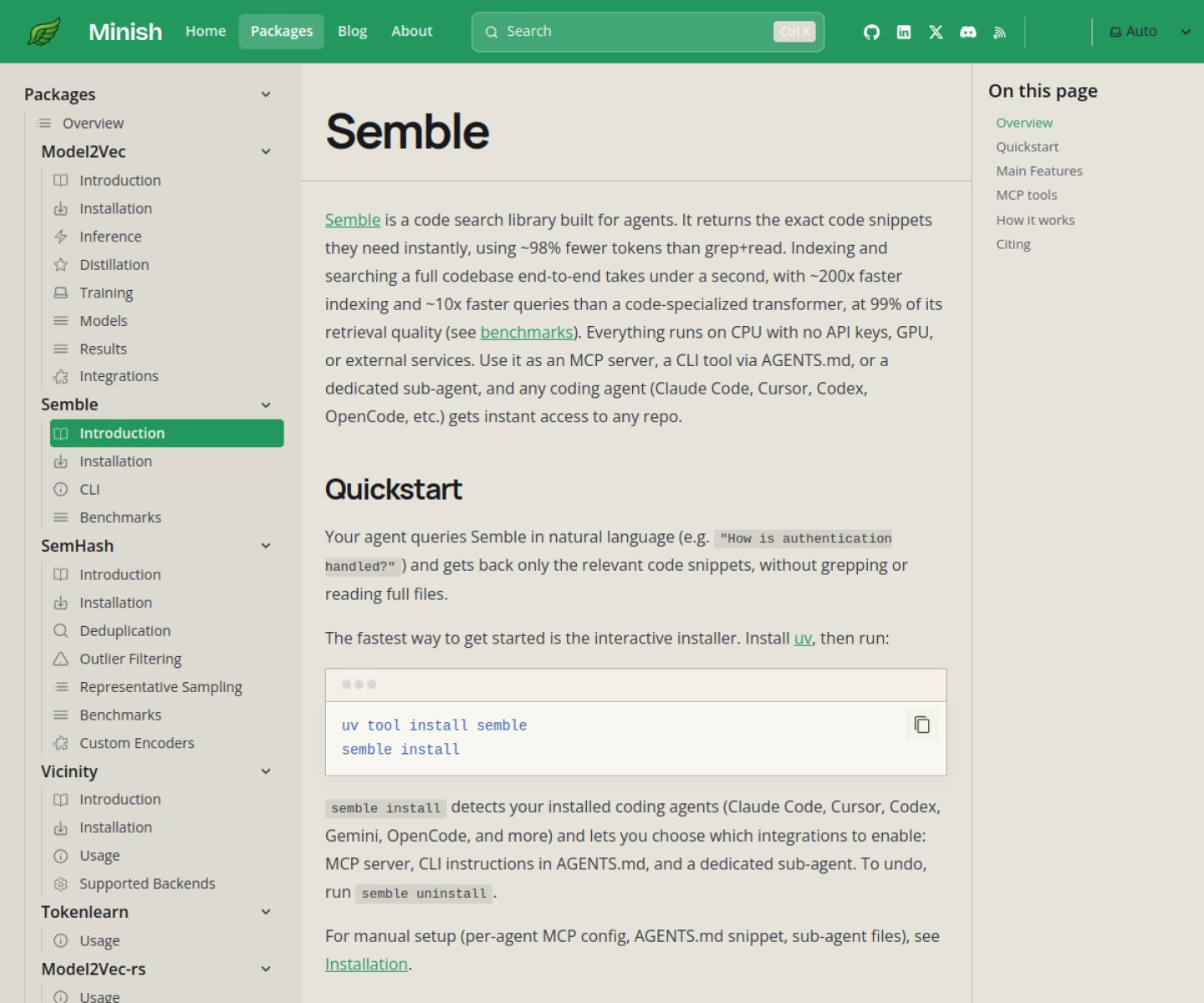
Semble
Code-search engine for agents that aims to surface the right repository context using far fewer tokens than naive grep-plus-read workflows.
AI Project Details
Semble review: Code-search engine for agents that aims to surface the right repository context using far fewer tokens than naive grep-plus-read workflows.
Semble stands out because it is not just another chat shell. The product materials describe a system centered on index the repository with semble, issue targeted queries from the agent or surrounding workflow, and retrieve smaller, more relevant code context for the next reasoning step. That matters because the mechanism is the product, not a thin wrapper around a frontier model.
Why the architecture matters
Semble is solving a narrow but expensive problem in agent workflows: overpaying for low-quality code retrieval. Its public positioning is specific about token savings, which makes the value proposition easy to test against existing search habits. The project is more useful than a plain search helper because it is designed around agent context quality, not only human browsing convenience.
How to evaluate the core loop
Start by testing the narrowest real workflow the product claims to improve. For Semble, that means users should index the repository with semble, issue targeted queries from the agent or surrounding workflow, and retrieve smaller, more relevant code context for the next reasoning step. The result should be easier to inspect, integrate, or control than a direct agent session.
Where it stands out
| Evaluation angle | Fit | Why it matters | | --- | --- | --- | | Best-fit user | High | Developers using coding agents on large repositories where context retrieval cost and noise can make ordinary file search expensive or brittle. | | Core workflow clarity | High | Index the repository with Semble, issue targeted queries from the agent or surrounding workflow, and retrieve smaller, more relevant code context for the next reasoning step. | | Switching cost reducer | Medium to high | Semble is solving a narrow but expensive problem in agent workflows: overpaying for low-quality code retrieval. | | Adoption risk | Medium | Teams should measure retrieval precision on their own repositories because token savings matter only if the returned context is still good enough. |
Practical use cases
- Reducing token burn during agent-driven code search
- Improving repository context retrieval for coding assistants
- Replacing brute-force grep-and-read loops on large codebases
Limits and buying notes
Teams should measure retrieval precision on their own repositories because token savings matter only if the returned context is still good enough. It is most useful on larger or noisier codebases; small repositories may not justify another retrieval layer. Pricing status today: Semble is documented as an open-source package, and the reviewed introduction pages did not expose separate commercial pricing.
FAQ
What is Semble best for?
Semble is strongest when reducing token burn during agent-driven code search matters more than a generic AI demo. The official product materials position it around a concrete workflow rather than a blank chatbot shell.
Who should try Semble first?
Developers using coding agents on large repositories where context retrieval cost and noise can make ordinary file search expensive or brittle. Teams with a real workflow match will get value faster than general curiosity users.
What should buyers verify before adopting Semble?
Teams should measure retrieval precision on their own repositories because token savings matter only if the returned context is still good enough. It is most useful on larger or noisier codebases; small repositories may not justify another retrieval layer. Pricing, privacy, and workflow fit should be checked directly on the current product before rollout.
Reviewed sources
- https://minish.ai/packages/semble/introduction/
- https://github.com/MinishLab/semble
FAQ
What is Semble best for?
Semble is strongest when reducing token burn during agent-driven code search matters more than a generic AI demo. The official product materials position it around a concrete workflow rather than a blank chatbot shell.
Who should try Semble first?
Developers using coding agents on large repositories where context retrieval cost and noise can make ordinary file search expensive or brittle. Teams with a real workflow match will get value faster than general curiosity users.
What should buyers verify before adopting Semble?
Teams should measure retrieval precision on their own repositories because token savings matter only if the returned context is still good enough. It is most useful on larger or noisier codebases; small repositories may not justify another retrieval layer. Pricing, privacy, and workflow fit should be checked directly on the current product before rollout.