Ponytail
Agent plugin and ruleset that pushes coding assistants toward smaller, cheaper, more native solutions before they write more code.
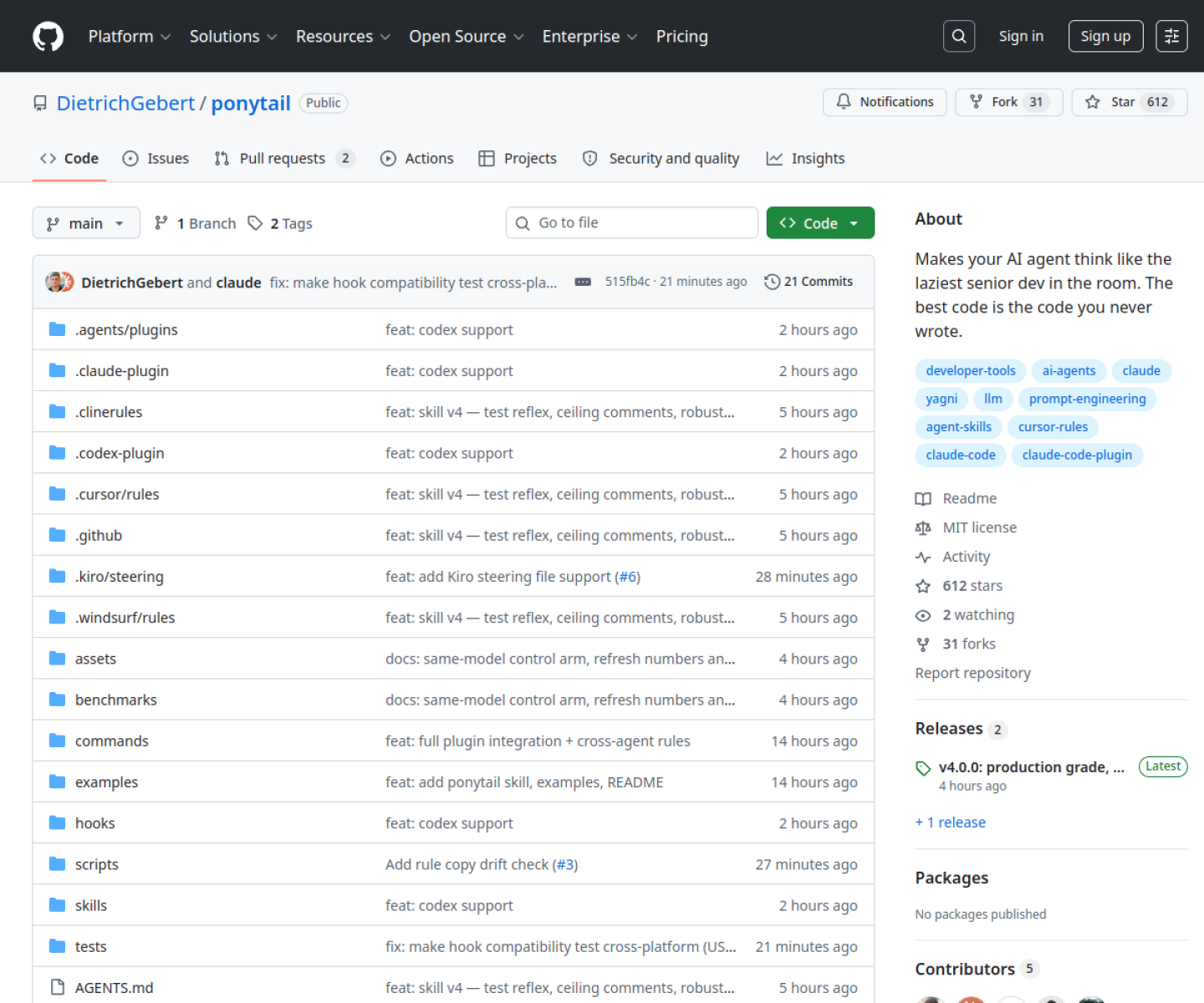
AI Project Details
Ponytail review: Agent plugin and ruleset that pushes coding assistants toward smaller, cheaper, more native solutions before they write more code.
Ponytail is built for developers who already use coding agents and want stricter defaults around minimalism, dependency avoidance, and cost discipline. Instead of asking users to replace their whole toolchain, the product wraps a familiar workflow around install the plugin or copy the rules file for the supported agent, let it inject the reduction ladder into coding sessions, then use the review helpers to cut unnecessary code out of the resulting diff. That makes it easier to judge on practical fit rather than hype.
What the product changes day to day
The real question is whether the workspace removes enough friction to matter. Ponytail has a crisp thesis: make the agent think like the laziest senior developer who keeps deleting unnecessary abstractions. The README is concrete about the decision ladder, installation paths across several agent products, and reproducible benchmark claims. Its explicit upgrade comments and review commands make it more operational than a one-page vibe-coding manifesto.
What the workflow feels like
For a serious evaluation, start with one active project instead of a synthetic demo. In practice that means users should install the plugin or copy the rules file for the supported agent, let it inject the reduction ladder into coding sessions, then use the review helpers to cut unnecessary code out of the resulting diff. If the product keeps context visible and cuts down tool hopping, the value shows up quickly.
Where it earns attention
| Evaluation angle | Fit | Why it matters | | --- | --- | --- | | Best-fit user | High | Developers who already use coding agents and want stricter defaults around minimalism, dependency avoidance, and cost discipline. | | Core workflow clarity | High | Install the plugin or copy the rules file for the supported agent, let it inject the reduction ladder into coding sessions, then use the review helpers to cut unnecessary code out of the resulting diff. | | Switching cost reducer | Medium to high | Ponytail has a crisp thesis: make the agent think like the laziest senior developer who keeps deleting unnecessary abstractions. | | Adoption risk | Medium | The approach is best for teams that already agree with the product philosophy; codebases that value heavy abstraction may resist it. |
Practical use cases
- Reducing bloated output from coding agents
- Standardizing minimalist rules across several AI developer tools
- Reviewing diffs for code that should never have been written
Limits and buying notes
The approach is best for teams that already agree with the product philosophy; codebases that value heavy abstraction may resist it. Users still need to apply judgment for security, accessibility, and trust-boundary work that should not be optimized away. Pricing status today: Ponytail is distributed as an open-source MIT-licensed project and the reviewed public sources did not show a separate paid pricing plan.
FAQ
What is Ponytail best for?
Ponytail is strongest when reducing bloated output from coding agents matters more than a generic AI demo. The official product materials position it around a concrete workflow rather than a blank chatbot shell.
Who should try Ponytail first?
Developers who already use coding agents and want stricter defaults around minimalism, dependency avoidance, and cost discipline. Teams with a real workflow match will get value faster than general curiosity users.
What should buyers verify before adopting Ponytail?
The approach is best for teams that already agree with the product philosophy; codebases that value heavy abstraction may resist it. Users still need to apply judgment for security, accessibility, and trust-boundary work that should not be optimized away. Pricing, privacy, and workflow fit should be checked directly on the current product before rollout.
Reviewed sources
- https://github.com/DietrichGebert/ponytail
- https://raw.githubusercontent.com/DietrichGebert/ponytail/main/README.md
- https://github.com/DietrichGebert/ponytail/tree/main/benchmarks
FAQ
What is Ponytail best for?
Ponytail is strongest when reducing bloated output from coding agents matters more than a generic AI demo. The official product materials position it around a concrete workflow rather than a blank chatbot shell.
Who should try Ponytail first?
Developers who already use coding agents and want stricter defaults around minimalism, dependency avoidance, and cost discipline. Teams with a real workflow match will get value faster than general curiosity users.
What should buyers verify before adopting Ponytail?
The approach is best for teams that already agree with the product philosophy; codebases that value heavy abstraction may resist it. Users still need to apply judgment for security, accessibility, and trust-boundary work that should not be optimized away. Pricing, privacy, and workflow fit should be checked directly on the current product before rollout.