Honeytree
Claude Code companion that grows a pixel-art forest in the terminal after each prompt and can turn virtual progress into paid real-world tree plantings.
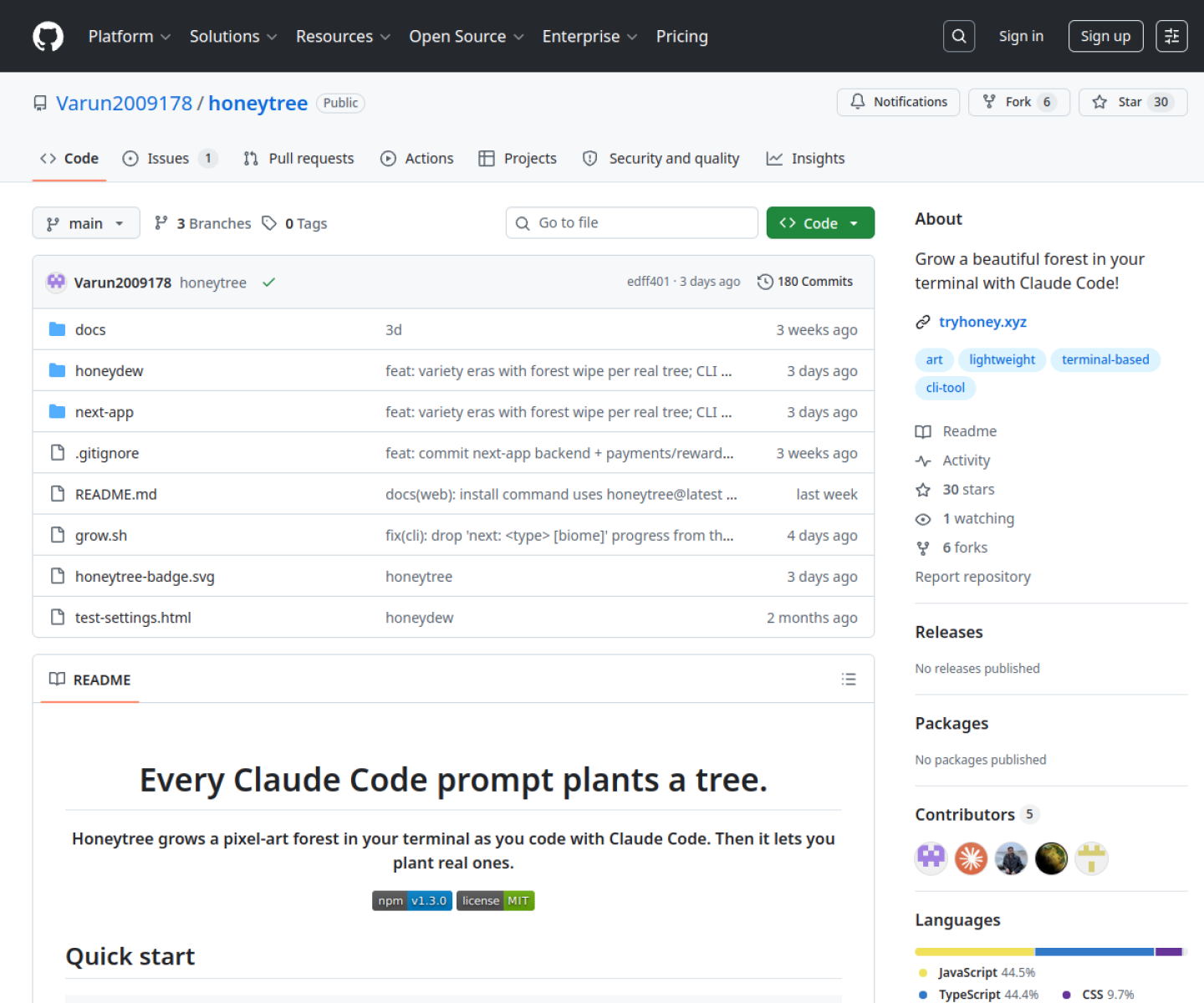
AI Project Details
Honeytree review: Claude Code companion that grows a pixel-art forest in the terminal after each prompt and can turn virtual progress into paid real-world tree plantings.
Honeytree is built for developers who want a more visible, playful way to track claude code usage and turn that activity into an optional real-world reward loop. Instead of asking users to replace their whole toolchain, the product wraps a familiar workflow around install the cli, register the claude code hook, keep the viewer open in a second terminal pane, and watch each prompt grow a tree while optional account sync unlocks public profiles and real planting rewards. That makes it easier to judge on practical fit rather than hype.
What the product changes day to day
The real question is whether the workspace removes enough friction to matter. Honeytree turns Claude Code activity into a persistent visual artifact instead of another spreadsheet-style usage report. The link between virtual trees and optional real planting makes the project more distinctive than a standard gamification plugin. Its hook-based local workflow means the core terminal forest works even without adopting the cloud and checkout pieces.
What the workflow feels like
For a serious evaluation, start with one active project instead of a synthetic demo. In practice that means users should install the cli, register the claude code hook, keep the viewer open in a second terminal pane, and watch each prompt grow a tree while optional account sync unlocks public profiles and real planting rewards. If the product keeps context visible and cuts down tool hopping, the value shows up quickly.
Where it earns attention
| Evaluation angle | Fit | Why it matters | | --- | --- | --- | | Best-fit user | High | Developers who want a more visible, playful way to track Claude Code usage and turn that activity into an optional real-world reward loop. | | Core workflow clarity | High | Install the CLI, register the Claude Code hook, keep the viewer open in a second terminal pane, and watch each prompt grow a tree while optional account sync unlocks public profiles and real planting rewards. | | Switching cost reducer | Medium to high | Honeytree turns Claude Code activity into a persistent visual artifact instead of another spreadsheet-style usage report. | | Adoption risk | Medium | The strongest appeal is emotional and habit-forming, so teams focused purely on operational metrics may prefer a more utilitarian tracker. |
Practical use cases
- Visualizing Claude Code activity as a growing terminal forest
- Adding a lightweight motivation loop to repeated coding-agent work
- Converting prompt activity into optional real-world tree planting rewards
Limits and buying notes
The strongest appeal is emotional and habit-forming, so teams focused purely on operational metrics may prefer a more utilitarian tracker. Real tree planting and public profile features depend on opting into accounts and payments, which some users will skip. Pricing status today: Honeytree is an open-source CLI, and the reviewed README says real tree planting is unlocked at $1 per redeemed planting through an opt-in checkout flow.
FAQ
What is Honeytree best for?
Honeytree is strongest when visualizing claude code activity as a growing terminal forest matters more than a generic AI demo. The official product materials position it around a concrete workflow rather than a blank chatbot shell.
Who should try Honeytree first?
Developers who want a more visible, playful way to track Claude Code usage and turn that activity into an optional real-world reward loop. Teams with a real workflow match will get value faster than general curiosity users.
What should buyers verify before adopting Honeytree?
The strongest appeal is emotional and habit-forming, so teams focused purely on operational metrics may prefer a more utilitarian tracker. Real tree planting and public profile features depend on opting into accounts and payments, which some users will skip. Pricing, privacy, and workflow fit should be checked directly on the current product before rollout.
Reviewed sources
- https://github.com/Varun2009178/honeytree
- https://raw.githubusercontent.com/Varun2009178/honeytree/main/README.md
- https://news.ycombinator.com/item?id=48543976
FAQ
What is Honeytree best for?
Honeytree is strongest when visualizing claude code activity as a growing terminal forest matters more than a generic AI demo. The official product materials position it around a concrete workflow rather than a blank chatbot shell.
Who should try Honeytree first?
Developers who want a more visible, playful way to track Claude Code usage and turn that activity into an optional real-world reward loop. Teams with a real workflow match will get value faster than general curiosity users.
What should buyers verify before adopting Honeytree?
The strongest appeal is emotional and habit-forming, so teams focused purely on operational metrics may prefer a more utilitarian tracker. Real tree planting and public profile features depend on opting into accounts and payments, which some users will skip. Pricing, privacy, and workflow fit should be checked directly on the current product before rollout.