fleet
Python supervisor for running several coding agents in parallel from one machine, with a centralized task queue, headless workers, and a dashboard for blocked-agent handoff.
AI Project Details
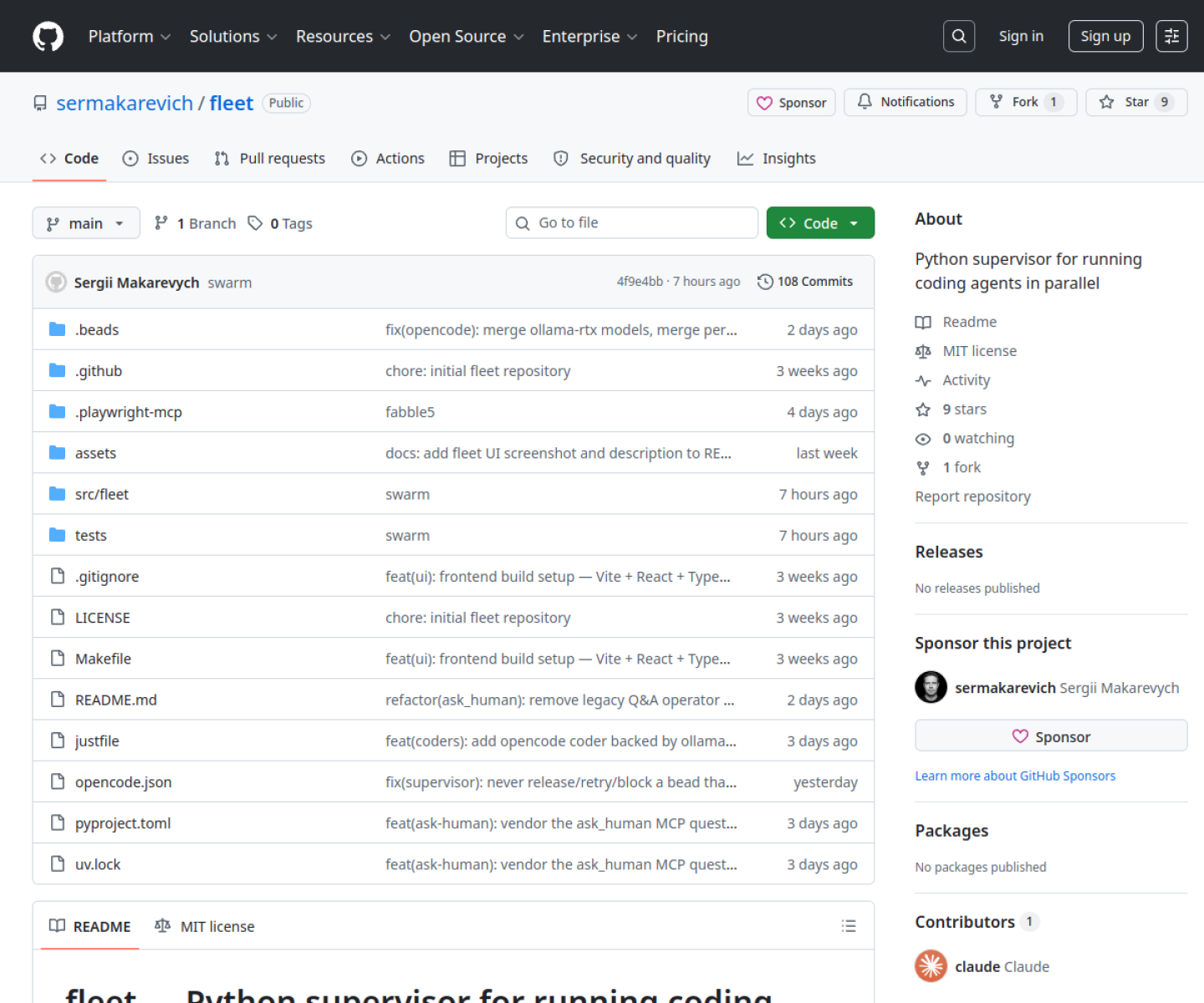
fleet review: Python supervisor for running several coding agents in parallel from one machine, with a centralized task queue, headless workers, and a dashboard for blocked-agent handoff.
fleet is built for developers already experimenting with claude, codex, or similar coding clis and wanting a more durable way to coordinate many concurrent workers. Instead of asking users to replace their whole toolchain, the product wraps a familiar workflow around create tasks in the centralized queue, let the supervisor claim and run them through headless coding agents, then monitor progress, logs, and blocked questions from the shared web ui or telegram hooks. That makes it easier to judge on practical fit rather than hype.
What the product changes day to day
The real question is whether the workspace removes enough friction to matter. fleet is direct about orchestrating real coding-agent work instead of demoing another single-agent shell. The README is concrete about centralized task claims, multi-backend coder support, per-task overrides, and live UI monitoring. Its task-queue model is useful for people trying to turn ad hoc agent sessions into an always-on work loop.
What the workflow feels like
For a serious evaluation, start with one active project instead of a synthetic demo. In practice that means users should create tasks in the centralized queue, let the supervisor claim and run them through headless coding agents, then monitor progress, logs, and blocked questions from the shared web ui or telegram hooks. If the product keeps context visible and cuts down tool hopping, the value shows up quickly.
Where it earns attention
| Evaluation angle | Fit | Why it matters | | --- | --- | --- | | Best-fit user | High | Developers already experimenting with Claude, Codex, or similar coding CLIs and wanting a more durable way to coordinate many concurrent workers. | | Core workflow clarity | High | Create tasks in the centralized queue, let the supervisor claim and run them through headless coding agents, then monitor progress, logs, and blocked questions from the shared web UI or Telegram hooks. | | Switching cost reducer | Medium to high | fleet is direct about orchestrating real coding-agent work instead of demoing another single-agent shell. | | Adoption risk | Medium | The payoff depends on teams actually running enough parallel agent work to justify orchestration overhead. |
Practical use cases
- Running several headless coding agents from one supervisor
- Managing blocked-agent questions and logs from a shared dashboard
- Coordinating long-lived coding tasks through a centralized queue
Limits and buying notes
The payoff depends on teams actually running enough parallel agent work to justify orchestration overhead. Users still need to think carefully about task quality, worker isolation, and cost control because more concurrent agents can also amplify mistakes. Pricing status today: fleet is presented as an open-source Python project, and the reviewed public sources did not show a hosted pricing plan.
FAQ
What is fleet best for?
fleet is strongest when running several headless coding agents from one supervisor matters more than a generic AI demo. The official product materials position it around a concrete workflow rather than a blank chatbot shell.
Who should try fleet first?
Developers already experimenting with Claude, Codex, or similar coding CLIs and wanting a more durable way to coordinate many concurrent workers. Teams with a real workflow match will get value faster than general curiosity users.
What should buyers verify before adopting fleet?
The payoff depends on teams actually running enough parallel agent work to justify orchestration overhead. Users still need to think carefully about task quality, worker isolation, and cost control because more concurrent agents can also amplify mistakes. Pricing, privacy, and workflow fit should be checked directly on the current product before rollout.
Reviewed sources
- https://github.com/sermakarevich/fleet
- https://raw.githubusercontent.com/sermakarevich/fleet/main/README.md
- https://news.ycombinator.com/item?id=48520757
FAQ
What is fleet best for?
fleet is strongest when running several headless coding agents from one supervisor matters more than a generic AI demo. The official product materials position it around a concrete workflow rather than a blank chatbot shell.
Who should try fleet first?
Developers already experimenting with Claude, Codex, or similar coding CLIs and wanting a more durable way to coordinate many concurrent workers. Teams with a real workflow match will get value faster than general curiosity users.
What should buyers verify before adopting fleet?
The payoff depends on teams actually running enough parallel agent work to justify orchestration overhead. Users still need to think carefully about task quality, worker isolation, and cost control because more concurrent agents can also amplify mistakes. Pricing, privacy, and workflow fit should be checked directly on the current product before rollout.