Context Gateway
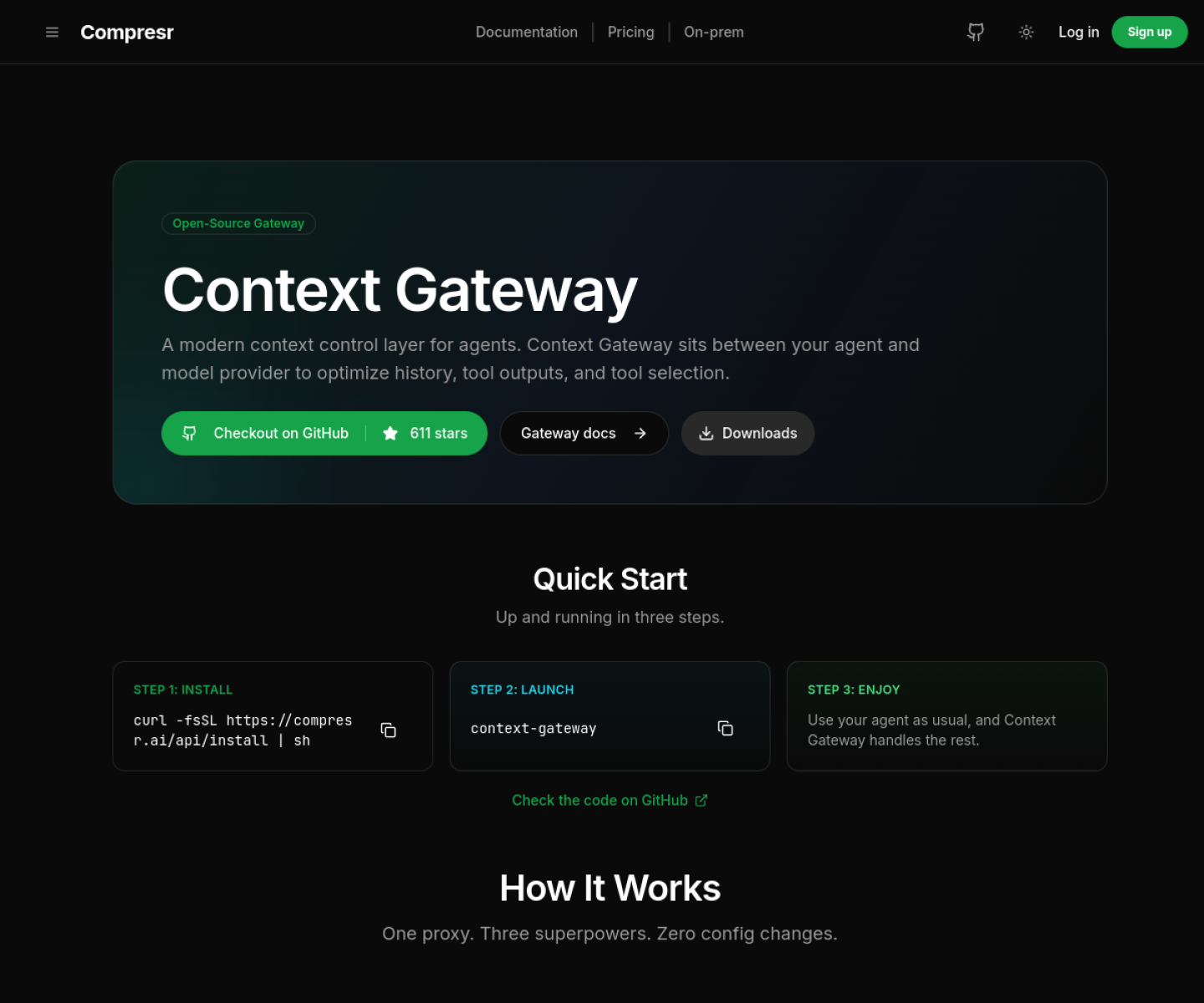
Context-control proxy for coding agents that compresses history and tool output, trims irrelevant tool definitions, and tries to preserve signal while lowering token use.
AI Project Details
Context Gateway review: Context-control proxy for coding agents that compresses history and tool output, trims irrelevant tool definitions, and tries to preserve signal while lowering token use.
Context Gateway stands out because it is not just another chat shell. The product materials describe a system centered on install context gateway in front of the coding agent, leave the agent flow unchanged, and let the proxy summarize older history, compress bulky tool output, and send only relevant tools on each turn. That matters because the mechanism is the product, not a thin wrapper around a frontier model.
Why the architecture matters
Context Gateway targets one of the most practical current pain points in coding agents: oversized tool payloads and bloated context windows. The official site lays out the three mechanisms separately, which makes the product easier to judge than vague 'optimization' claims. Because it acts as a proxy rather than a new coding environment, teams can test it without rebuilding the rest of their workflow.
How to evaluate the core loop
Start by testing the narrowest real workflow the product claims to improve. For Context Gateway, that means users should install context gateway in front of the coding agent, leave the agent flow unchanged, and let the proxy summarize older history, compress bulky tool output, and send only relevant tools on each turn. The result should be easier to inspect, integrate, or control than a direct agent session.
Where it stands out
| Evaluation angle | Fit | Why it matters | | --- | --- | --- | | Best-fit user | High | Developers running verbose coding agents such as Claude Code or Cursor who want lower token burn without constantly compacting context by hand. | | Core workflow clarity | High | Install Context Gateway in front of the coding agent, leave the agent flow unchanged, and let the proxy summarize older history, compress bulky tool output, and send only relevant tools on each turn. | | Switching cost reducer | Medium to high | Context Gateway targets one of the most practical current pain points in coding agents: oversized tool payloads and bloated context windows. | | Adoption risk | Medium | Compression products always introduce a tradeoff between lower token cost and the possibility of losing edge-case detail, so teams should benchmark carefully. |
Practical use cases
- Reducing token spend in Claude Code or similar coding agents
- Compressing large tool outputs before they flood the model context
- Improving tool relevance by selecting only the tools needed for each turn
Limits and buying notes
Compression products always introduce a tradeoff between lower token cost and the possibility of losing edge-case detail, so teams should benchmark carefully. The value is strongest for heavy, tool-rich sessions; light agent usage may not justify an extra layer. Pricing status today: Compresr's official site says API users can start with $10 free and no card, while the Context Gateway itself is presented as an open-source gateway and on-prem or custom pricing is handled through contact sales.
FAQ
What is Context Gateway best for?
Context Gateway is strongest when reducing token spend in claude code or similar coding agents matters more than a generic AI demo. The official product materials position it around a concrete workflow rather than a blank chatbot shell.
Who should try Context Gateway first?
Developers running verbose coding agents such as Claude Code or Cursor who want lower token burn without constantly compacting context by hand. Teams with a real workflow match will get value faster than general curiosity users.
What should buyers verify before adopting Context Gateway?
Compression products always introduce a tradeoff between lower token cost and the possibility of losing edge-case detail, so teams should benchmark carefully. The value is strongest for heavy, tool-rich sessions; light agent usage may not justify an extra layer. Pricing, privacy, and workflow fit should be checked directly on the current product before rollout.
Reviewed sources
- https://compresr.ai/gateway
- https://compresr.ai/docs
- https://compresr.ai/pricing
FAQ
What is Context Gateway best for?
Context Gateway is strongest when reducing token spend in claude code or similar coding agents matters more than a generic AI demo. The official product materials position it around a concrete workflow rather than a blank chatbot shell.
Who should try Context Gateway first?
Developers running verbose coding agents such as Claude Code or Cursor who want lower token burn without constantly compacting context by hand. Teams with a real workflow match will get value faster than general curiosity users.
What should buyers verify before adopting Context Gateway?
Compression products always introduce a tradeoff between lower token cost and the possibility of losing edge-case detail, so teams should benchmark carefully. The value is strongest for heavy, tool-rich sessions; light agent usage may not justify an extra layer. Pricing, privacy, and workflow fit should be checked directly on the current product before rollout.