AtomicMemory
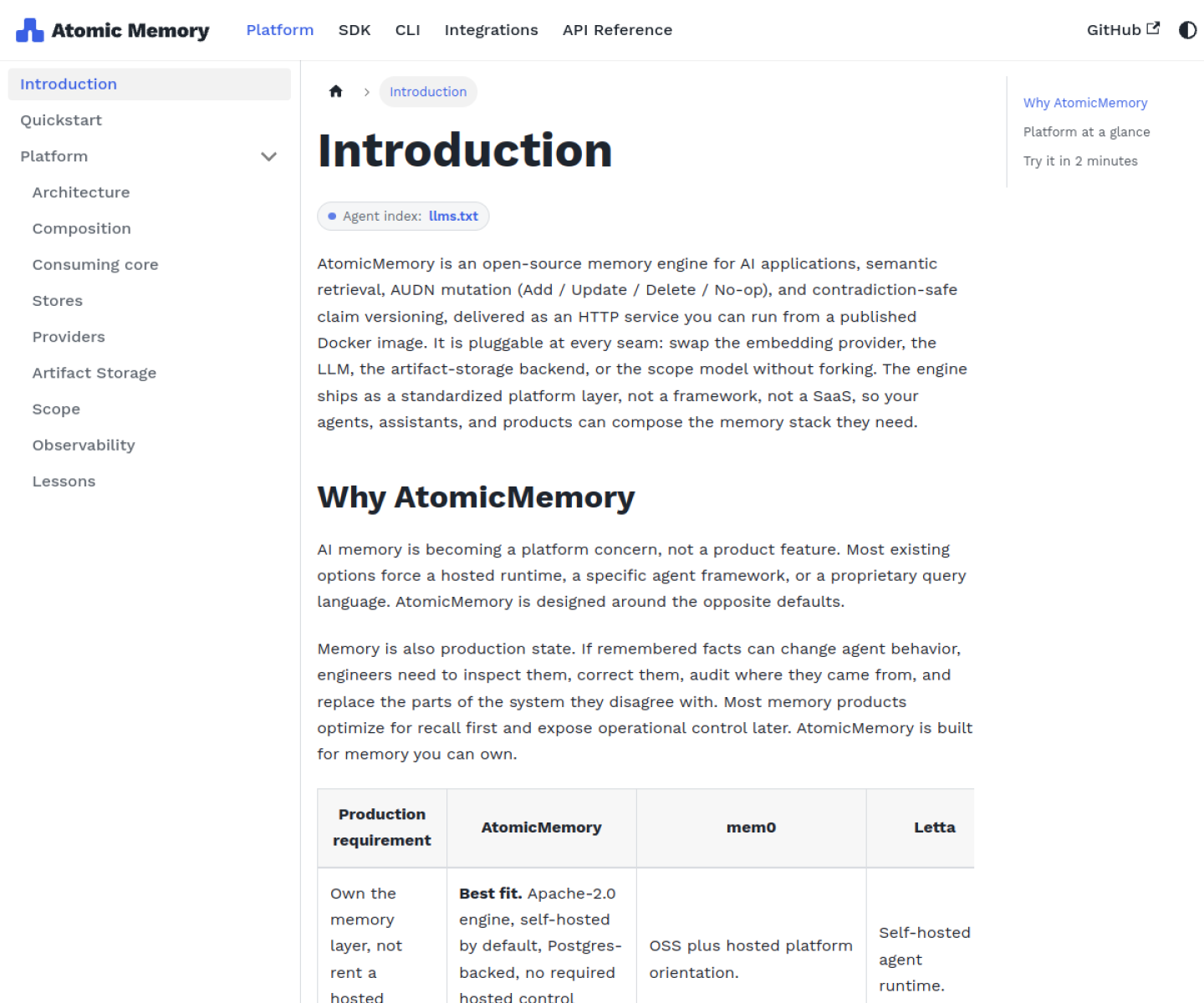
Portable semantic-memory stack for AI agents with a core engine, SDK, CLI, host plugins, and MCP server rather than a single app-specific memory feature.
AI Project Details
AtomicMemory review: Portable semantic-memory stack for AI agents with a core engine, SDK, CLI, host plugins, and MCP server rather than a single app-specific memory feature.
AtomicMemory stands out because it is not just another chat shell. The product materials describe a system centered on deploy the core memory engine, connect the sdk or cli to the target agent surface, and use the mcp server or plugins to persist and retrieve relevant context across sessions. That matters because the mechanism is the product, not a thin wrapper around a frontier model.
Why the architecture matters
AtomicMemory is designed as portable infrastructure, which is more flexible than a memory feature hidden inside one product. The docs describe multiple connection surfaces up front, making the cross-client story more credible than a vague portability claim. It fits current agent workflows because teams increasingly need memory that survives tool changes rather than memory locked inside one assistant.
How to evaluate the core loop
Start by testing the narrowest real workflow the product claims to improve. For AtomicMemory, that means users should deploy the core memory engine, connect the sdk or cli to the target agent surface, and use the mcp server or plugins to persist and retrieve relevant context across sessions. The result should be easier to inspect, integrate, or control than a direct agent session.
Where it stands out
| Evaluation angle | Fit | Why it matters | | --- | --- | --- | | Best-fit user | High | Developers who want to add durable semantic memory across multiple agent surfaces without tying that memory to one editor or one vendor. | | Core workflow clarity | High | Deploy the core memory engine, connect the SDK or CLI to the target agent surface, and use the MCP server or plugins to persist and retrieve relevant context across sessions. | | Switching cost reducer | Medium to high | AtomicMemory is designed as portable infrastructure, which is more flexible than a memory feature hidden inside one product. | | Adoption risk | Medium | Memory quality still depends on retrieval design and pruning rules, so portability alone does not guarantee better results. |
Practical use cases
- Sharing semantic memory across agent surfaces
- Adding an MCP-backed memory layer to coding tools
- Keeping durable context portable instead of vendor-locked
Limits and buying notes
Memory quality still depends on retrieval design and pruning rules, so portability alone does not guarantee better results. The main value appears when teams actually run multiple agents or recurring workflows over time. Pricing status today: AtomicMemory is documented as an open-source memory stack, and the reviewed docs did not expose a separate hosted pricing page.
FAQ
What is AtomicMemory best for?
AtomicMemory is strongest when sharing semantic memory across agent surfaces matters more than a generic AI demo. The official product materials position it around a concrete workflow rather than a blank chatbot shell.
Who should try AtomicMemory first?
Developers who want to add durable semantic memory across multiple agent surfaces without tying that memory to one editor or one vendor. Teams with a real workflow match will get value faster than general curiosity users.
What should buyers verify before adopting AtomicMemory?
Memory quality still depends on retrieval design and pruning rules, so portability alone does not guarantee better results. The main value appears when teams actually run multiple agents or recurring workflows over time. Pricing, privacy, and workflow fit should be checked directly on the current product before rollout.
Reviewed sources
- https://docs.atomicstrata.ai/
- https://github.com/atomicstrata/atomicmemory
FAQ
What is AtomicMemory best for?
AtomicMemory is strongest when sharing semantic memory across agent surfaces matters more than a generic AI demo. The official product materials position it around a concrete workflow rather than a blank chatbot shell.
Who should try AtomicMemory first?
Developers who want to add durable semantic memory across multiple agent surfaces without tying that memory to one editor or one vendor. Teams with a real workflow match will get value faster than general curiosity users.
What should buyers verify before adopting AtomicMemory?
Memory quality still depends on retrieval design and pruning rules, so portability alone does not guarantee better results. The main value appears when teams actually run multiple agents or recurring workflows over time. Pricing, privacy, and workflow fit should be checked directly on the current product before rollout.