Agentspan
Open-source durable runtime for AI agents that keeps execution state outside your process so runs can survive crashes and resume cleanly.
AI Project Details
Agentspan review: Open-source durable runtime for AI agents that keeps execution state outside your process so runs can survive crashes and resume cleanly.
Agentspan is aimed at developers and platform teams moving from demos to production agent workflows that need durability, retries, and pause-and-resume control. The current product materials describe a workflow built around define agents in code, run them through the agentspan server, let long workflows persist outside the local process, and reconnect or approve steps as needed. That matters because many new AI launches still sound broad until you try to map them to an actual job.
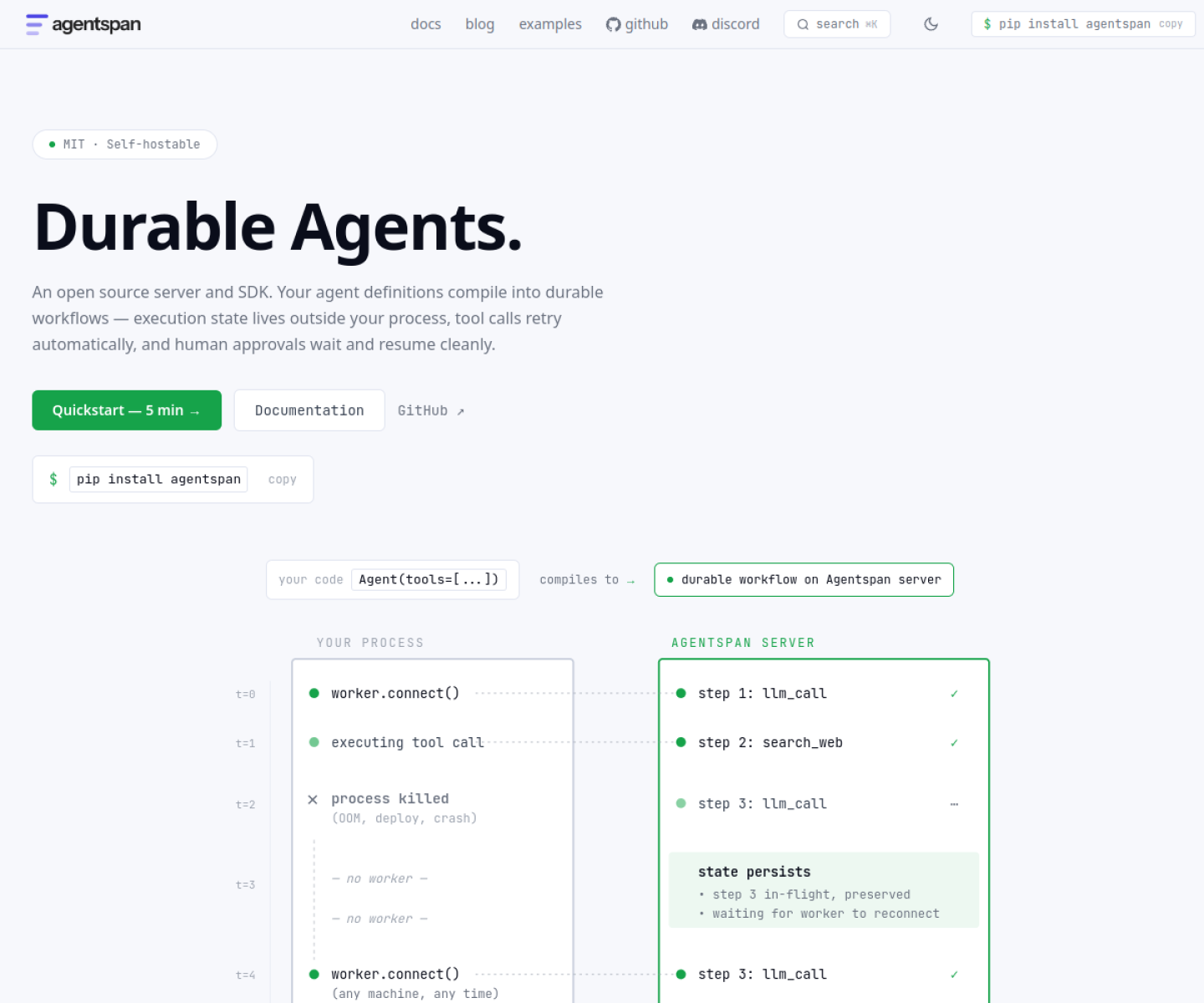
The reason this tool stands out is practical fit. The official site makes the runtime argument directly: your agent code stays familiar while durability moves into a separate server layer. Agentspan is clearer than many framework launches about the production failure modes it is trying to solve. It is newly notable because durable execution has become a sharper distinction point across 2026 agent infrastructure projects.
How the workflow works
The fastest way to judge Agentspan is to walk the main loop on one real task. For this product, users should define agents in code, run them through the agentspan server, let long workflows persist outside the local process, and reconnect or approve steps as needed. If that loop feels clearer, more controllable, or easier to repeat than the alternatives, the product is doing useful work.
Where Agentspan stands out
| Evaluation angle | Fit | Why it matters | | --- | --- | --- | | Best-fit user | High | Developers and platform teams moving from demos to production agent workflows that need durability, retries, and pause-and-resume control. | | Core workflow clarity | High | Define agents in code, run them through the Agentspan server, let long workflows persist outside the local process, and reconnect or approve steps as needed. | | Switching cost reducer | Medium to high | The official site makes the runtime argument directly: your agent code stays familiar while durability moves into a separate server layer. | | Adoption risk | Medium | Teams should confirm that the extra runtime layer is justified by real operational failures rather than theoretical architecture neatness. |
Practical use cases
- Running crash-resilient long-horizon agents
- Adding human approval and resume behavior to production agent workflows
- Improving observability and retries without rewriting agent definitions
Limits and buying notes
Teams should confirm that the extra runtime layer is justified by real operational failures rather than theoretical architecture neatness. The product is more relevant to long-running or approval-heavy agent systems than to short single-shot tool loops. Pricing status today: The official site emphasizes MIT and self-hosting; no separate managed pricing table was visible on the reviewed pages.
FAQ
What is Agentspan best for?
Agentspan works best when running crash-resilient long-horizon agents matters more than using a generic assistant. The official materials point to a more concrete workflow than a blank AI shell.
Who should try Agentspan first?
Developers and platform teams moving from demos to production agent workflows that need durability, retries, and pause-and-resume control. Teams with that exact workflow will learn faster than broad curiosity users.
What should users verify before adopting Agentspan?
Teams should confirm that the extra runtime layer is justified by real operational failures rather than theoretical architecture neatness. The product is more relevant to long-running or approval-heavy agent systems than to short single-shot tool loops. Users should also check the current docs, pricing, and release status before rollout.
Reviewed sources
- https://agentspan.ai/
- https://agentspan.ai/docs/why-agentspan/
- https://github.com/agentspan-ai/agentspan
FAQ
What is Agentspan best for?
Agentspan works best when running crash-resilient long-horizon agents matters more than using a generic assistant. The official materials point to a more concrete workflow than a blank AI shell.
Who should try Agentspan first?
Developers and platform teams moving from demos to production agent workflows that need durability, retries, and pause-and-resume control. Teams with that exact workflow will learn faster than broad curiosity users.
What should users verify before adopting Agentspan?
Teams should confirm that the extra runtime layer is justified by real operational failures rather than theoretical architecture neatness. The product is more relevant to long-running or approval-heavy agent systems than to short single-shot tool loops. Users should also check the current docs, pricing, and release status before rollout.