AgentBridge
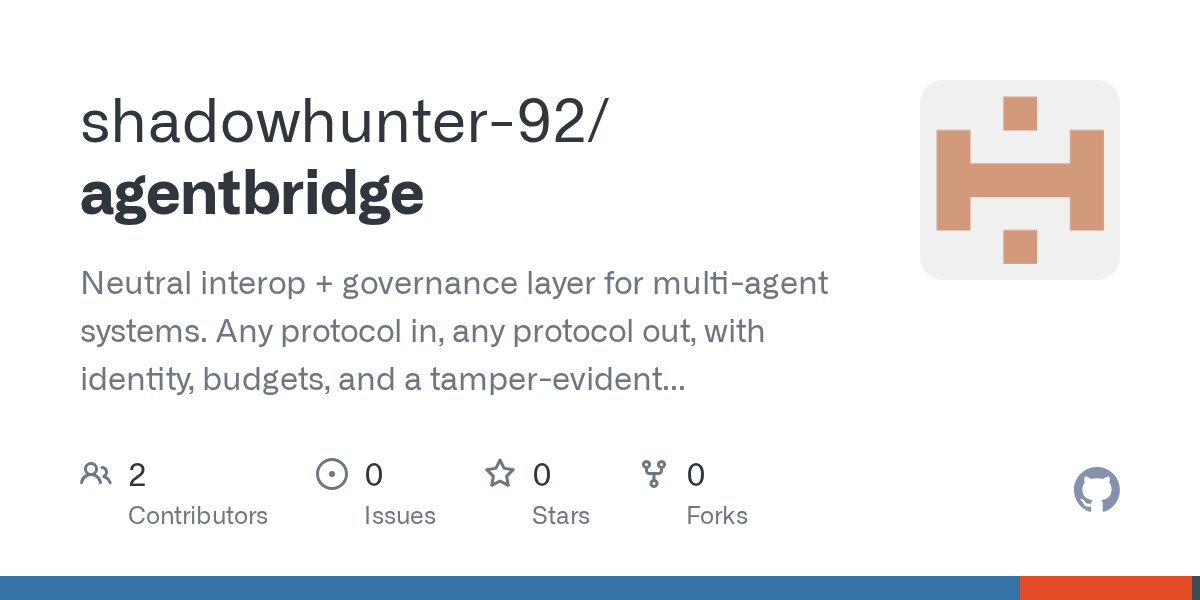
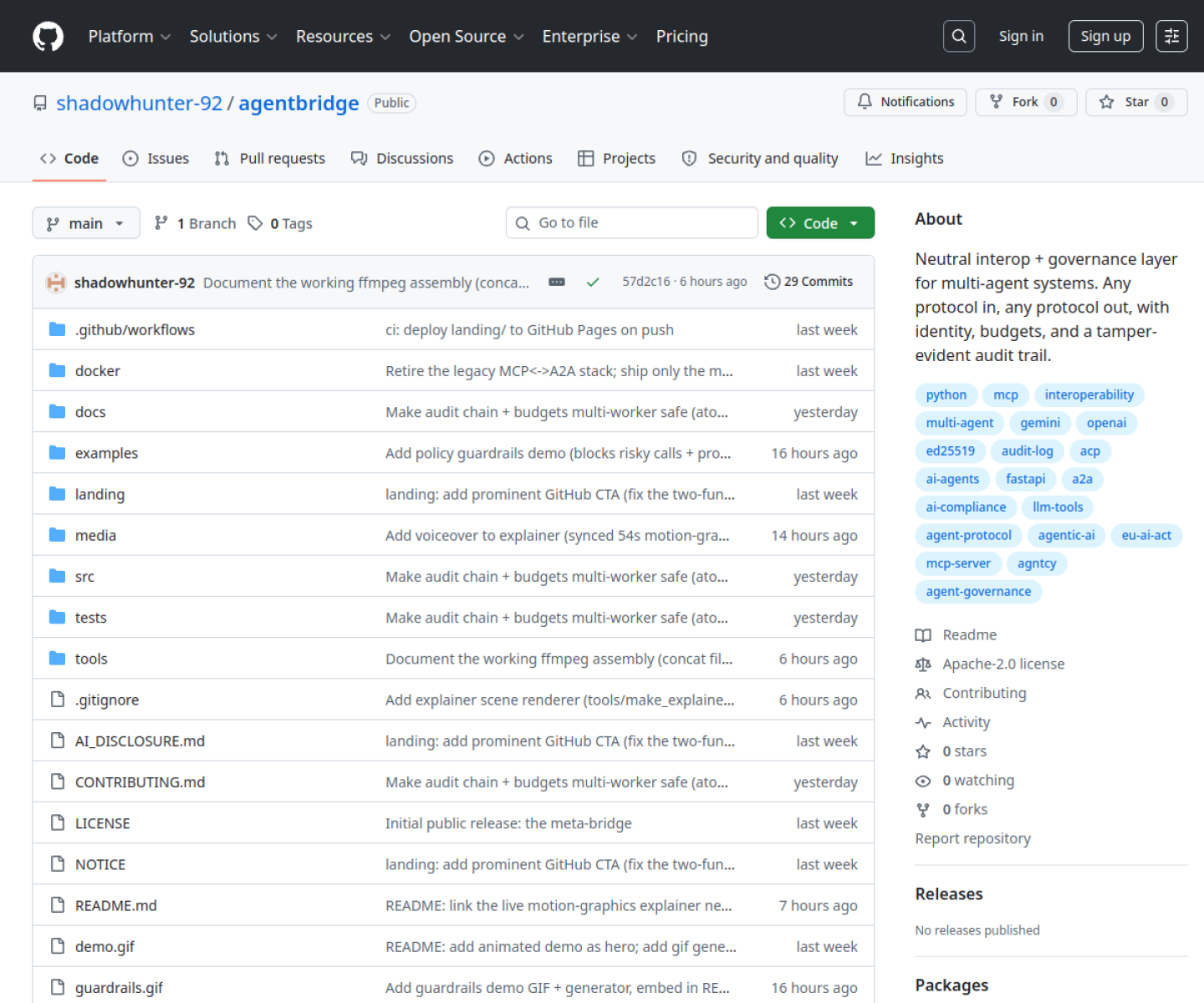
Protocol-translation and governance mesh for multi-agent systems that routes calls across MCP, A2A, ACP, OpenAI function calling, Gemini function calling, and related interfaces with identity, budgets, and audit trails.
AI Project Details
AgentBridge review: Protocol-translation and governance mesh for multi-agent systems that routes calls across MCP, A2A, ACP, OpenAI function calling, Gemini function calling, and related interfaces with identity, budgets, and audit trails.
AgentBridge stands out because it is not just another chat shell. The product materials describe a system centered on run the bridge between agent protocols, translate calls into a canonical model, then enforce identity, policy, budget, and audit checks in the live call path before the request reaches the destination tool or agent. That matters because the mechanism is the product, not a thin wrapper around a frontier model.
Why the architecture matters
AgentBridge focuses on protocol translation plus enforcement in one place, which is more operationally useful than tools that only convert message formats. The README is concrete about supported protocols, conformance testing, human approval hooks, and tamper-evident audit trails, so the architecture is easier to evaluate than a vague agent-gateway pitch. Its strongest angle is neutrality: one mesh can sit between incompatible agent systems instead of forcing a team to standardize every toolchain at once.
How to evaluate the core loop
Start by testing the narrowest real workflow the product claims to improve. For AgentBridge, that means users should run the bridge between agent protocols, translate calls into a canonical model, then enforce identity, policy, budget, and audit checks in the live call path before the request reaches the destination tool or agent. The result should be easier to inspect, integrate, or control than a direct agent session.
Where it stands out
| Evaluation angle | Fit | Why it matters | | --- | --- | --- | | Best-fit user | High | Developers and platform teams building agent systems that need multiple protocols to interoperate without giving up governance, approval, or budget controls. | | Core workflow clarity | High | Run the bridge between agent protocols, translate calls into a canonical model, then enforce identity, policy, budget, and audit checks in the live call path before the request reaches the destination tool or agent. | | Switching cost reducer | Medium to high | AgentBridge focuses on protocol translation plus enforcement in one place, which is more operationally useful than tools that only convert message formats. | | Adoption risk | Medium | The product is still presented as an early prototype, so teams should expect rough edges and verify protocol coverage against their own stack before adopting it widely. |
Practical use cases
- Translating between MCP, A2A, ACP, and function-calling agent protocols
- Adding per-agent budgets and audit trails to cross-protocol tool calls
- Centralizing governance for multi-agent systems that already use mixed standards
Limits and buying notes
The product is still presented as an early prototype, so teams should expect rough edges and verify protocol coverage against their own stack before adopting it widely. A bridge layer adds complexity of its own, which only pays off when a team actually has several protocols or governance requirements to reconcile. Pricing status today: The reviewed README describes AgentBridge as an early working prototype and did not expose a public hosted pricing page in the sources reviewed for this run.
FAQ
What is AgentBridge best for?
AgentBridge is strongest when translating between mcp, a2a, acp, and function-calling agent protocols matters more than a generic AI demo. The official product materials position it around a concrete workflow rather than a blank chatbot shell.
Who should try AgentBridge first?
Developers and platform teams building agent systems that need multiple protocols to interoperate without giving up governance, approval, or budget controls. Teams with a real workflow match will get value faster than general curiosity users.
What should buyers verify before adopting AgentBridge?
The product is still presented as an early prototype, so teams should expect rough edges and verify protocol coverage against their own stack before adopting it widely. A bridge layer adds complexity of its own, which only pays off when a team actually has several protocols or governance requirements to reconcile. Pricing, privacy, and workflow fit should be checked directly on the current product before rollout.
Reviewed sources
- https://github.com/shadowhunter-92/agentbridge
- https://raw.githubusercontent.com/shadowhunter-92/agentbridge/main/README.md
- https://news.ycombinator.com/item?id=48536823
FAQ
What is AgentBridge best for?
AgentBridge is strongest when translating between mcp, a2a, acp, and function-calling agent protocols matters more than a generic AI demo. The official product materials position it around a concrete workflow rather than a blank chatbot shell.
Who should try AgentBridge first?
Developers and platform teams building agent systems that need multiple protocols to interoperate without giving up governance, approval, or budget controls. Teams with a real workflow match will get value faster than general curiosity users.
What should buyers verify before adopting AgentBridge?
The product is still presented as an early prototype, so teams should expect rough edges and verify protocol coverage against their own stack before adopting it widely. A bridge layer adds complexity of its own, which only pays off when a team actually has several protocols or governance requirements to reconcile. Pricing, privacy, and workflow fit should be checked directly on the current product before rollout.