agent-inspect
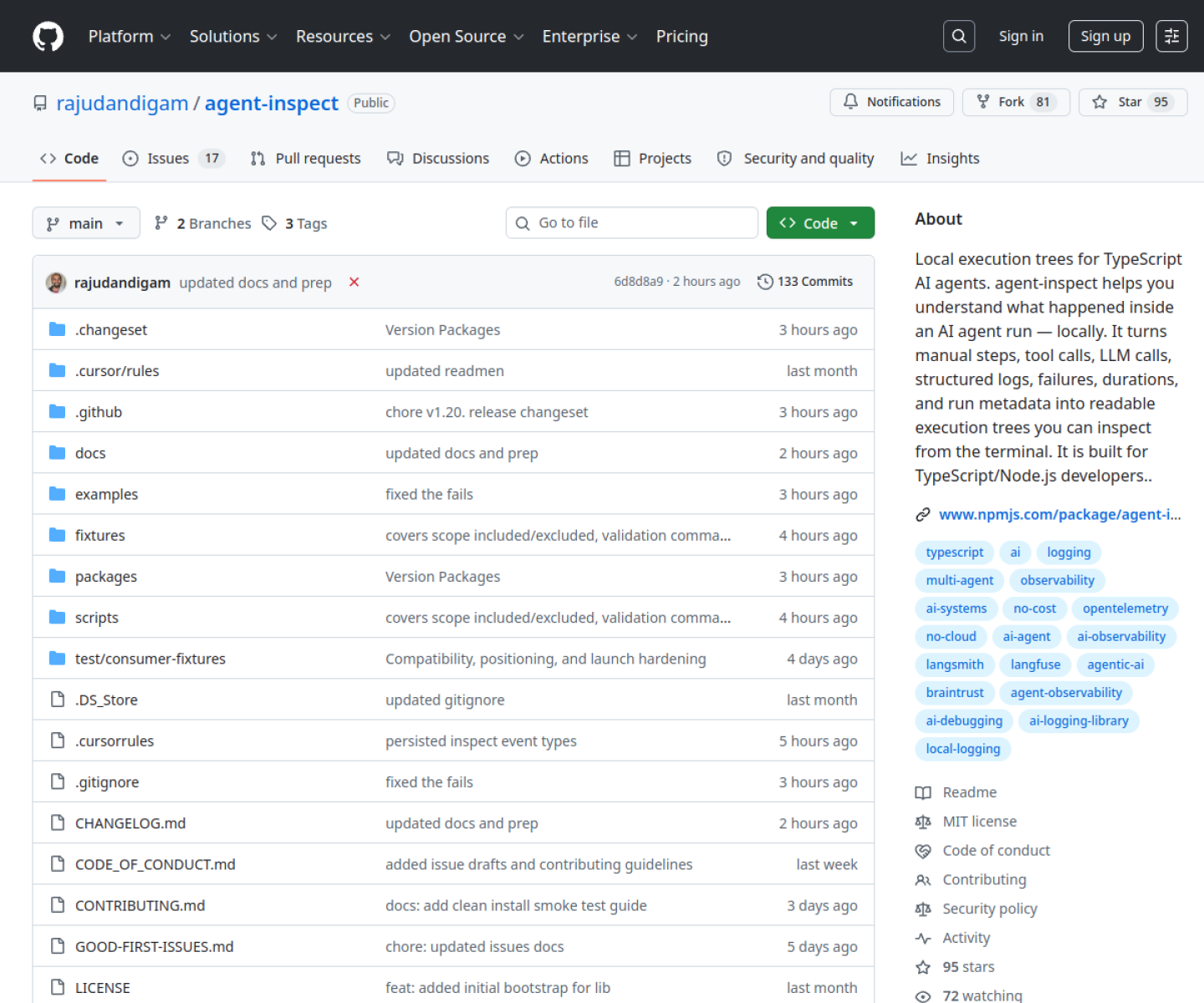
Local observability tool for TypeScript AI agents that turns tool calls, LLM calls, logs, failures, and durations into readable execution trees in the terminal.
AI Project Details
agent-inspect review: Local observability tool for TypeScript AI agents that turns tool calls, LLM calls, logs, failures, and durations into readable execution trees in the terminal.
agent-inspect is aimed at typescript developers who need to debug or explain agent runs without shipping those traces to a hosted observability platform. The current product materials describe a workflow built around install the package in a node project, instrument the target agent run, and inspect the resulting execution tree locally to understand calls, failures, durations, and metadata. That makes the page easier to read as an operating model, not just a brand claim.
Why it is timely
agent-inspect is focused on one useful debugging job rather than claiming to be a full agent platform. Its local execution-tree output is a practical middle ground between ad hoc logging and heavier hosted tracing products. The project is straightforward to evaluate because it is specific about what gets surfaced: calls, logs, failures, durations, and run metadata.
How the workflow works in practice
A sensible first pass is to start from the product's main entry point and test the shortest path to value. For agent-inspect, that means users should install the package in a node project, instrument the target agent run, and inspect the resulting execution tree locally to understand calls, failures, durations, and metadata. If that loop reduces review drag, coordination, or governance work, the product is doing something real.
Where agent-inspect stands out
| Evaluation angle | Fit | Why it matters | | --- | --- | --- | | Best-fit user | High | TypeScript developers who need to debug or explain agent runs without shipping those traces to a hosted observability platform. | | Core workflow clarity | High | Install the package in a Node project, instrument the target agent run, and inspect the resulting execution tree locally to understand calls, failures, durations, and metadata. | | Switching cost reducer | Medium to high | agent-inspect is focused on one useful debugging job rather than claiming to be a full agent platform. | | Adoption risk | Medium | The tool is most relevant for TypeScript and Node users rather than mixed-language teams that need one cross-stack observability layer. |
Practical use cases
- Debugging TypeScript agent runs from local execution trees
- Reviewing tool calls and failures without a hosted tracing service
- Adding lightweight observability to Node-based agent projects
Limits and buying notes
The tool is most relevant for TypeScript and Node users rather than mixed-language teams that need one cross-stack observability layer. Local inspection is convenient, but teams with larger shared operations may still need broader centralized tracing later. Pricing status today: agent-inspect is published as an open-source npm package in the reviewed official sources, which did not show a separate commercial pricing model.
FAQ
What is agent-inspect best for?
agent-inspect is strongest when debugging typescript agent runs from local execution trees matters more than a generic AI demo. The official product materials position it around a concrete workflow rather than a blank chatbot shell.
Who should try agent-inspect first?
TypeScript developers who need to debug or explain agent runs without shipping those traces to a hosted observability platform. Teams with a real workflow match will get value faster than general curiosity users.
What should buyers verify before adopting agent-inspect?
The tool is most relevant for TypeScript and Node users rather than mixed-language teams that need one cross-stack observability layer. Local inspection is convenient, but teams with larger shared operations may still need broader centralized tracing later. Pricing, privacy, and workflow fit should be checked directly on the current product before rollout.
Reviewed sources
- https://github.com/rajudandigam/agent-inspect
- https://www.npmjs.com/package/agent-inspect
FAQ
What is agent-inspect best for?
agent-inspect is strongest when debugging typescript agent runs from local execution trees matters more than a generic AI demo. The official product materials position it around a concrete workflow rather than a blank chatbot shell.
Who should try agent-inspect first?
TypeScript developers who need to debug or explain agent runs without shipping those traces to a hosted observability platform. Teams with a real workflow match will get value faster than general curiosity users.
What should buyers verify before adopting agent-inspect?
The tool is most relevant for TypeScript and Node users rather than mixed-language teams that need one cross-stack observability layer. Local inspection is convenient, but teams with larger shared operations may still need broader centralized tracing later. Pricing, privacy, and workflow fit should be checked directly on the current product before rollout.