AccInt
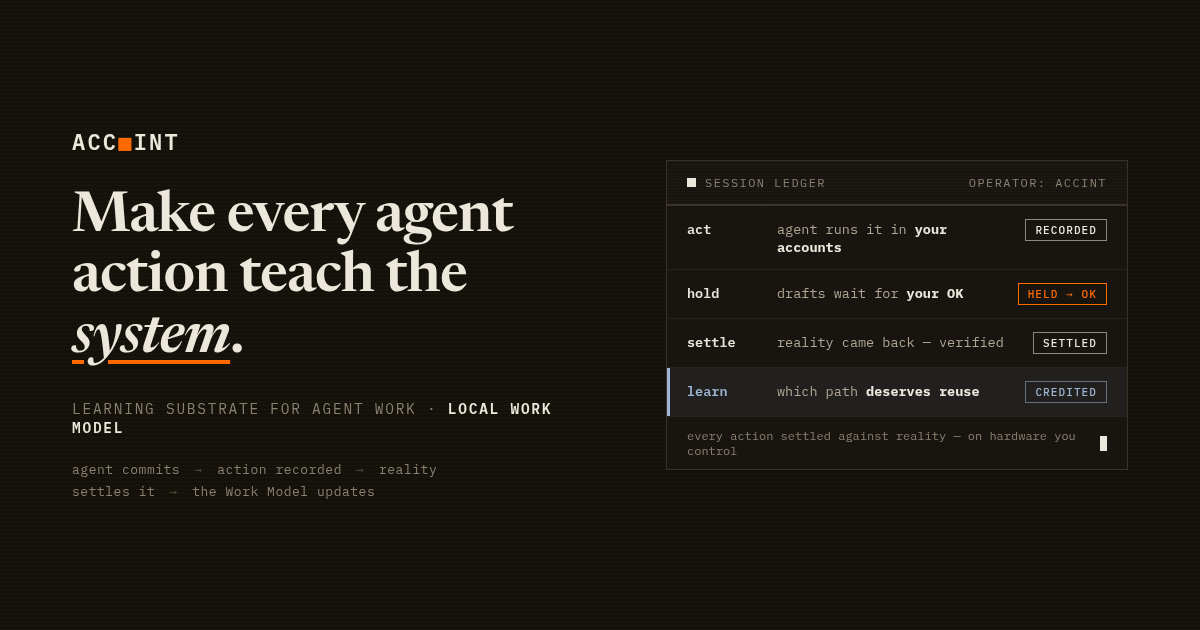
On-premise work model for agent-run development that tries to preserve receipts, authority gates, outcome credit, and reusable learning across repeated coding tasks.

AI Project Details
AccInt review: On-premise work model for agent-run development that tries to preserve receipts, authority gates, outcome credit, and reusable learning across repeated coding tasks.
AccInt stands out because it is not just another chat shell. The product materials describe a system centered on connect the local layer to the agent tools you already use, capture what actually worked on past tasks, and reuse those checked outcomes so the next run is faster, cheaper, and easier to govern. That matters because the mechanism is the product, not a thin wrapper around a frontier model.
Why the architecture matters
AccInt frames the core problem as learned operational memory for agent work instead of just another chat wrapper. The official site is concrete about commitments, receipts, authority gates, and on-premise control rather than relying on generic agent language. Its local-first positioning is useful for teams that want stronger control over the evidence trail behind agent-made changes.
How to evaluate the core loop
Start by testing the narrowest real workflow the product claims to improve. For AccInt, that means users should connect the local layer to the agent tools you already use, capture what actually worked on past tasks, and reuse those checked outcomes so the next run is faster, cheaper, and easier to govern. The result should be easier to inspect, integrate, or control than a direct agent session.
Where it stands out
| Evaluation angle | Fit | Why it matters | | --- | --- | --- | | Best-fit user | High | Teams already running Claude, Cursor, Codex, or similar agents and wanting those tools to retain grounded operational memory instead of starting blank each run. | | Core workflow clarity | High | Connect the local layer to the agent tools you already use, capture what actually worked on past tasks, and reuse those checked outcomes so the next run is faster, cheaper, and easier to govern. | | Switching cost reducer | Medium to high | AccInt frames the core problem as learned operational memory for agent work instead of just another chat wrapper. | | Adoption risk | Medium | The value depends on repeated agent work over similar tasks; one-off prototyping will not show the same compounding benefit. |
Practical use cases
- Preserving validated lessons from repeated coding-agent tasks
- Adding an on-premise governance and memory layer to AI development work
- Reusing checked outcomes instead of restarting agent workflows from scratch
Limits and buying notes
The value depends on repeated agent work over similar tasks; one-off prototyping will not show the same compounding benefit. Prospective buyers still need to test how much setup and process change the work-model layer adds to their existing developer workflow. Pricing status today: The official site currently positions AccInt as early access, and the reviewed public pages did not expose a public tier table.
FAQ
What is AccInt best for?
AccInt is strongest when preserving validated lessons from repeated coding-agent tasks matters more than a generic AI demo. The official product materials position it around a concrete workflow rather than a blank chatbot shell.
Who should try AccInt first?
Teams already running Claude, Cursor, Codex, or similar agents and wanting those tools to retain grounded operational memory instead of starting blank each run. Teams with a real workflow match will get value faster than general curiosity users.
What should buyers verify before adopting AccInt?
The value depends on repeated agent work over similar tasks; one-off prototyping will not show the same compounding benefit. Prospective buyers still need to test how much setup and process change the work-model layer adds to their existing developer workflow. Pricing, privacy, and workflow fit should be checked directly on the current product before rollout.
Reviewed sources
- https://accint.xyz/
- https://news.ycombinator.com/item?id=48511393
FAQ
What is AccInt best for?
AccInt is strongest when preserving validated lessons from repeated coding-agent tasks matters more than a generic AI demo. The official product materials position it around a concrete workflow rather than a blank chatbot shell.
Who should try AccInt first?
Teams already running Claude, Cursor, Codex, or similar agents and wanting those tools to retain grounded operational memory instead of starting blank each run. Teams with a real workflow match will get value faster than general curiosity users.
What should buyers verify before adopting AccInt?
The value depends on repeated agent work over similar tasks; one-off prototyping will not show the same compounding benefit. Prospective buyers still need to test how much setup and process change the work-model layer adds to their existing developer workflow. Pricing, privacy, and workflow fit should be checked directly on the current product before rollout.